Quasi-Stars: Black Holes Inside Giant Stars express
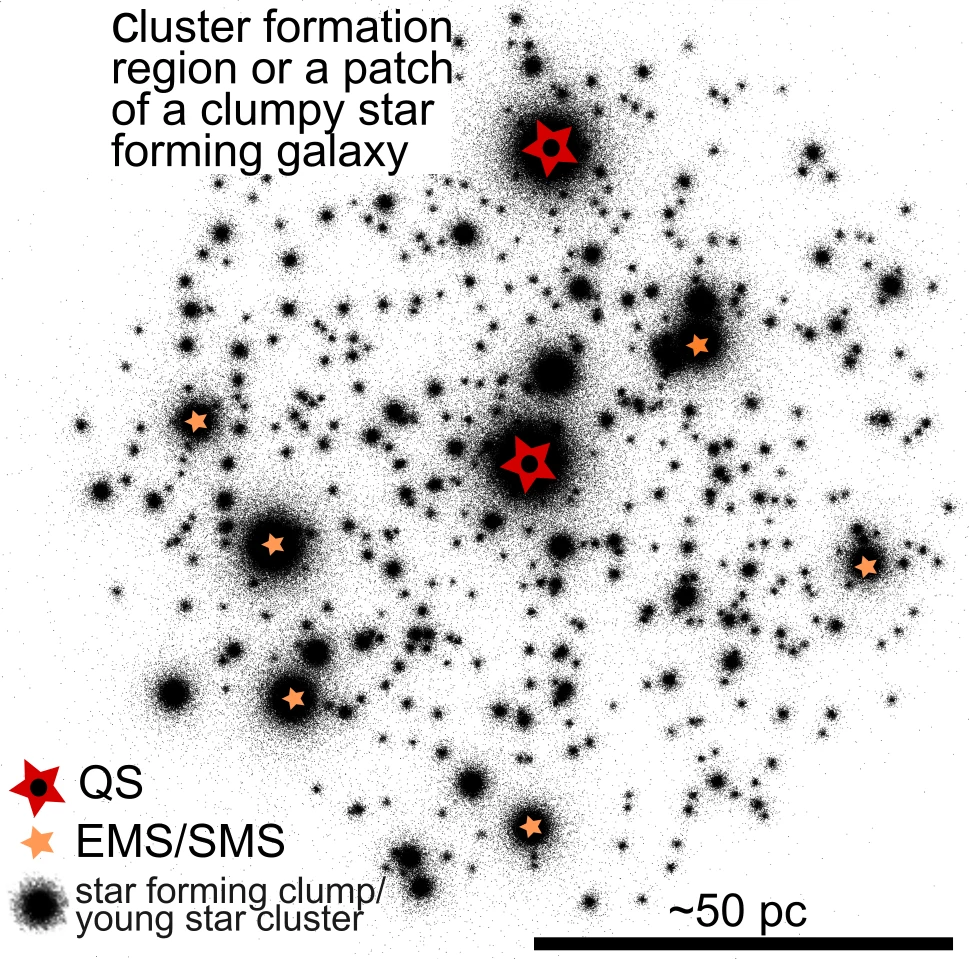
In the early Universe, star clusters were so dense that they gave birth to giants the size of the Solar System. If such a giant had taken the place of the Sun, its edge would have reached as far as Jupiter. These stars sometimes swallowed small black holes. The black hole would sink into the core and begin to grow, turning the star into a ghostly glow — a quasi-star. Here's a surprising paradox: a quasi-star weighs as much as ten thousand Suns, yet its outer layers are so thin that it's almost transparent.
Such a cosmic ghost can live for hundreds of thousands of years, until the black hole inside gains colossal mass. These rare objects explain the mysterious red dots that the James Webb Space Telescope has found in distant galaxies. And if several black holes fall into the same star, their merger creates gravitational waves — ripples in spacetime, detected by instruments on Earth. Thus, the ancient light of ghost stars reveals the secrets of the birth of supermassive black holes.
A quasi-star weighs as much as 10,000 Suns, but its outer layers are so thin that it's almost transparent — a true cosmic ghost.