Dust Rings Reveal the Secrets of the Spiral Arms express
Imagine a dark room with dust floating in the air. A bright flashlight goes off, and the dust particles light up, revealing their positions. Astronomers have applied a similar trick to our Galaxy. The flashlights were gamma-ray bursts, the most powerful explosions in distant galaxies, and the dust particles were interstellar clouds. X-rays from a burst pass through such a cloud, some of the radiation is deflected, and we see a glowing ring. The delay between the burst and the ring's appearance depends on the distance to the cloud, and it can be measured to within a few percent.
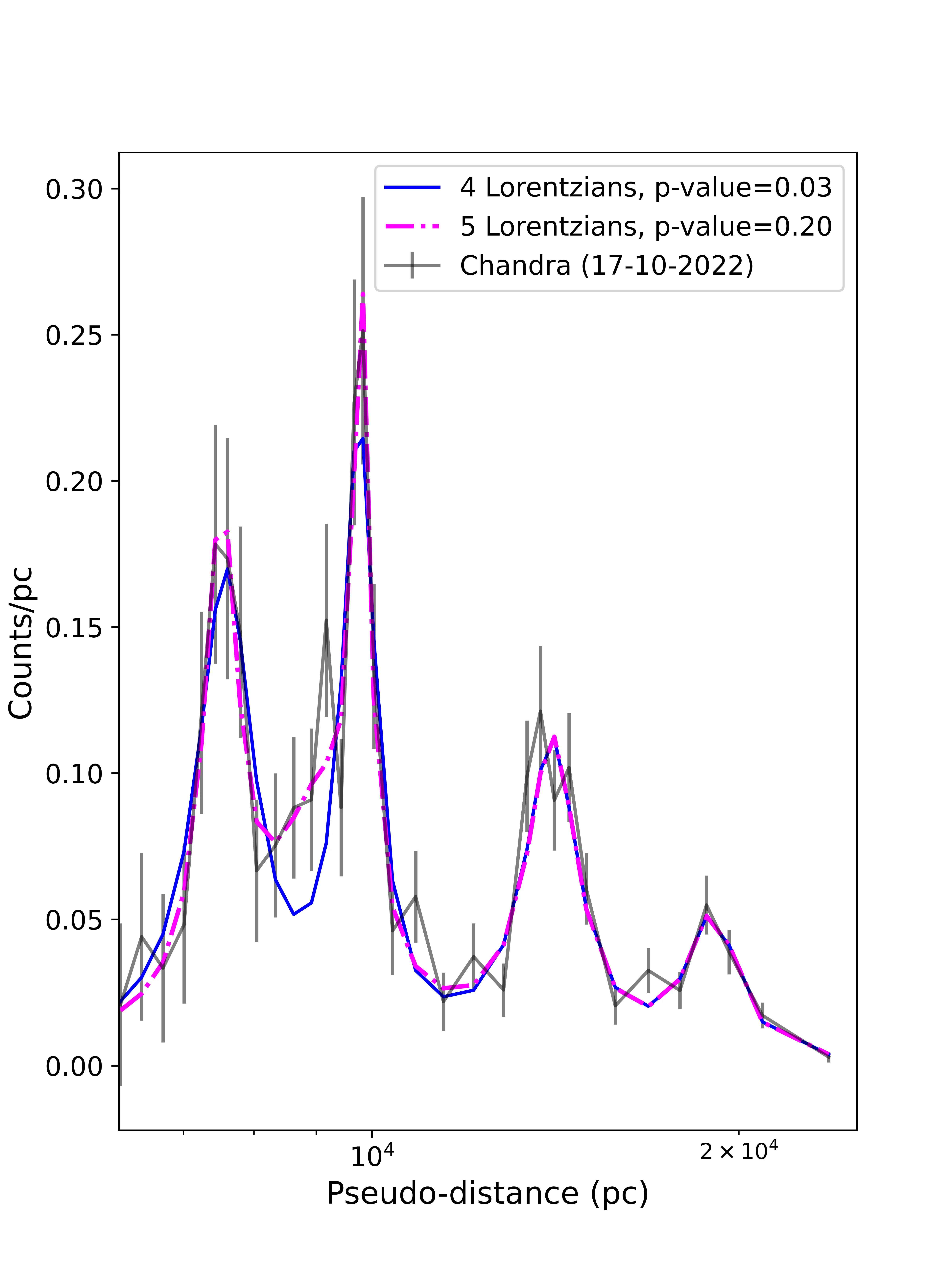
In the new study, the team analyzed observations of three gamma-ray bursts made with the XMM-Newton and Chandra telescopes. The bursts illuminated dust clouds in the directions of the Perseus arm, the Outer arm, and the Outer Scutum-Centaurus arm. They not only confirmed distances to known clouds but also found two new rings. These lie at about 7 and 10 kiloparsecs (23,000 and 33,000 light-years) in the direction of one burst. Analysis of multiple observations of the brightest one, GRB 221009A, allowed them to measure the distance to a cloud at 19 kiloparsecs (62,000 light-years) with an uncertainty of just 0.2 kiloparsecs.
Such precise measurements show that the actual geometry of the Milky Way's outer arms differs noticeably from what current models predict. Those models rely on spectroscopic measurements of the Galaxy's rotation speeds. It seems our stellar home is a bit more complex than we thought. Dust rings, like echoes of distant explosions, help us probe structures invisible to the eye and refine the map of the Galaxy. A flashlight in a dark room revealed the outlines of dust, and so gamma-ray bursts are gradually bringing the pattern of galactic arms into focus.
Original abstract
as written by the authors arXiv:2604.24617
The details of the spiral structure of the Milky Way are still debated due to large uncertainties in the distance estimates obtained through the most common tracers. X-ray dust scattering rings produced by short extragalactic X-ray transients provide instead a direct method to measure the 3D distribution of interstellar clouds up to the edges of our Galaxy with a few percent precision. We report on the analysis of all the available XMM-Newton and Chandra follow-up observations of three low-latitude gamma-ray bursts: GRB 031203 ($$l \sim 255{\deg}$$, $$b \sim -5{\deg}$$), GRB 160623A ($$l \sim 84{\deg}$$, $$b \sim -3{\deg}$$), and GRB 221009A ($$l \sim 53{\deg}$$, $$b \sim 4{\deg}$$). The previous detection of X-ray rings in these observations, produced by dust clouds located beyond 5 kpc, can be associated with dust in the Perseus, Outer, and Outer Scutum-Centaurus arms, thus providing direct distance measurements to these structures along three distinct lines of sight. We have identified two additional rings in the direction of GRB 160623A, produced by dusty clouds at $$6.91\, \pm\,0.06$$ kpc and $$9.9\,\pm\,0.6$$ kpc, and confirmed -- through a second XMM-Newton observation -- the presence of one cloud at $$9.7\,\pm\,0.4$$ kpc toward GRB 031203. We also accurately measured the distance of dusty clouds up to $$19.0\,\pm\,0.2$$ kpc owing to the analysis of one Chandra and four XMM-Newton observations of GRB 221009A. The small statistical and systematic uncertainties of these measurements place tight constraints on the geometry of the outer Milky Way and reveal significant deviations from current models, which critically depend on spectroscopy-based Galactic rotation curves at large distances.
The dust clouds that gamma-ray bursts illuminate are made mostly of tiny particles about the size of cigarette smoke — less than a micron across. But there are so many of them that together they scatter X-rays noticeably.
In Arthur C. Clarke's novel "Light of Other Days," people learn to see through any barrier using wormholes. Here, nature itself has given us a way to peer through the Galaxy's dust.