The Magnetic Roots of the Solar Wind express
The crown of a huge tree sways in the wind, but the roots and trunk are hidden underground. On the Sun, magnetic fields play the role of such invisible roots. They emerge from the depths, thread through the entire atmosphere, and govern the motion of the hot gas — plasma. Seeing this connection directly is very difficult, especially in the upper layers, where magnetic forces should dominate over gas forces.
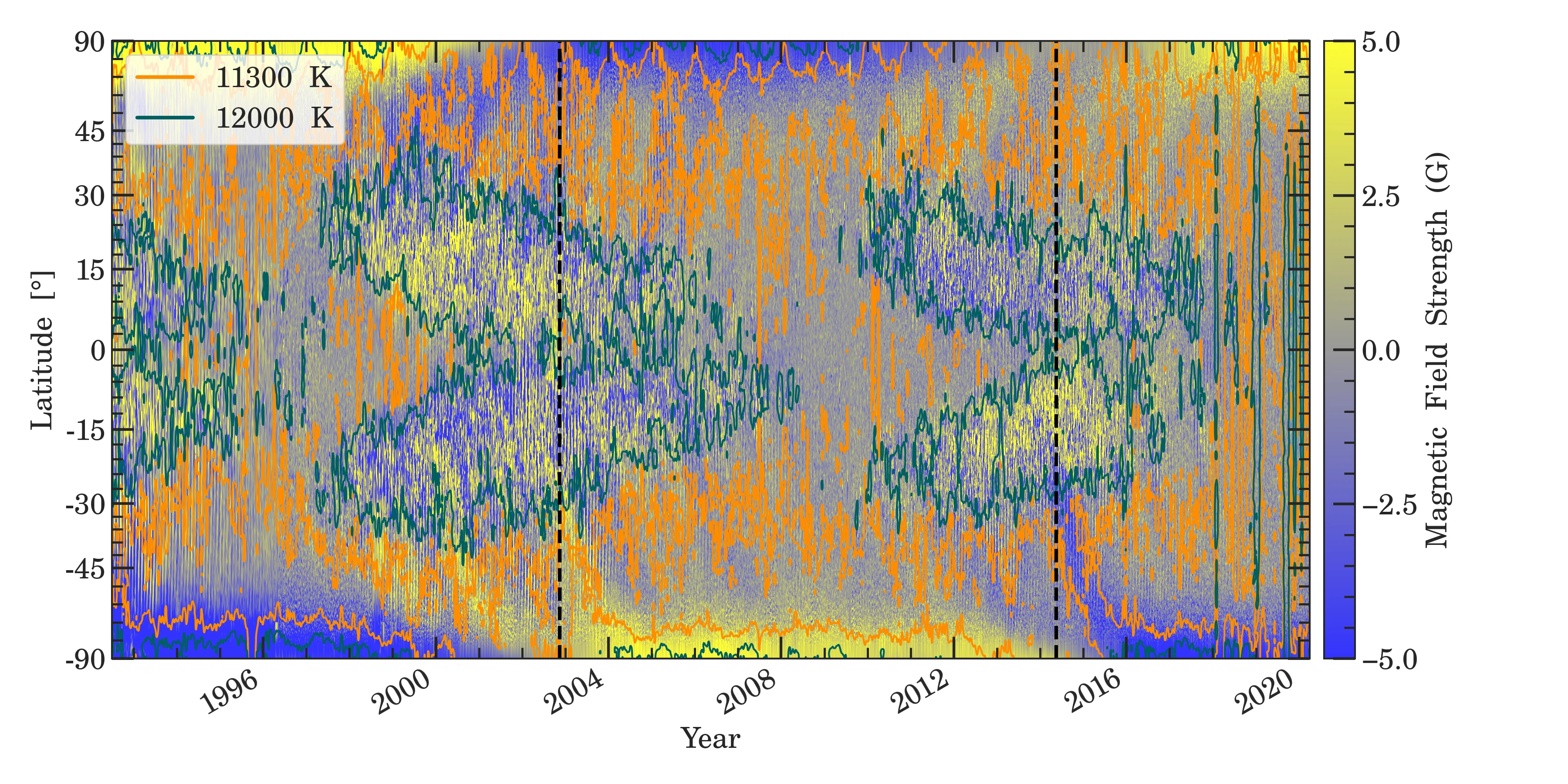
Japanese scientists spent 27 years collecting radio images of the Sun at a frequency of 17 GHz using the Nobeyama radioheliograph. At an altitude of roughly 3000 kilometers (with an uncertainty of 500 km), they noticed a faint but persistent drift of bright spots toward the poles — at a speed of 5–15 meters per second. This is like leaves at the treetop moving in sync with the sap flowing at the roots. Comparing with long-term magnetic maps of the photosphere (the lower layer), the researchers found that the motion of radio spots exactly follows the routes of magnetic fluxes at the surface.
Thus, for the first time, it became possible to directly see the "magnetic tree"—a hypothesis where the upper atmospheric layers are anchored to deep magnetic roots. This discovery helps us understand how the Sun rotates, how it transports energy, and why its activity changes with an 11-year cycle. Now we have radio evidence that the solar atmosphere is not chaos but a unified structure from the interior to the corona.
Original abstract
as written by the authors arXiv:2605.01947
The coupling between plasma flows and magnetic fields in the solar atmosphere governs the transport of angular momentum and the redistribution of magnetic flux, yet its manifestation in the magnetically dominated upper chromosphere remains uncertain. Using 27 years of 17 GHz full-disk solar radio imaging observations from the Nobeyama Radioheliograph, we report the first detection of a poleward flow signature at heights of $$3000\pm500$$ km, an altitude where plasma magnetohydrodynamics expects magnetic dominance ($$\beta<1$$). The derived latitudinal velocity profile ($$5-15$$ m/s) mirrors the established photospheric meridional circulation, displaying modulation with solar cycle parameters. Comparison with long-term synoptic magnetograms reveals that the motion of 17 GHz brightness features closely tracks poleward magnetic flux transport, implying a deep magnetic anchoring of these structures. This finding provides the first observational evidence that chromospheric flows at radio wavelengths reflect subsurface meridional dynamics, consistent with the "magnetic tree" hypothesis, which links high-altitude motion to deep-seated magnetic connectivity.
The Nobeyama radioheliograph has been operating since 1992 and captures images of the entire solar disk every second — millions of images that allowed researchers to spot the slow but steady drift of magnetic patterns.
In Stanislaw Lem's novel "Solaris," the planet's ocean controls the movement of giant structures like a living magnetic organism — much the same way the Sun's magnetic fields conduct plasma from the depths to the corona.