A Neutron Star Dances on the Edge express
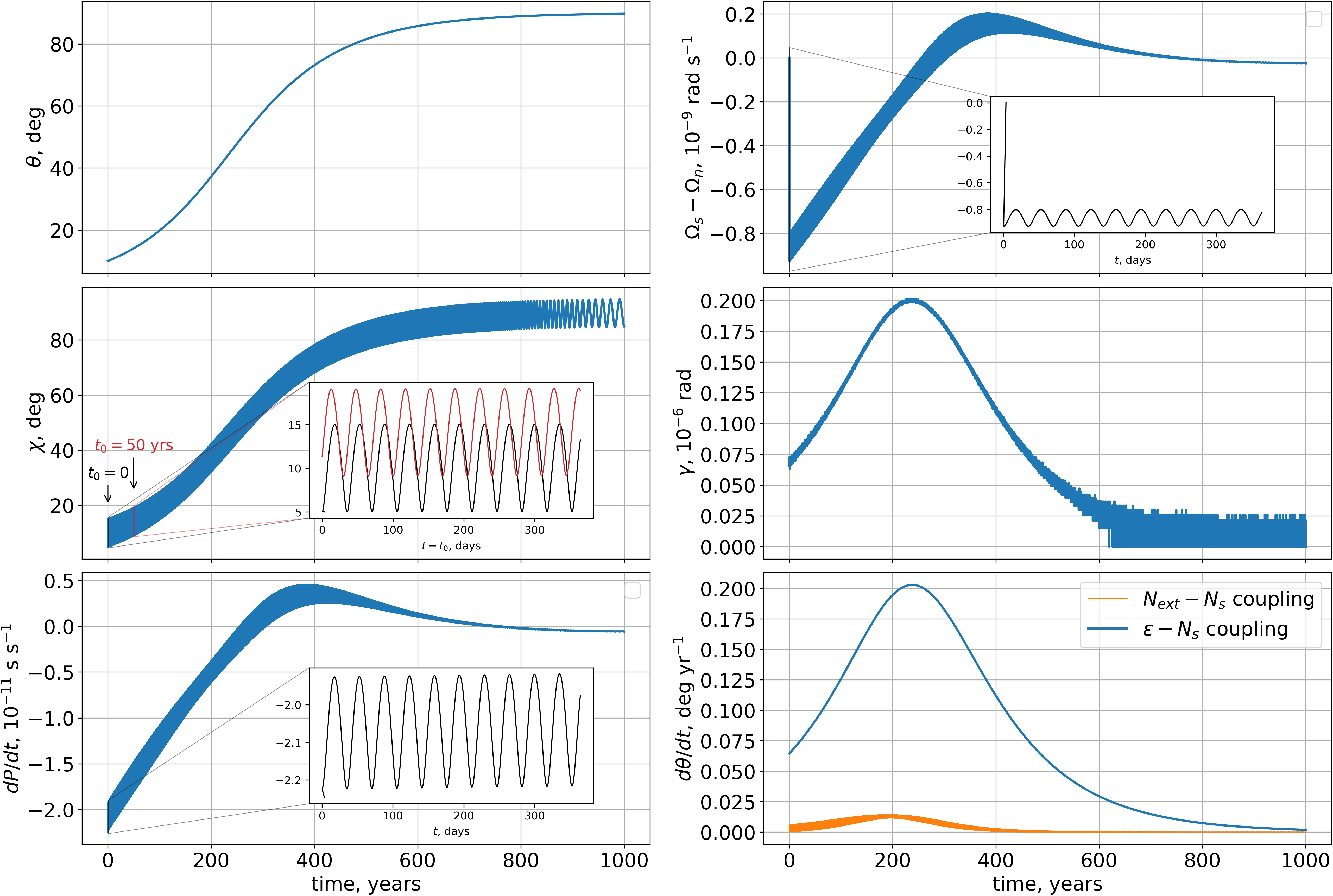
A spinning top that wobbles as it rotates: that's roughly how astronomers picture the neutron star in the binary system Hercules X-1. It completes one full turn on its axis every second, but its axis slowly traces a cone with a period of 35 days. Recently, the IXPE space observatory measured how the polarization of the star's X-ray emission (simply put, the direction in which the light waves oscillate) changes over this cycle. It turns out that the polarization rotates in sync with the 35-day rhythm, which is a strong hint of a wobbling star.
If this is indeed free precession, then something strange is happening inside the star. A neutron star is not just a hot ball. Its crust is a rigid crystal lattice of atomic nuclei, while inside flows a superfluid threaded with microscopic vortices. Normally, these vortices pin to the lattice nuclei, and when stress builds up, they break free — causing sudden spin glitches. But for the star to wobble for decades, the vortices must remain free and experience almost no friction against the lattice. Such weak pinning seems almost unbelievable, like water in a glass that doesn't notice the walls.
The researchers conclude: if precession really exists, the star's equilibrium is maintained by a delicate balance between internal forces pushing on the axis and the external braking torque from matter falling from the companion star. This opens a new window into the physics of superfluid interiors of neutron stars — a realm where quantum effects manifest on the scale of an entire celestial body.
Original abstract
as written by the authors arXiv:2605.04686
Recent IXPE observations of Her X-1 reveal correlations between flux, polarization degree, and polarization angle across its 35-day superorbital cycle. These measurements have been interpreted as strong evidence that the 35-day period is driven by nearly free precession of the neutron star. We show that this interpretation carries far-reaching implications for the dynamics of the crustal superfluid. In particular, maintaining precession over the $$\sim 50$$-year observational baseline of Her X-1 would require that superfluid vortices remain unpinned for centuries and experience extremely weak mutual friction while traversing the heavy-ion lattice of the inner crust -- conditions that challenge conventional wisdom and standard models of glitch dynamics. Under the condition of weak pinning, nearly free precession of the crust may be sustained by a balance between the internal and external torques.
The superfluid inside a neutron star can flow without any friction — if you spun it in a jar, it would keep rotating forever.