The interior of a neutron star is one of the most extreme environments in the universe. A neutron star is the collapsed core of a massive star that exploded as a supernova, packing more mass than the Sun into a sphere about 20 kilometers in diameter. The interior is not simply a uniform soup of neutrons; it is thought to have a complex structure, with a crust of atomic nuclei and a core where matter is compressed to densities several times that of an atomic nucleus. The physics here is governed by the strong nuclear force and quantum mechanics, and it is a natural laboratory for studying matter under conditions that cannot be reproduced on Earth.
History
The concept of a neutron star was proposed by Walter Baade and Fritz Zwicky in 1934, just two years after the discovery of the neutron. The detailed structure of the interior has been studied theoretically since the 1960s, but many aspects remain speculative due to the difficulty of probing such extreme conditions.
How it works
The interior is divided into layers. The outer crust is a lattice of neutron-richnuclei. As you go deeper, the nuclei become more neutron-rich and eventually dissolve, forming a 'nuclear pasta' phase where nuclei take on bizarre shapes like spheres, rods, and sheets. The inner core is a superfluid of neutrons, possibly with a small fraction of protons, electrons, and even hyperons or a quark-gluon plasma. Neutrino processes play a key role: neutrinos are produced copiously during the star's birth and can carry away energy, cooling the star. The exact composition and behavior of the core are still unknown, and observations of neutron star cooling, glitches, and gravitational waves are helping to constrain the equation of state of dense matter.
In practice
Understanding the neutron star interior is crucial for interpreting observations of neutron stars, including their thermal emission, spin-down, and gravitational wave signals from mergers. This knowledge also informs our understanding of nuclear physics and the behavior of matter at extreme densities.
Fun fact
A teaspoon of neutron star material would weigh about a billion tons on Earth, and the interior is so dense that protons and electrons are squeezed together to form neutrons.
The orchestra plays, though no one sees the conductor. The musicians are charged particles in the pulsar's magnetosphere, and the score is the electric and magnetic fields generated by the spinning superdense star.
A massive star exhausts its fuel, and its core collapses in a fraction of a second. A supernova is born, along with a brief but powerful shower of neutrinos. These particles barely interact with matter, so they fly away freely, carrying information about the catastrophe.
A star's radius drops by a thousand kilometers. Not because its mass increased, but because its own magnetic field squeezed the crust like an invisible corset.
For almost a century, seismology has been the planet’s chief X-ray, probing the interior through elastic waves. But neutrinos, ghost particles predicted by Wolfgang Pauli, offer a different perspective.
A supernova is the final explosion of a massive star, scattering its material over light-years. Inside the expanding shell, a neutron star remains, and the shell itself continues to plow through interstellar gas for thousands of years.
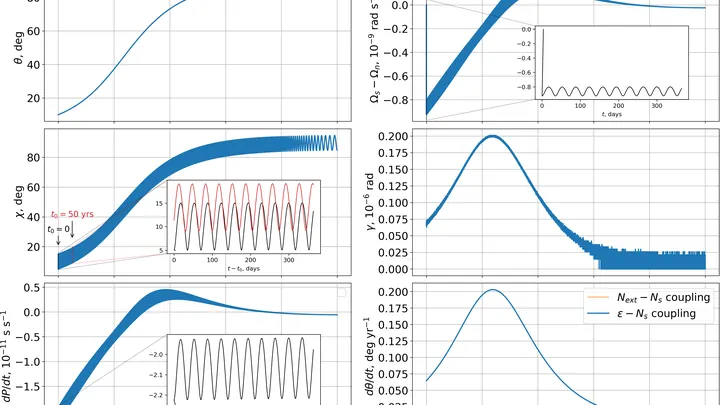
A spinning top that wobbles as it rotates: that's roughly how astronomers picture the neutron star in the binary system Hercules X-1. It completes one full turn on its axis every second, but its axis slowly traces a cone with a period of 35 days.
The center of our galaxy is a crowded kitchen where several dishes are simmering at once, and their steam blends into a single cloud. X-rays from the exploded star's remnant, from the stellar wind around the supermassive black hole, and from hot gas between stars all overlap.
In the Norma cluster, the nearest rich galaxy cluster to us, astronomers have spotted a shock wave. It arose when one cluster plowed into another, like the bow wave of a ship cutting through water. This wave compressed and heated the gas between the galaxies.
Two galaxies sit right behind the wave front.
When a massive star runs out of fuel, its core collapses and a shock wave races outward. But even before the star tears apart, particles that barely interact with ordinary matter may be born in its depths. If they decay into light, that energy leaks into the dense gas around the star.
This gas, like a blanket, wraps the star.
Inside a neutron star, matter is squeezed so tightly that a single teaspoon weighs as much as a mountain. Under such pressure, ordinary particles, protons and neutrons, can transform into exotic particles known as hyperons. These particles resemble neutrons but contain strange quarks.
When an X-ray burst erupts on a neutron star, its atmosphere heats up to millions of degrees. The light we catch with telescopes passes through this dense layer of gas, and gets dramatically altered along the way. The spectrum no longer looks like that of an ideal radiator: some colors get amplified, others dim.
A young sub-Neptune is a pressure cooker where hydrogen and rock simmer in the same pot. Six Earth masses, three percent hydrogen by mass, and interior temperatures above 4000 K. At that heat, silicate melt and hydrogen don't just coexist: they mix completely, forming a single supercritical fluid. There is no boundary between core and envelope.