Neutron starsuperfluidity is a quantum phenomenon occurring in the interior of neutron stars, where matter flows without any viscosity. This state arises because neutrons, being fermions, can pair up at extremely high densities and low temperatures to form bosonic Cooper pairs, which then condense into a superfluid. This is analogous to superconductivity in metals, but with neutrons instead of electrons. The superfluid state is crucial for understanding several observed behaviors of neutron stars, particularly their cooling rates and the sudden spin-up events known as glitches.
History
The concept was proposed in the late 1960s by Arkady Migdal and others, who suggested that neutron stars might contain a superfluid phase. The link to glitches was developed in the 1970s by theorists like Pines and Anderson.
How it works
In a neutron star, the core is so dense that neutrons pair up via the strong force, forming a superfluid that can flow without resistance. When the star's rotation slows down over time, the superfluid's vortices (quantized whirlpools) can suddenly unpin from the crust and move outward, transferring angular momentum and causing a rapid spin-up — a glitch. This mechanism is similar to how vortices behave in laboratory superfluids, but on a cosmic scale. The superfluid also enhances neutrino emission, which accelerates the star's cooling.
In practice
Understanding neutron starsuperfluidity helps astrophysicists interpret pulsar timing data and constrain the equation of state of dense nuclear matter, which is relevant for nuclear physics and gravitational wave astronomy.
Fun fact
A neutron star superfluid can rotate with thousands of tiny vortices, each carrying a quantum of angular momentum, and their collective motion can cause the star to 'glitch' — a sudden change in rotation period observed in pulsars like the Crab.
Deep inside a neutron star, where matter is compressed to the density of an atomic nucleus, neutrons form a superfluid and protons form a superconductor. A neutron vortex is a quantized vortex in the superfluid, akin to a miniature whirlpool that cannot stop spinning.
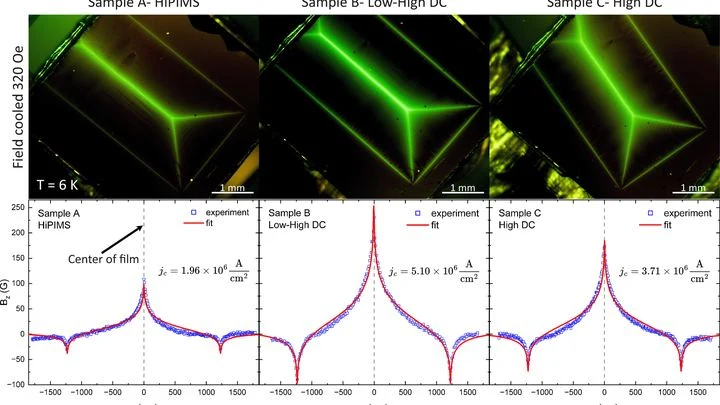
A tiny sandwich of oxides, grown layer by layer, becomes perfectly conducting at about minus 200 degrees Celsius. This is not a magic trick but a new chapter in the search for high-temperature superconductors.
The interiors of neutron stars are a realm of degenerate matter. Here, protons condense into a superconducting condensate, threaded by quantum vortices. Imagine tiny magnetic tops: each carries a quantum of magnetic flux and glides through the electron fluid.
Deep inside a star compressed to its limit, particles behave like the strings of an unusual musical instrument. Their oscillations obey a complex equation that for nearly a century no one could solve exactly.
Imagine a spinning top the size of a city, weighing more than the Sun and making hundreds of revolutions per second. That's a neutron star — the remnant of an exploded star. Occasionally, its rotation suddenly speeds up, as if something inside has switched. Astronomers call these jumps glitches and suspect that invisible vortices in the star's superfluid interior are to blame.
A swarm of fireflies rarely collides, yet they synchronously change color by exchanging signals. This is how neutrinos behave in dense streams from collapsing stars: they collectively transform from one type to another, even though individually they interact extremely weakly.
Imagine a packed dance floor where dancers glide without any friction — passing through each other without a touch. That's a superfluid. In a neutron star's crust, neutrons could behave this way, but a rigid lattice of ions gets in the way, like suddenly sticking the dance floor full of pillars.
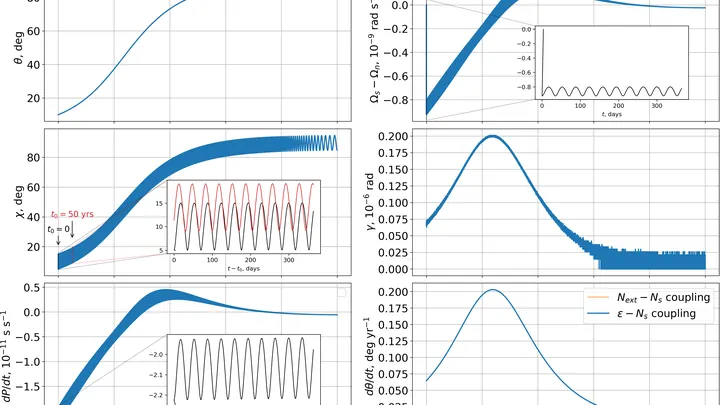
A spinning top that wobbles as it rotates: that's roughly how astronomers picture the neutron star in the binary system Hercules X-1. It completes one full turn on its axis every second, but its axis slowly traces a cone with a period of 35 days.
In superfluid helium, friction disappears — the liquid flows like a mountain stream, but without a single eddy. A short laser pulse rippled this smooth surface, and scientists using spectroscopy captured the spreading ripples — quantum waves with many speeds.
A neutron star is a spinning top with the mass of the Sun, crushed to the size of a city. It's born in the fire of a supernova and usually only slows its spin. But sometimes, for no apparent reason, it suddenly speeds up — such a jerk is called a glitch.
A thin sheet of graphene, just a few micrometers thick, was placed in a weak magnetic field, and it began to push the field out of itself, like a sponge squeezing out water. This effect, known as the Meissner effect, is the hallmark of a superconductor: a material that conducts electricity without loss.
In April 2023, Japanese satellites detected a super-intense X-ray burst on the neutron star MAXI J1752–457. The star cooled down in 4 days — five times faster than usual. Like someone cracked open a cosmic window.
In the macroscopic world we know, any motion inevitably decays: friction, a dissipative process that scatters energy, intervenes. But quantum reality has surprises in store.
A quantum computer is like an orchestra where every musician must play in perfect harmony. If even one instrument is off-key, the melody falls apart. Superconducting qubits play the role of these musicians, and their "off-key" is the loss of quantum coherence.
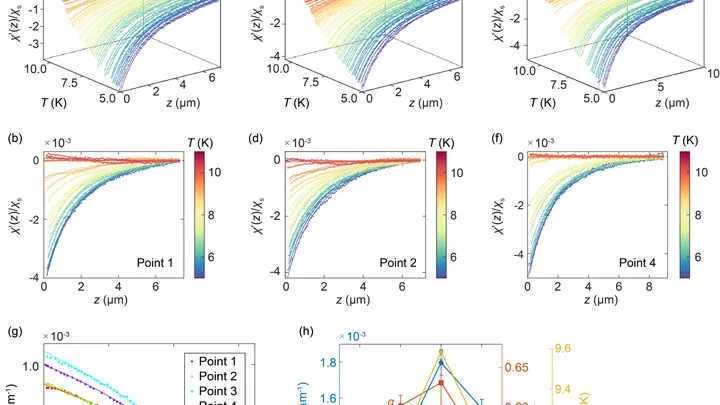
A superconductor is like a city where electrons stop jostling and start moving in pairs, like people strolling arm in arm. In neodymium-strontium nickelate (Nd₀.₈Sr₀.₂NiO₂), this 'parade' kicks in at around 10 kelvin (minus 263 degrees Celsius), but not uniformly.
Empty space is never truly still. It teems with tiny energy fluctuations, like a sculptor's raw clay. In a new experiment, a thin film of superconducting material was placed inside a cavity designed to trap terahertz light, a form of invisible radiation. The cavity acted as a mold, shaping the vacuum fluctuations around the film.
Uranus and Neptune have long puzzled scientists: their magnetic fields are heavily tilted and tangled, nothing like Earth's. The answer lay in an exotic form of water — superionic ice, which fills their interiors.
A supersolid is ice that flows. Think of a pond with a frozen crust, but beneath it, a liquid depth without friction. Usually, creating that crust means changing the liquid's properties throughout its entire volume.
Dark matter is the invisible scaffold of the cosmos, its existence betrayed by whirls of galaxies to Fritz Zwicky and Vera Rubin. What it is made of remained a mystery for half a century.
A new hypothesis paints an unusual picture.
Superfluorescence is a crystal’s synchronized exhale of light. Researchers just witnessed its mirror image: superabsorption, a coordinated inhale. They zapped cheap perovskite nanocrystals with laser pulses (spectroscopy) and saw a time-reversed absorption burst.