Dust Rings at the Edge of a Distant System express
A huge rotating pancake of gas and dust surrounds a young star. In such a "maternity ward" for planets, rings and gaps are often seen, as if an invisible plow had carved furrows. These are usually attributed to already-formed planets that clear paths with their gravity. But around the star V1094 Scorpii, astronomers saw something unusual: four pairs of rings extending out to 380 astronomical units. That's nearly ten times farther than Pluto is from the Sun.
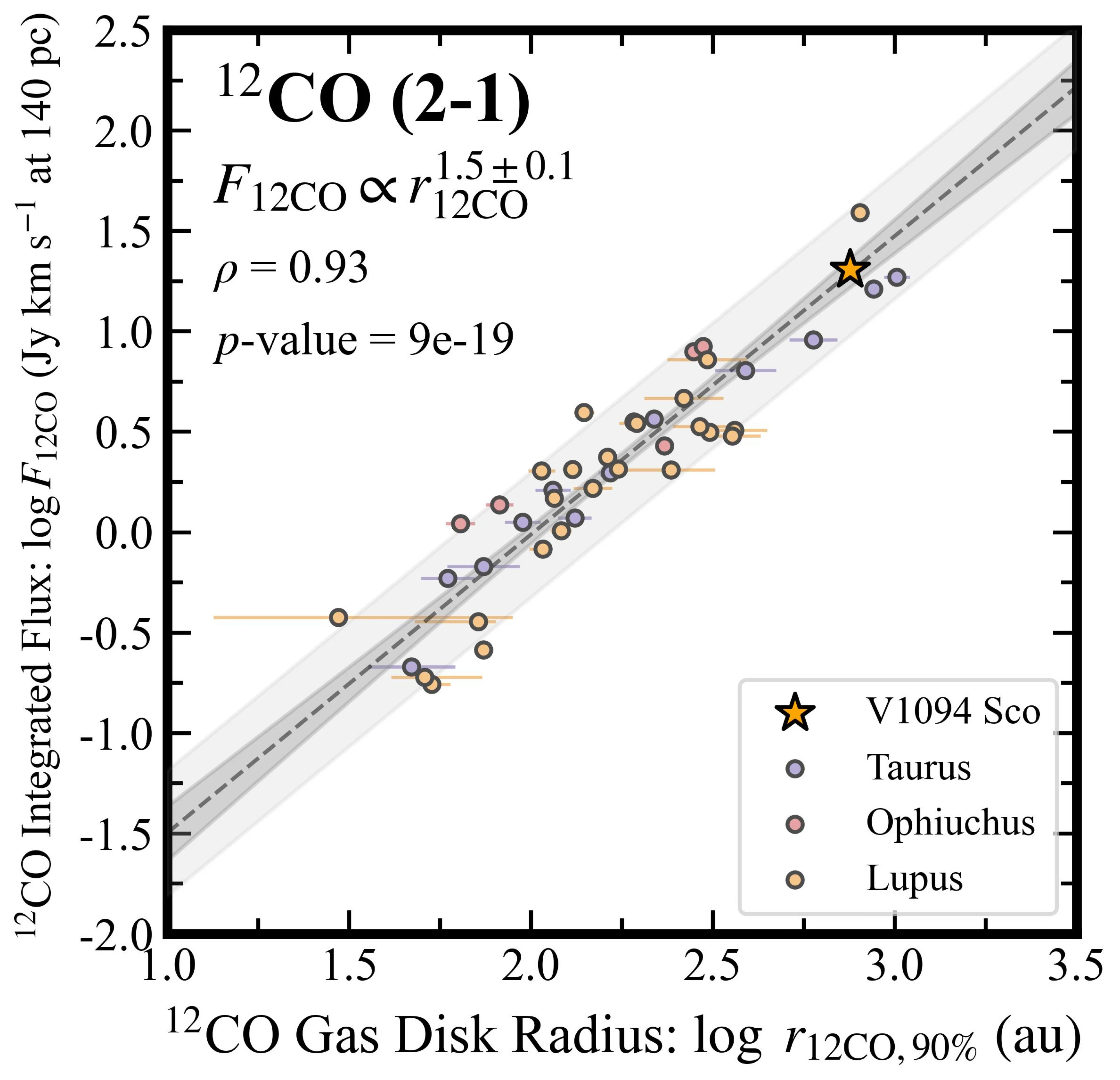
Using the ALMA radio telescopes and the SPHERE optical instrument, researchers peered into the disk at different wavelengths. The dust revealed itself in millimeter emission, while the gas showed up in carbon monoxide (CO) lines. The gas disk turns out to extend even farther, out to 760 AU, and rotates smoothly, like an old vinyl record: inner parts faster, outer parts slower.
The most interesting part is the nature of the rings. The closest gap to the star (at 100 AU) indeed looks like the trail of a single planet with a mass of about 55 Earths. But the outer rings (170–230 AU) are evenly spaced and are not visible in scattered light. This means there are no large bodies there to illuminate the dust. Scientists suggest that another mechanism is at work: the dust clumps on its own under gravity. This is called secular gravitational instability. In a nearly quiescent medium, even tiny inhomogeneities can, over millions of years, gather into dense rings where planets will later be born.
V1094 Scorpii shows that nature uses a mixed scenario. Closer to the star, "plow" planets dominate, while at the outskirts, in quiet and calm, dust molds its own cradles.
A distance of 380 astronomical units is about 57 billion kilometers. Light from the star takes almost two days to reach such an outer part of the disk.
In Arthur C. Clarke's novel "Rendezvous with Rama," the giant cylindrical ship has internal ring structures reminiscent of these distant dust rings — except there they are artificial.