Simple

Dark Matter: A Calculation Error?

Original: "When Weak Fields Arent Weak: Post-Newtonian effective theory and the Dark Matter Puzzle"
· Marco Galoppo, Giorgio Torrieri
arXiv:2605.13557v1 · 2026-05-13 · CC BY 4.0 · ⏱ 1 min · General Relativity HEP Phenomenology
A simplified gravity calculation, accurate for star pairs, gives a colossal error for galaxies. Some dark matter might turn out to be an illusion.
Abstract

When gravity is weak and speeds are low, we simplify the laws by pretending space is flat. But in clusters of many bodies, trading rotation (angular momentum) through curved space messes up the accuracy. Scientists have found a threshold for when this simplification fails, leaning on effective field theories—a framework that links physics across different scales. It’s a way to measure mass in weak fields, a key to unlocking dark matter’s secrets.

Links in the knowledge graph 1

Astronomers Fritz Zwicky and Vera Rubin figured out: galaxy clusters and the galaxies themselves spin too fast. As if an invisible mass boosts the gravitational pull. That's how the dark matter hypothesis was born. But what if the dance of these cosmic giants was just calculated incorrectly?

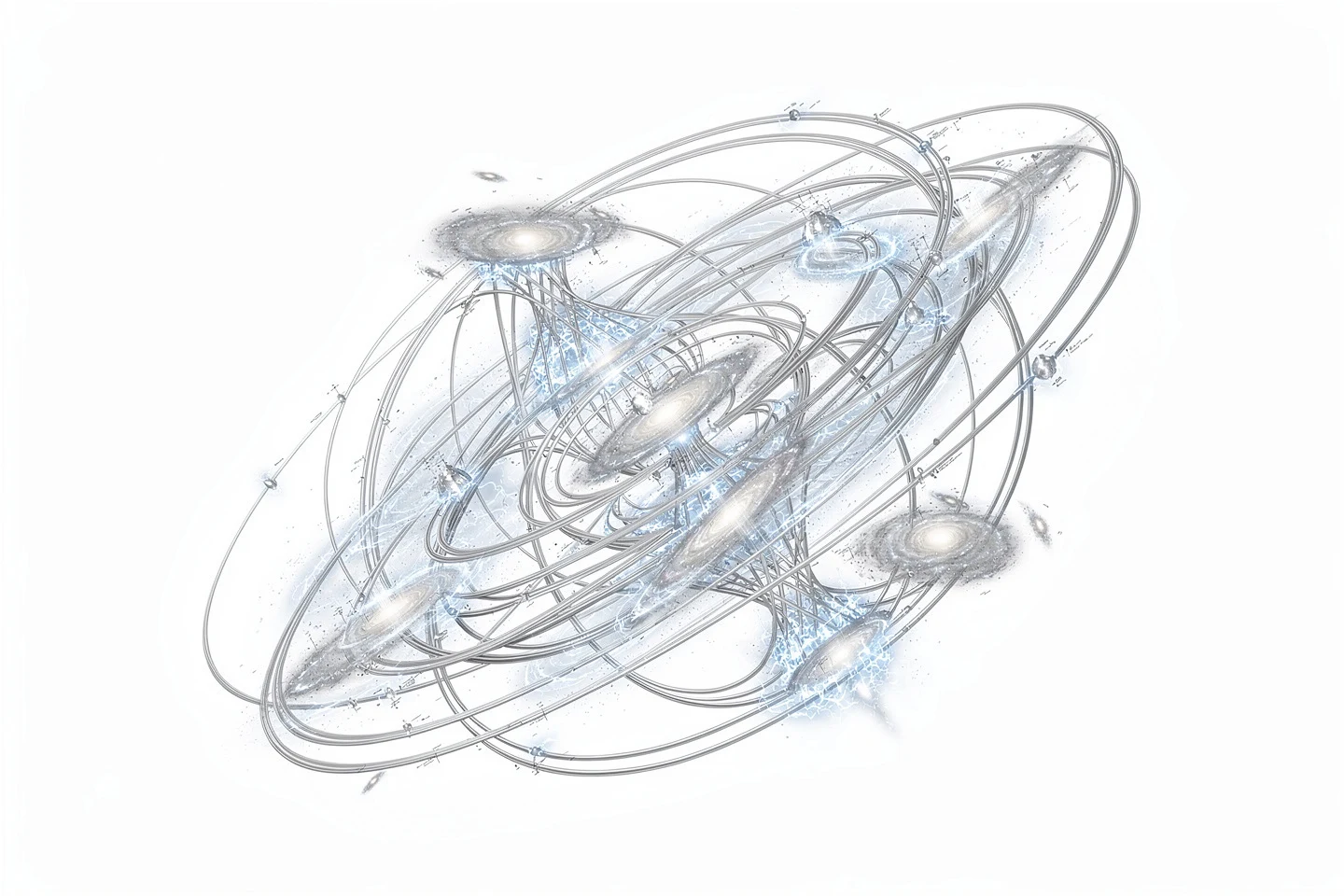
The standard gravity calculation is like adding up the forces from each celestial body—like summing the steps of individual dancers. For a duet this is accurate, but in a crowded ballroom where partners exchange spins, a simple sum leads to error. Physicists introduced a measure of this discrepancy. For a pair of neutron stars it's negligible—less than a billionth, but for galaxies it skyrockets billions of times higher. For the Laniakea supercluster the number reaches 10²⁶—as if trying to reconstruct an entire ballet from a single pirouette.

It turns out, some of the invisible mass might not be new particles, but a mirage born of simplified gravity theory. The glow from the universe's edge still holds mysteries, but this finding demands we recheck all computer models and account for the whims of curved spacetime without simplifications. Dark matter, perhaps, is an error in cosmic choreography.

🎯 The calculation error for Laniakea is 10²⁶ times larger than for a binary star—like an atom growing to the size of the Sun.

\tilde{\alpha} \sim G \langle R \rangle \langle J \rangle^2 \langle V \rangle^2
This dimensionless criterion determines the fate of the post-Newtonian expansion: if it's small, the corrections work; if it's huge, the methods break down. G is the gravitational constant, R is the characteristic spacetime curvature, J is the angular momentum, V is the system's volume.
J^{\mu\nu\alpha}(x) = x^{\mu} T^{\nu\alpha}(x) - x^{\nu} T^{\mu\alpha}(x)
Local density of angular momentum in flat spacetime. In a curved world, this current loses conservation, opening the door to nonlocal effects.
Scientists
Alan GuthAndrei LindeGeorges LemaîtreJames PeeblesAdam RiessBrian Schmidt
Tags
dark matter gravity spacetime curvature galaxy galaxy cluster neutron star numerical simulation cosmic microwave background
Laws
Friedmann equationsHubble's lawgravitational lensingPlanck's lawFermi–Dirac statisticsequivalence principle
Original: arXiv:2605.13557v1 · CC BY 4.0 · bridge42worlds