The Angular Momentum Symphony: When Weak Gravity Is Strong ✛ ✦
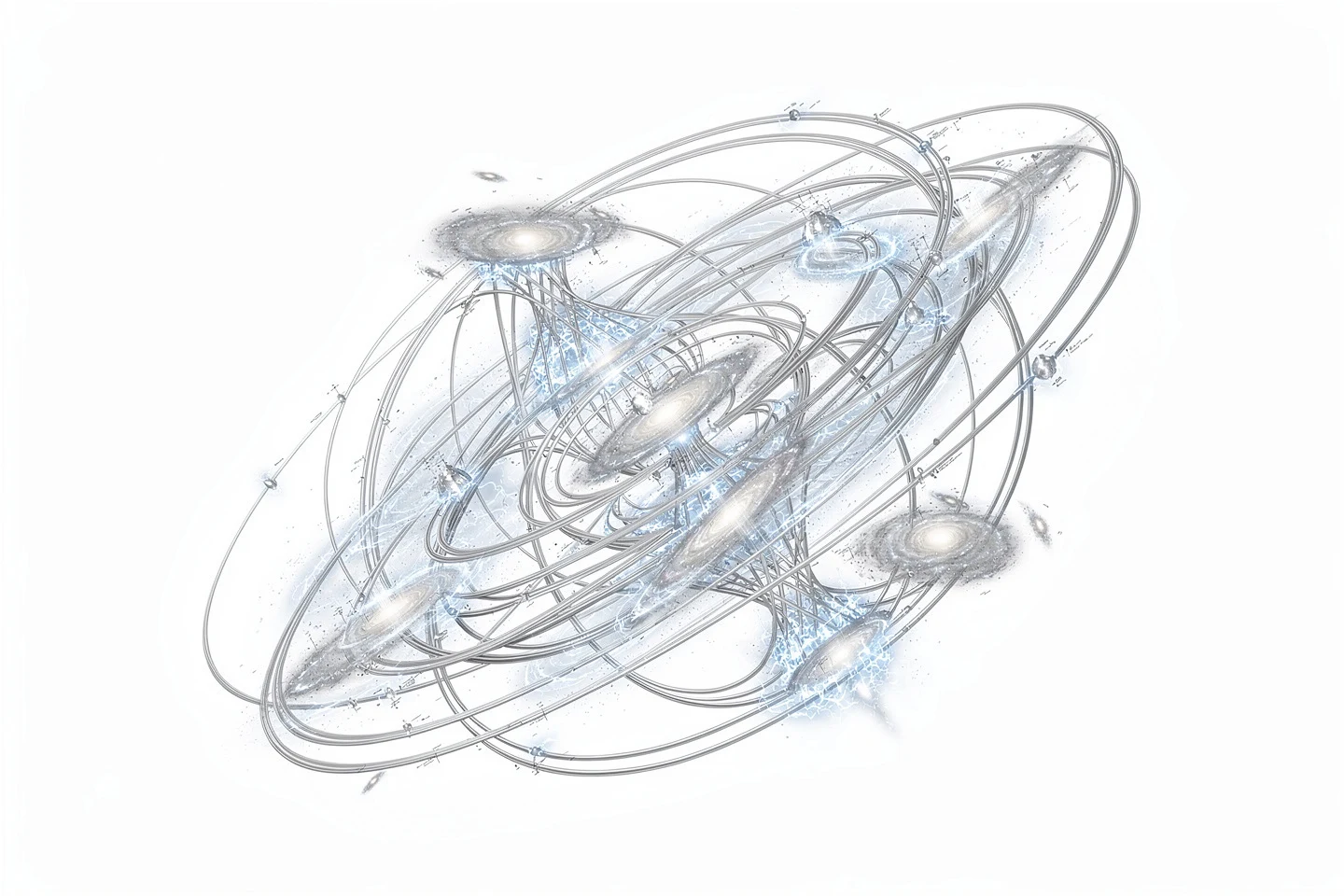
Back in the 1930s, Fritz Zwicky noticed that the speeds of galaxies in clusters were too high for the visible mass. Later, Vera Rubin confirmed this for individual galaxies. Since then, the 'missing mass' puzzle led to the hypothesis of dark matter — an invisible substance that holds cosmic structures together. Einstein's Albert Einstein general theory of relativity works flawlessly on everyday scales, and its corrections to Newtonian gravity were thought to be negligible in the weak fields of galaxies. But that's true only for simple duets, like pairs of violins. In a symphony of billions of bodies, the soft notes merge into a loud chord.
Exactly this accumulative mechanism is revealed by a new diagnostic parameter \(\tilde{\alpha}\), proposed in the work. It captures the nonlocal transfer of angular momentum via spacetime curvature — a kind of gravitational echo that stays silent in simple systems like binary neutron stars, where \(\tilde{\alpha} \sim 10^{-5}\). But for an elliptical galaxy, this parameter soars to \(10^{9}\), and for the Laniakea supercluster, it reaches an unimaginable \(10^{26}\).
This means that the standard method of 'weighing' galaxies by stellar motion might introduce a systematic error. Some of the mass attributed to dark matter could turn out to be an artifact of unaccounted gravitational correlations — a collective mirage. Curiously, for the cosmic microwave background, where angular momentum plays no role, the ΛCDM model works perfectly — highlighting that the new effect emerges precisely in rotating systems, as if the orchestra's noise vanishes when the musicians freeze. The hypothesis can be tested with numerical simulations of full nonlinear GR, which are already becoming a reality.
If \(\tilde{\alpha}\) truly points to a gravitational origin of 'hidden mass,' it will overturn our understanding of galaxy cluster dynamics and gravitational lensing. Future sky surveys, LSST and Euclid, will test the parameter on thousands of dwarf galaxies with varying angular momentum. Theorists, meanwhile, must build an effective theory with explicit nonlocal operators, where gravity ceases to be 'local' in the usual sense: it becomes a long-range echo.
The story of \(\tilde{\alpha}\) reminds us that even in the most well-tested theories, surprises can lurk when we move from simplicity to complexity. The lack of global symmetries in curved spacetime and the resemblance to Wilson loops in quantum chromodynamics give this work mathematical depth. Perhaps it is here, in the quiet hum of the galactic orchestra, that the key to one of the Universe's greatest mysteries hides. And who knows what other illusions we take for fundamental entities until we hear the true music of the cosmos?
The value of \(\tilde{\alpha}\) for the Laniakea supercluster reaches \(10^{26}\)—that's 35 orders of magnitude larger than for binary pulsars, where post-Newtonian dynamics are refined to perfection. It's like comparing the ticking of a single clock to the roar of a billion hurricanes.