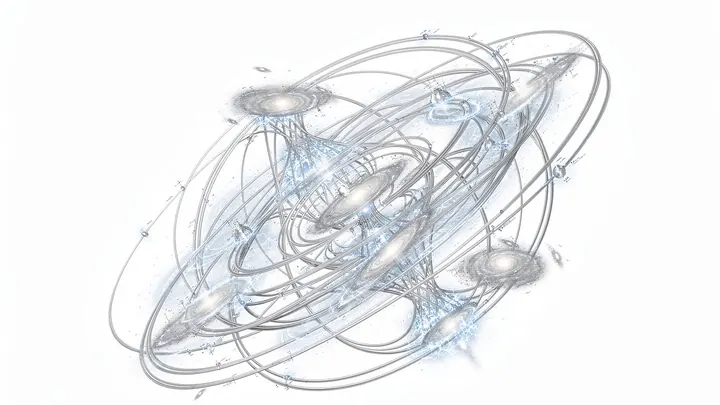
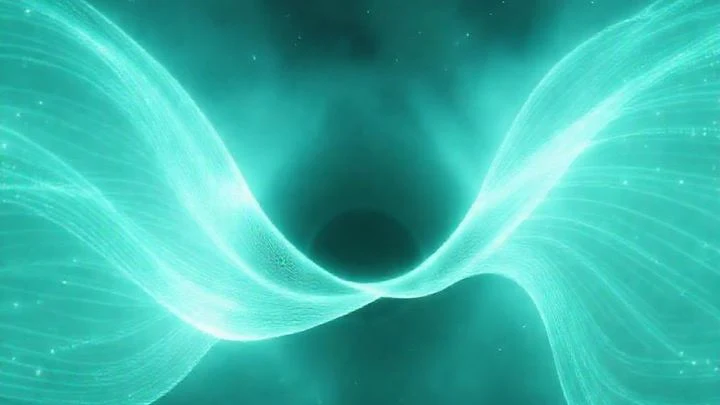
A strong gravitational field is a region of space where the gravitational acceleration is so intense that it dramatically warps spacetime, as described by general relativity. The most extreme examples are found near black holes, where the field can slow time, bend light, and even trap particles. These fields are not just cosmic curiosities; they are natural laboratories for testing fundamental physics, including the behavior of matter and radiation under conditions impossible to replicate on Earth.
History
The concept of strong gravitational fields was predicted by Albert Einstein's general relativity in 1915. The first exact solution for a black hole was found by Karl Schwarzschild in 1916, but the term 'black hole' was coined much later by John Wheeler in 1967.
How it works
According to general relativity, mass and energy curve spacetime, and this curvature dictates how objects move. In a strong field, the curvature is so pronounced that even light follows curved paths, and time dilation becomes significant. Near a black hole's event horizon, the gravitational pull is so strong that escape velocity exceeds the speed of light, making the region invisible. The field also affects quantum processes, such as Hawking radiation, where virtual particles become real due to the intense gradient.
In practice
Strong gravitational fields are used as natural laboratories to test general relativity, study accretion physics, and probe the behavior of matter under extreme conditions, informing models of galaxy formation and cosmology.
Fun fact
In a strong gravitational field, time runs slower for an observer closer to the mass compared to one farther away—an effect that must be corrected for in GPS satellites orbiting Earth.
A black hole spun up almost to its limit is like an athlete balancing on the edge of a record. The most interesting action isn't inside the hole itself, but in the thinnest film of spacetime at its horizon. It's there that tiny corrections to Einstein's gravity can suddenly swell to gigantic proportions.
Light from the very beginning of the cosmos has been traveling toward us for 13.8 billion years. During that time, its polarization, the direction of its oscillations, might have been twisted, like a compass needle that someone quietly nudged. Physicists call this phenomenon cosmic birefringence.
At the center of a distant galaxy, where a supermassive black hole weighing a hundred million suns spins, space is threaded with magnetic fields. They coil into tight vortices, like a drain in a sink, but instead of water, there's plasma whipped up to near-light speeds.
An inflatable balloon with magnetic field lines drawn on it with a marker is a simple model of how a weak magnetic field behaves in an expanding universe. While the balloon is small, the lines lie obediently on the rubber and don't hinder its stretching. That's roughly how a field fills ready-made space without arguing with its geometry.
A tiny star spirals around a giant rotating black hole. Slowly, it moves closer in a spiral, and this dance lasts thousands of years. All the while, waves ripple through space, like ripples on water, but these are gravitational waves. They can be "heard" with special detectors.
The gravity of a black hole creates a curvature of spacetime, acting like a lens: light from a distant galaxy splits in two, stretching into arcs. Dark matter around the hole barely changes the picture, as if a transparent curtain was added to a window pane.
Back in the 1930s, Fritz Zwicky noticed that the speeds of galaxies in clusters were too high for the visible mass. Later, Vera Rubin confirmed this for individual galaxies.
When two black holes merge, their event horizons – surfaces of 'no return' – combine like two pieces of sticky film. The total area never decreases. This is the law discovered by Stephen Hawking in the 1970s.
Inside a magnet, there are regions where all the atomic magnets point in the same direction. Between such regions lies a narrow transition zone where the magnetization direction gradually rotates. This zone is called a domain wall. Previously, it was considered massless: give it a push, and it stops immediately.