The Planck satellite was a European Space Agency space observatory that mapped the cosmic microwave background (CMB) radiation — the faint afterglow of the Big Bang — with extraordinary precision. Launched in 2009, it operated for over four years, measuring temperature fluctuations in the CMB down to a few millionths of a degree. These tiny variations encode the seeds of all cosmic structure, from galaxies to galaxy clusters, and their detailed pattern provides a wealth of information about the universe's composition, age, and geometry.
History
Planck was named after the German physicist Max Planck, who introduced the concept of energy quanta. It was a successor to NASA's WMAP mission and was launched on 14 May 2009, with its final data release in 2018.
How it works
Planck carried two instruments: a low-frequency instrument using radio receivers and a high-frequency instrument using bolometers, which measure the heating effect of incoming radiation. By observing the sky at nine different frequency bands, Planck could separate the CMB from foreground emission from our galaxy, such as dust and synchrotron radiation. The satellite's position at the second Lagrange point (L2), far from Earth's interference, allowed it to scan the entire sky repeatedly, building up a highly accurate map.
In practice
The Planck data set is a cornerstone of modern cosmology, used to constrain the parameters of the standard model of the universe, including the Hubble constant, the density of dark matter, and the properties of cosmic inflation.
Fun fact
Planck's observations revealed that the universe is slightly older than previously thought — about 13.8 billion years — and that ordinary matter makes up only about 5% of the total energy density.
Eight sky maps taken by different detectors of the Planck telescope resemble eight road atlases of the same city drawn by different cartographers. Each atlas is rotated by its own angle: one cartographer held the tablet slightly tilted, another slightly turned. If you overlay the atlases, the streets won't align. But if you know how each atlas is rotated, you can align them perfectly.
Imagine an interpreter distracted by every rustle in the hall, turning a one-hour meeting into two. That's roughly how gravitational wave detectors behaved when analyzing long signals: each turn of the Earth added noise to the calculations, and processing a day-long neutron star merger threatened to stretch into weeks.
From 1987 to 1991, astronomers last measured how Jupiter's icy moons reflect radio waves. Then came a long pause. In 2011–2024, researchers aimed a radar beam at Europa again: this time using the 70-meter antenna at Goldstone and the Green Bank Telescope.
Ice is nearly transparent to radio waves, like clear window glass is to light.
The night sky is like an ocean: the longer you stare, the more faint lights you notice in the depths. That's how astronomers, peering into the outskirts of the Milky Way, found Aquarius IV — a tiny stellar system that had been hiding in the dark until now.
The system was spotted in images from an early survey by the future Vera Rubin Observatory.
380 thousand years after the Big Bang, the universe cooled enough for light to decouple from plasma. That cosmic microwave background still pervades space, like the first chord of a symphony, the echo of a fiery beginning.
The cosmic microwave background is the petrified light of the first moments. Shortly after the Big Bang, microscopic quantum fluctuations were stretched by inflation to the scales of galactic superclusters.
A radio telescope is not just an antenna, but a computing machine that builds an image from millions of equations. This mathematical prism is as fragile as glass: one wrong digit in the calibration, and the real sky splits, spawning phantom sources.
Ancient light, traveling 14 billion years, reaches us from all directions. At first glance, it looks perfectly smooth, but if you look closely, tiny fluctuations appear, like ripples on a still pond. Those ripples aren't random noise; they're an encoded history of the universe.
The birth of the universe resembles not an explosion, but a traffic jam. At first, a tiny fraction of a second after the Big Bang, space expanded sluggishly, like cars stuck in gridlock. Then came a sharp surge — accelerated expansion, which cosmologists call inflation.
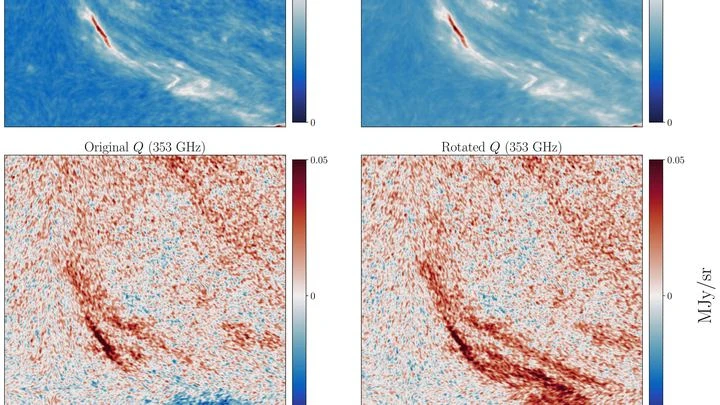
A dust storm that has raged for millions of years is not in a desert but between the stars. There, clouds of tenuous gas drift, threaded by magnetic fields. These fields align dust grains like compass needles along field lines. When such dust emits, its light becomes polarized: it oscillates in a single plane, like a rope shaken only up and down.
Radio waves from a gamma-ray burst — the cataclysmic death of a massive star whose flash briefly outshines an entire galaxy — reach Earth polarized. This means their electric field oscillates predominantly in a single plane, like a compass needle frozen in a magnetic field.
Light that has traveled to us for nearly 14 billion years is like an old photograph whose details emerge with careful processing. The cosmic microwave background (the afterglow of the Big Bang) holds the imprint of the universe's first moments, but its signal is faint and distorted.
Astronomers are trying to capture the radio echo of the Big Bang — a faint glow that fills the entire universe. But the receiver is choking with noise: our Galaxy is packed with glowing interstellar dust, whose emission can easily be mistaken for a signal from the distant past.
Rhythmic flashes of a lighthouse in thick fog: that's what searching for pulsars looks like. The lighthouse spins, and its beam periodically sweeps across the telescope. But the fog smears the light, making the period seem slightly different. If the same lighthouse was observed twice, you can compare: the periods should nearly match, and the smearing should be similar.
The cosmic microwave background is a faint glow left over from the Big Bang, like the cooling embers of a campfire. It encodes gravitational waves that may have arisen in the first fractions of a second, when the universe inflated faster than light.
An X-ray telescope captures light from hot gas around stars, but that light arrives 'blurred'—like a voice over a bad phone line. To make out the words, you need a dictionary of the exact frequencies at which atoms glow. Such a dictionary is written not only with calculations but also with direct experiments.
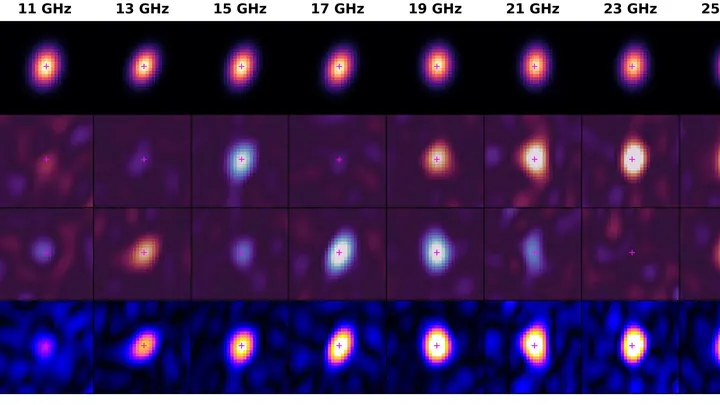
In the stream of charged particles that constantly blows from the Sun, radio bursts sometimes occur — short, powerful signals at frequencies you can pick up on an ordinary radio. Until now, it was unclear how exactly these signals are born in that stream.
When a massive star exhausts its thermonuclear fuel, its core collapses and the outer layers are blown off in a colossal explosion — a supernova (a term coined by Fritz Zwicky while studying these catastrophes).
According to the Big Bang theory, developed by Georges Lemaître, the Universe began from a hot dense point and then rapidly expanded — an inflation proposed by Alan Guth. Echoes of that time reach us as a faint glow — the ancient light.
High above Earth, a satellite flies, and inside it is an instrument the size of a small wardrobe. It catches particles that have been racing through the galaxy for billions of years and finally slam into the detector. Such particles are called cosmic rays, and they bring news of distant stellar explosions.