Dark States in Spin Chains express
In an orchestra, one musician plays so quietly that their sound is almost inaudible in the overall chorus. In the quantum world, such 'quiet' states are called dark: their energy barely escapes, like light in a darkened room. But if there are many musicians, their mutual influence can unexpectedly awaken even the most silent one.
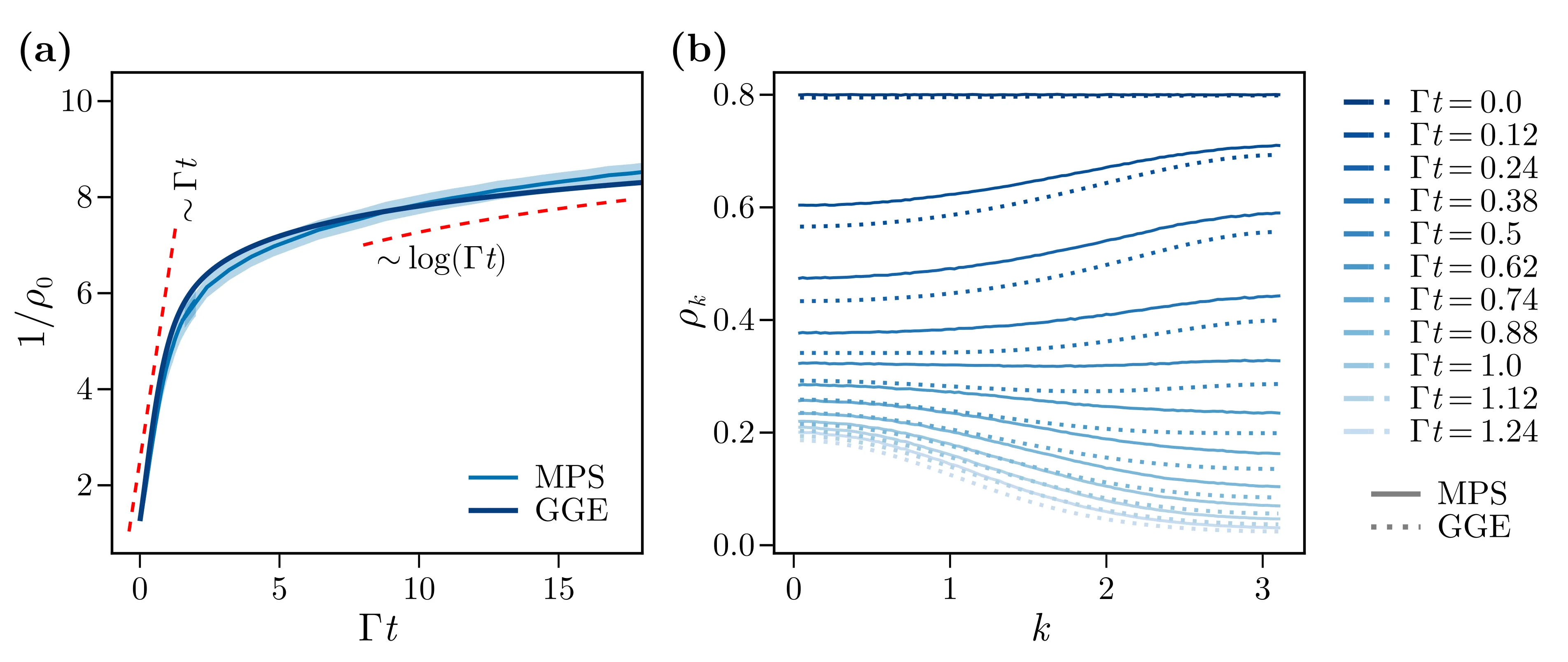
In the new work, physicists considered a chain of spins (quantum 'tops') with a special type of dissipation acting on neighboring sites. In such a system, there exists a single-particle dark state with zero momentum: it, like a conductor, sets the rhythm but remains in the shadows. However, with a large number of particles, this state begins to slowly fade: its decay goes as [formula:decay]1/ln(t)[/formula], where t is time. It's like watching a candle flame not go out at once but smolder for a long time, obeying a tricky law.
The most surprising thing is that the system's behavior turned out to be universal. The distribution of particles over velocities (momenta) is described by a single form depending on [formula:scaling]k√t[/formula], and the total particle density falls as [formula:density]1/(√t * ln(t))[/formula]. This resembles the pattern left on sand after the tide: no matter what the tide was like, the lines remain similar. The results were confirmed by numerical simulation, and even with weak particle interactions the picture does not change — nature seems to insist on this scenario.
Similar dark states occur in optics: if atoms are placed at distances smaller than the wavelength of light, they can stop emitting, forming a 'silent' lattice.
In Greg Egan's novel 'The Permutation City', dark states of quantum systems allow the creation of virtual worlds that consume almost no energy.