Hidden particle decay refers to hypothetical processes where known particles, such as eta-mesons or protons, decay into final states that include invisible particles — particles that interact so weakly with ordinary matter that they escape detection in particle detectors. These invisible particles are often candidates for dark matter, the mysterious substance that makes up about 85% of the universe's mass but does not emit or absorb light. The study of these decays is a key experimental strategy for discovering physics beyond the Standard Model, as any observed deviation from predicted decay rates or patterns could signal the existence of new particles.
History
The concept of invisible decay products has been part of particle physics since the 1970s, particularly with the search for neutrinos, which are invisible to most detectors. The modern search for dark matter candidates through hidden particle decays gained prominence in the 2000s with theoretical models like supersymmetry and extra dimensions.
How it works
In quantum field theory, a particle can decay into a set of lighter particles if energy and momentum conservation allow it. For hidden particle decay, the final state includes at least one particle that does not interact electromagnetically or strongly, so it leaves no trace in a detector. Physicists infer its presence by measuring the missing energy and momentum in the decay. For example, in a decay like K+ → π+ + invisible, the invisible particle would carry away a specific amount of energy, creating a distinct signature in the detector. Experiments search for such signatures in high-precision measurements of rare decays, often using particle colliders or dedicated beam-dump facilities.
In practice
This research directly informs the design of next-generation particle physics experiments, such as those at the Large Hadron Collider and proposed future colliders, and helps constrain the properties of dark matter candidates.
Fun fact
The decay of a proton into invisible particles is one of the most sensitive probes of grand unified theories, and experiments like Super-Kamiokande have set limits on the proton lifetime exceeding 10^34 years.
In a tank holding three tons of liquid xenon, buried deep underground, something stirred one day. Not the xenon itself, but one of its atomic nuclei: it received a kick with an energy of 248 thousand electronvolts and recoiled like a billiard ball struck by an invisible cue ball.
The cosmological standard model is like a recipe for a cake where everything is strictly measured: dark matter is like flour without a single lump (zero pressure), and dark energy is like the perfect leavening agent (equation of state exactly minus one). But what if the flour is a bit damp and the leavening agent has lost its oomph?
In the first moments after the Big Bang, the universe was a searing 'soup' of particles. As it cooled, phase transitions occurred — much like water turning to ice. At one such moment, magnetic monopoles of dark matter could have been born: tiny clumps of field with a single magnetic pole.
In the galaxy NGC 1052 DF2, stars move at only 8 kilometers per second, as if there were no invisible mass around. For comparison: in our Milky Way, outlying stars accelerate to 200 kilometers per second, held by a massive dark matter halo.
The Universe grows like a metropolis: galaxies skyscrapers are erected on an invisible scaffold of dark matter: its gravity pulling in construction material. Meanwhile, dark energy makes the city itself continuously expand.
The story began almost a century ago, when Edwin Hubble showed that galaxies are receding, and Fritz Zwicky and Vera Rubin later realized: to explain their motions, invisible mass is needed — dark matter.
In an orchestra, one musician plays so quietly that their sound is almost inaudible in the overall chorus. In the quantum world, such 'quiet' states are called dark: their energy barely escapes, like light in a darkened room. But if there are many musicians, their mutual influence can unexpectedly awaken even the most silent one.
At the Large Hadron Collider, protons collide at nearly the speed of light. Sometimes they don't smash apart but exchange photons — particles of light. These photons can produce a pair: one particle the detector sees, and another that flies off unnoticed.
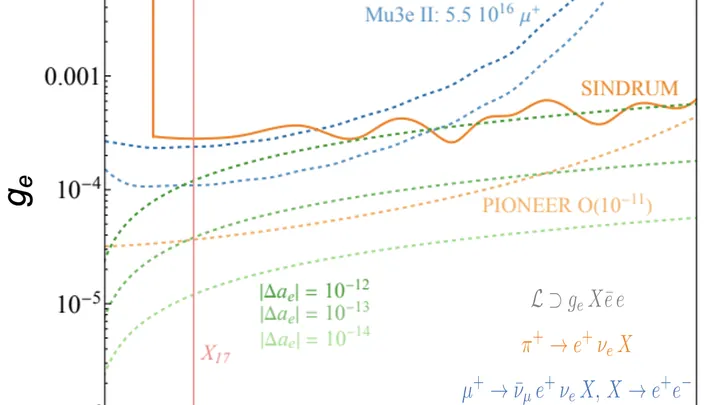
In nuclear transitions of beryllium-8, helium-4, and carbon-12, physicists from the ATOMKI collaboration have been seeing extra events since 2020—as if, when an excited nucleus decays, something else is sometimes born besides the usual photons. The energy of this "something" is always the same: about 17 million electron-volts.
Hidden in the heart of the Alps is the Large Hadron Collider. From time to time its detectors register sudden bursts — scientists call them UFOs (Unidentified Falling Objects). According to one theory, these are not equipment malfunctions at all, but traces of dark matter.
Around a young star spins a flat pancake of gas and dust — the future building blocks of planets. The star heats it with ultraviolet radiation, and gas from the disk's surface escapes into space, like water from a puddle under the sun.
In 1976, Gerard 't Hooft noticed that the vacuum of a gauge theory is not as simple as it seems: it possesses a topological structure that manifests itself in a nonzero topological susceptibility.