Quantum collective phenomena are emergent behaviors that arise in many-body quantum systems, where the interactions between a large number of particles produce effects that cannot be predicted from the properties of individual particles alone. Examples include synchronization of quantum spins, formation of polarons, and dark states in spin chains. These phenomena are central to understanding how complexity emerges from quantum mechanics, bridging the gap between microscopic physics and macroscopic behavior.
History
The study of collective phenomena in quantum systems dates back to the early 20th century, with the development of quantum mechanics and the understanding of superconductivity and superfluidity. Key contributions were made by Lev Landau, who introduced the concept of quasiparticles, and by John Bardeen, Leon Cooper, and Robert Schrieffer, who explained superconductivity in 1957. The specific study of quantum synchronization and dark states is more recent, emerging in the late 20th and early 21st centuries.
How it works
In a many-body system, particles such as electrons or spins interact with each other, and these interactions can lead to correlated states where the whole system behaves as a single entity. For instance, in a crystal, an electron can distort the surrounding lattice, creating a quasiparticle called a polaron that moves as a coherent unit. Similarly, quantum spins can synchronize their oscillations through mutual coupling, even in the presence of disorder. These collective states often arise from the competition between kinetic energy and interactions, and they can be described using concepts like quasiparticles, order parameters, and symmetry breaking.
In practice
Quantum collective phenomena are used in quantum computing and simulation, where they can be harnessed to create stable qubits or to simulate complex materials. They also underpin technologies like superconductors and quantum sensors.
Fun fact
In a phenomenon called 'dark states,' certain quantum states become completely decoupled from light, allowing spins to remain coherent without emitting photons, which is useful for quantum memory.
A stone falls into a pond, and ripples spread across the water. Long waves and short ones travel at the same speed: that's how ordinary sound behaves in almost any medium. But in quantum liquids, things can be different.
Physicists considered a superfluid where particles move along a "flat" energy band.
A swarm of fireflies rarely collides, yet they synchronously change color by exchanging signals. This is how neutrinos behave in dense streams from collapsing stars: they collectively transform from one type to another, even though individually they interact extremely weakly.
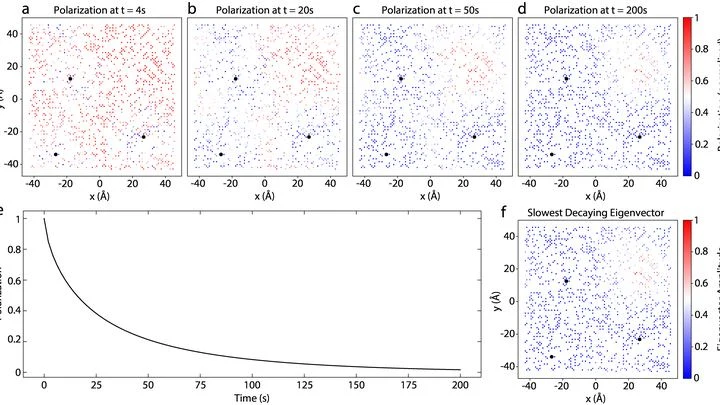
An orchestra where every musician plays their own part, yet together they weave a complex melody: that's what a cloud of atoms looks like when their spins (intrinsic rotations, like tiny tops) oscillate in sync. Usually, these tops behave independently.
In an orchestra, one musician plays so quietly that their sound is almost inaudible in the overall chorus. In the quantum world, such 'quiet' states are called dark: their energy barely escapes, like light in a darkened room. But if there are many musicians, their mutual influence can unexpectedly awaken even the most silent one.
When many excited atoms are gathered together, they often fire light in concert, like a crowd clapping in rhythm. This well-known phenomenon is called Dicke superradiance. But the authors of the new study asked: what happens if the atoms are not identical and each one feels its neighbors?
Picture a crowded hall where each person is a molecule, and their private conversation is the motion of electrons within it. Normally, everyone talks to themselves, and the overall buzz is chaotic. But if a bright spotlight is turned on in the center, it begins to conduct the crowd: people synchronize their movements, even though the light merely reflects off the walls.
A neutron star is the collapsed core of a massive star, squeezed to the size of a city. In its heart, matter is packed so densely that atoms cease to exist, and protons and neutrons dissolve into a sea of quarks.
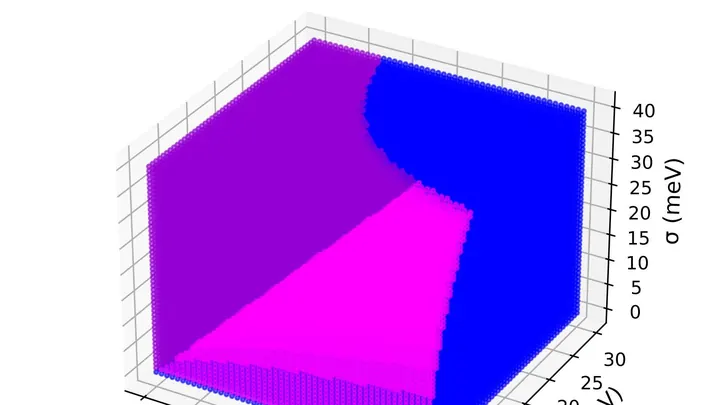
A crowd of people suddenly starts moving as one. In physics, this happens with atomic spins — tiny magnetic arrows. When many spins come together and interact through a shared medium, they form one big magnet, or a macrospin. This macrospin doesn't just point in one direction; it can get stuck in several positions, like an ice cube that refuses to melt even when it's warm.
A Network That Decides When to Stop
A crowd grows: each new person joins the group with a probability that depends on how large the group already is. If the group is small, joining is easy; if it is huge, people start to hesitate, and growth slows down. This mechanism, called feedback, changes the entire behavior of the network.
A quantum walk is like a drunk person who turns randomly at every intersection. Except instead of streets, there are graph nodes, and instead of steps, there are quantum transitions. Scientists have discovered that such a walk has a hidden measure — Krylov complexity.
A magnesium oxide crystal is like a row of soldiers: atoms stand in neat lines, and an electron runs along them. But if the electron lingers, the nearest atoms shift slightly from their positions, like neighbors in a rank turning their heads. The electron finds itself in a dip made of displaced atoms and can no longer move freely.
In the everyday world, order preserves and disorder destroys. But in quantum computing, this logic is turned on its head. Consider a diamond: carbon atoms with their nuclei and electrons behave like tiny magnets capable of storing a quantum "whisper"—information encoded in the orientation of their spins.
Superfluorescence is a crystal’s synchronized exhale of light. Researchers just witnessed its mirror image: superabsorption, a coordinated inhale. They zapped cheap perovskite nanocrystals with laser pulses (spectroscopy) and saw a time-reversed absorption burst.