Popular

Sound Trap in a Superfluid ⚡ экспресс

Original: "Extending the model of rotating acoustic geometries to include non-vanishing solid-body rotation: quasibound spectra"
· H. S. Vieira
arXiv:2605.16621 · 2026-05-15 · CC BY · ⏱ 1 min · General Relativity
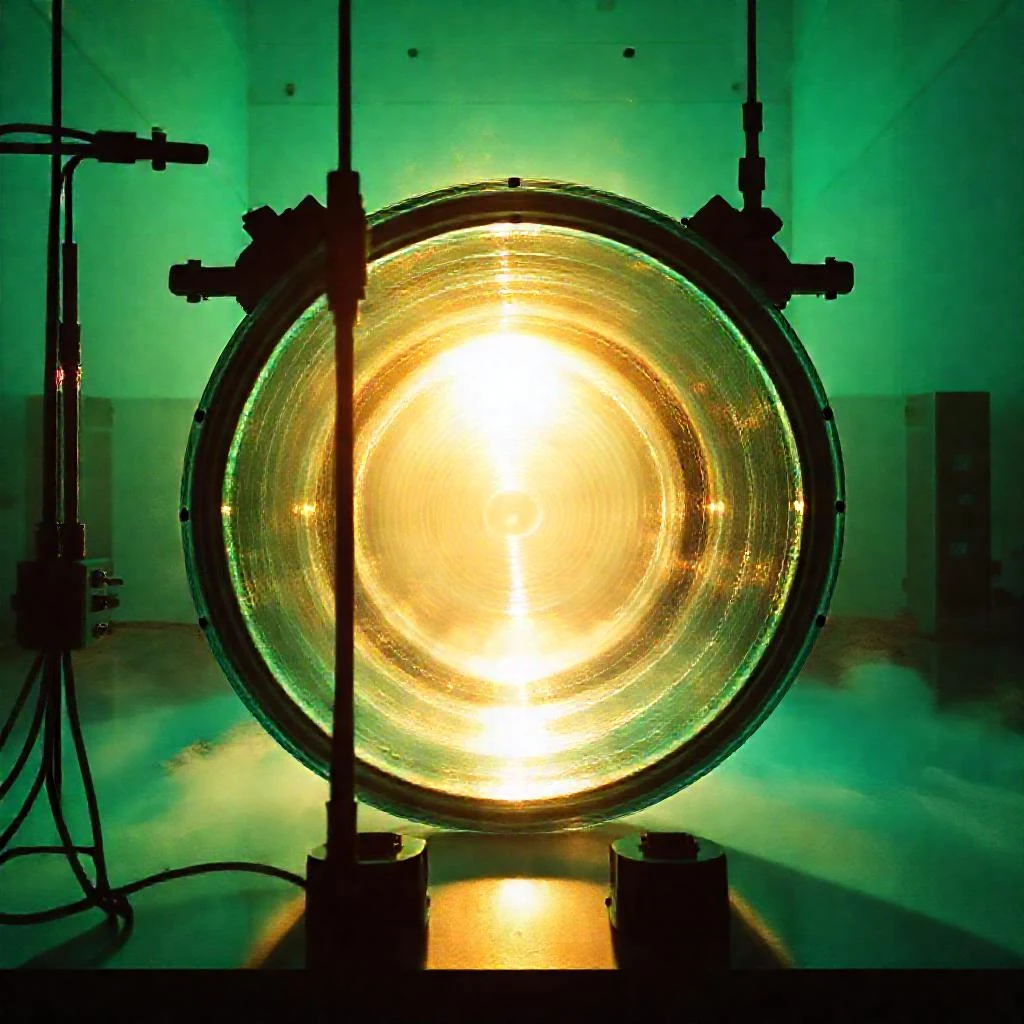
Sound waves fall into a vortex's inescapable trap, just like light into a black hole.
Abstract

Acoustic black holes are regions in a fluid where the flow moves faster than sound, trapping sound waves. Previously computed quasi-bound states in such a geometry with circulation matched experiments on superfluids. But real vortices over large distances spin as a rigid whole, something earlier models missed. To fix this, scientists added solid-body rotation and analytically found the spectrum of sound perturbations. It’s like a rotating cosmic string model, only in a glass of liquid.

Links in the knowledge graph 1

📄 Showing the "Simple" version — "Popular" is not ready yet. Add it to favorites to help prioritize it.

Sound travels through a medium at a certain speed. If the medium moves faster, the sound gets swept along by the flow — like a wood chip pulled into a whirlpool. In superfluid helium — a frictionless liquid — rapid rotation spawns vortex funnels. Inside them, an acoustic black hole forms: a region from which sound cannot return.

Researchers added uniform rotation and computed the resonant frequencies — the notes at which the vortex 'sings.' Using vibration analysis, they observed stable wave patterns within the curved space of the funnel.

A vortex in superfluid helium behaves like a miniature black hole: sound falls in and never returns — right on the lab bench.

These calculations help explain superfluid helium experiments and test Hawking’s hypothesis about black hole radiation without ever leaving Earth. Amazingly, the core of each vortex is a quantum thread as thin as an atom: a microscopic trap mimicking the cosmic abyss.

🎯 When cooled nearly to absolute zero, superfluid helium can circulate forever in a closed loop without slowing down — that’s the ideal frictionless liquid in action.

🎬 In *Interstellar*, the Gargantua black hole twists light; a lab vortex twists sound.

Scientists
Christian DopplerD. B. McLaughlinDidier QuelozMichel MayorR. A. RossiterStephen Hawking
Tags
black hole spacetime curvature helium spectroscopy
Laws
Doppler effectHawking radiationgravitational lensingBekenstein-Hawking entropyEinstein field equationsMaxwell's equations
Original: arXiv:2605.16621 · CC BY · bridge42worlds