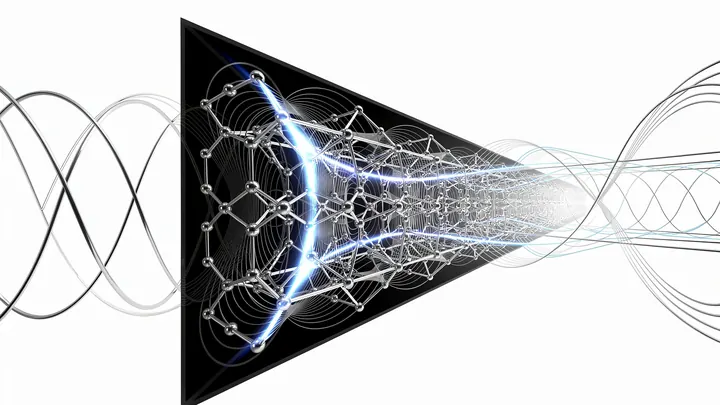
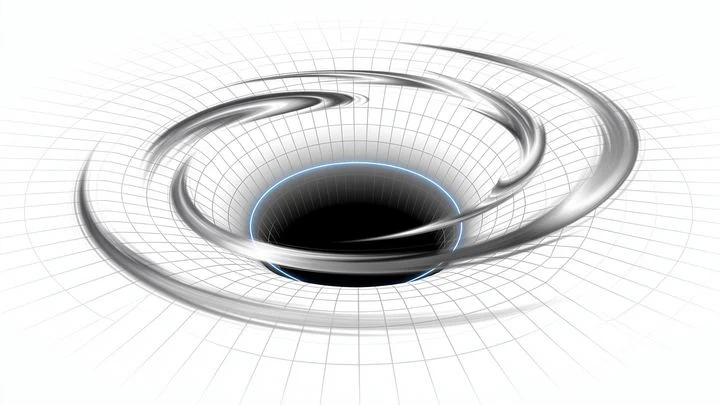
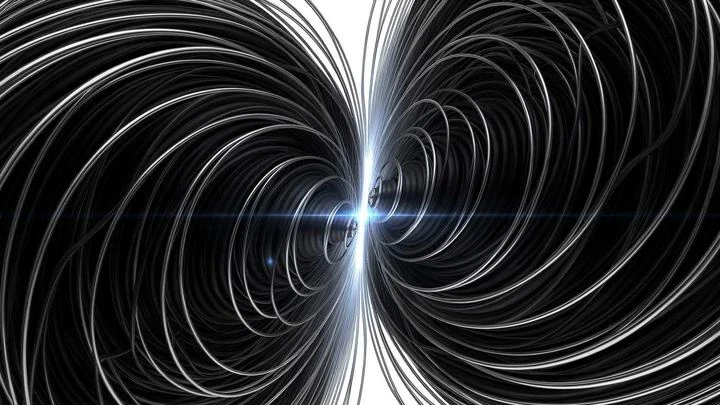
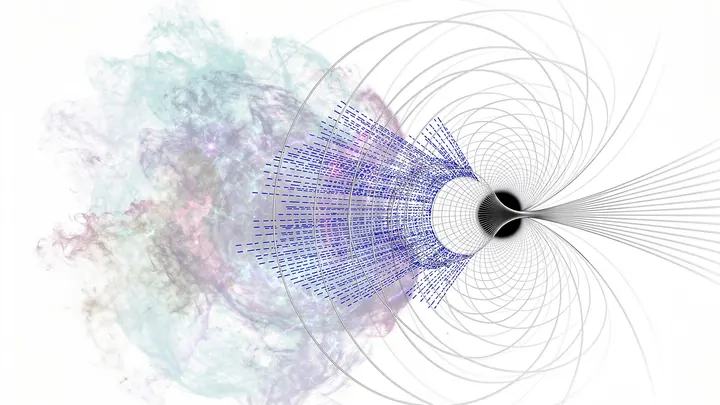
Black holespectroscopy is the analysis of gravitational wave signals emitted by a perturbed black hole to extract information about its properties, such as mass, spin, and the structure of spacetime around it. When two black holes merge, the resulting black hole 'rings' like a struck bell, emitting gravitational waves at specific frequencies and damping rates known as quasi-normal modes. By studying these modes, physicists can test Einstein's theory of general relativity in the strong-field regime and probe the nature of black holes.
History
The concept of quasi-normal modes was developed in the 1970s, with key contributions from Chandrasekhar and Detweiler. The first detection of gravitational waves by LIGO in 2015 opened the door to practical black holespectroscopy, and the detection of overtones was reported in the 2020s.
How it works
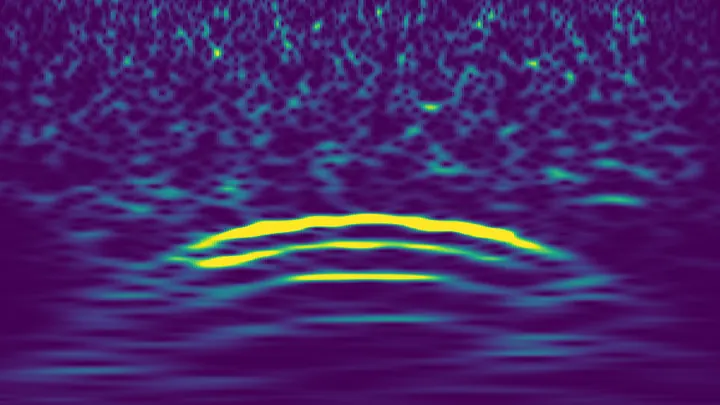
The ringdown phase of a black hole merger produces gravitational waves that are a superposition of damped sinusoids, each characterized by a frequency and decay time. These quasi-normal modes depend only on the black hole's mass and spin, not on how it was formed. By matching the observed signal to theoretical templates, researchers can identify individual modes and overtones. Recent work has detected nonlinear overtones, where the gravitational wave itself perturbs the black hole, creating a second generation of ringing that confirms predictions of general relativity.
In practice
Black holespectroscopy is used to test general relativity, measure black hole parameters, and potentially reveal new physics beyond Einstein's theory, such as deviations due to quantum gravity effects.
Fun fact
The gravitational wave signal from a black hole merger can be so loud that it briefly 'rings' the black hole itself, producing nonlinear overtones that were only recently detected.
Imagine a lottery where instead of money, you win black holes. Each ticket is a random spot on the sky, and the prize is a gravitational wave from the merger of two giants. The chance of hitting the jackpot is minuscule, but if you do, the wave is heard across the entire universe.
Two tiny diamonds float in a vacuum, separated by a distance that light cannot cross during the experiment. Inside each, like a frozen spark, resides an entangled spin — a quantum state linking them into a single whole. Now the diamonds begin to move, but not just any motion: each one seems to split, existing in two places at once.
Somewhere in the depths of space, two supermassive black holes are circling each other. Their dance is not smooth — the orbit is stretched, like a rubber band that alternately tightens and relaxes. Each revolution sends ripples through the fabric of spacetime — gravitational waves.
A black hole rings like a bell after being struck. This ring is the gravitational waves that detectors pick up. But what changes if the space around the hole is curved not only by its mass but also by an additional quantum correction?
You could send a short radio pulse toward a black hole and wait for the reflected echo. Intuitively, the shorter the signal, the better it would probe the finest details of spacetime right at the horizon: that region from which even light cannot return.
After a hit, a black hole rings like a bell. But instead of sound, it emits gravitational waves whose frequency rapidly decays: these are called quasinormal modes. From such a 'ring,' you can infer the hole's mass, spin, and other properties.
In May 2020, the LIGO and Virgo detectors picked up a gravitational-wave burst known as GW200105. Among the many similar gravitational waves recorded, this one stood out for an oddity: the orbit of the colliding neutron star and black hole was not a perfect circle, but a stretched ellipse.
The Universe is humming, but our ears catch only the bass. LIGO hears the rumble of black hole mergers — the infrasound of space. Higher up, in the gigahertz range, the flutes and violins of primordial gravity ring out.
A stone drops into a pond — ripples spread and fade. Strike a bell, and it hums at its own pitch. A black hole, after being perturbed, also 'rings,' emitting gravitational waves of a decaying tone.
Gravitational-wave detectors are like sensitive microphones, listening for the whispers of distant cataclysms. But every now and then, a sharp crack bursts in — a brief noise spike known as a glitch.
The early universe resembled an overcrowded hall where heavy particles collided and decayed at a deafening pace. Among them could have been scalar leptoquarks — particles that simultaneously latch onto a quark (a building block of matter) and a lepton (such as an electron).
A figure skater spins on the ice, gradually spiraling inward. Similarly, a small star or black hole orbiting a massive black hole loses energy. It emits gravitational waves — ripples in spacetime that detectors on Earth pick up.
But the dance of this pair is more intricate than it seems. The small companion isn't just a point.
A black hole is not a dead object. After a disturbance, such as merging with another hole, it rings like a bell. This ring is not just a sound but a complex set of damped oscillations called quasinormal modes. Their frequency and damping rate depend on the hole itself: its mass, charge, and spin.
The universe as painted in Einstein’s textbooks is a smooth four-dimensional canvas. But string theory adds a frame of extra dimensions — invisible, yet tangible to gravity. Imagine our universe as a membrane that trembles under the pressure of hidden layers.
A hum resonates across the universe. It is not sound, but a trembling of space itself — the gravitational wave background. It is produced by pairs of supermassive black holes circling each other at the centers of distant galaxies. Each pair is like a bass instrument in a vast orchestra.
Gravitational waves are ripples in the very fabric of spacetime, akin to vibrations of a giant cosmic string. Conventional detectors like LIGO and Virgo pick up low-frequency "notes"—disturbances from mergers of massive black holes of stellar masses.
Two heavy spheres of dark emptiness hurtle toward each other and collide dead-on. This is not billiards: it's the collision of two equal black holes. The impact sends a tremor through space itself — gravitational waves.
Most of this tremor is a low hum that physicists call bremsstrahlung.
The merger of two black holes is the most powerful explosion in the Universe, yet we cannot see it. We only catch the shudder in spacetime — gravitational waves that carry information from the heart of the cataclysm. In December 2025, the LIGO detectors registered event GW250114.
After a merger, the newborn black hole emits a fading tremble — gravitational waves, similar to a ringing bell. By analyzing the overtones of this signal, spectroscopy can determine its mass and spin rate.
Gravitational waves are the trembling of spacetime itself. Usually we only catch their overall hum, but each wave also has a direction of oscillation – polarization. Old maps were built only from signal loudness, which led to errors. It's like trying to see the bottom of a pond through sun glare.
Sound travels through a medium at a certain speed. If the medium moves faster, the sound gets swept along by the flow — like a wood chip pulled into a whirlpool. In superfluid helium — a frictionless liquid — rapid rotation spawns vortex funnels. Inside them, an acoustic black hole forms: a region from which sound cannot return.
Dark matter is the great cosmic invisible. It neither emits, absorbs, nor reflects light, yet its gravitational grip is felt in every motion of galaxies. Seventy years ago Vera Rubin showed that the outskirts of galaxies rotate too fast — as if spurred on by an unseen shepherd.
A stone falls into a well, and a second later, a splash. A star falls into a black hole, and disappears beyond the horizon, leaving only a ripple in space. But what if the bottom of the well is not a dead end but a passage? In the usual picture, matter compresses into a point of infinite density — a singularity.
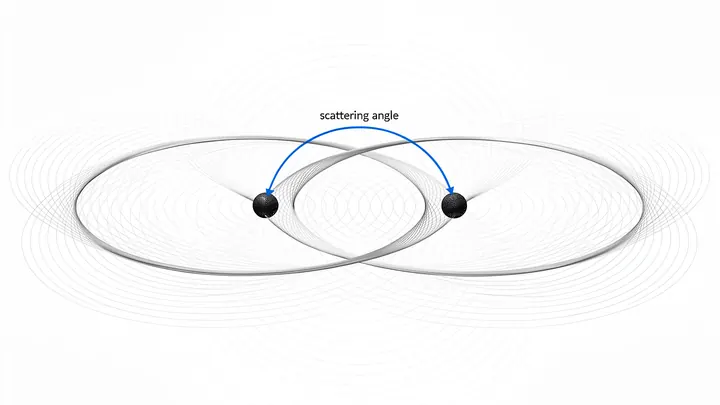
When black holes approach and then fly apart — without merging, just grazing each other's gravitational fields — they become ideal projectiles for testing the laws of gravity. In extreme fields, where time dilation reaches monstrous magnitudes, any crack in the theory would flash dazzlingly bright.
The symphony plays, but a barely perceptible wrong note has crept into the score. This is roughly how physicists search for deviations from general relativity in the 'sounds' of the universe — gravitational waves from merging black holes.
Strike a bell, and it responds with its own note. Likewise, a black hole disturbed by the fall of a star or another black hole begins to 'ring,' emitting gravitational waves. But instead of sound, it's the trembling of space itself, and instead of a single note, a whole set of decaying frequencies. These are called quasinormal modes.
A black hole, perturbed by a merger, vibrates at characteristic resonant frequencies — much like a bell ringing after being struck. Each hole has its own spectrum of these oscillations, allowing astronomers to reconstruct its parameters.
Imagine a vast lake at night, perfectly still. You can't see waves, but you hear them lapping evenly on the shore from all sides. That's what astronomers call the gravitational-wave background — a constant hum from distant black hole mergers. But what if the splashing were slightly louder on one side?
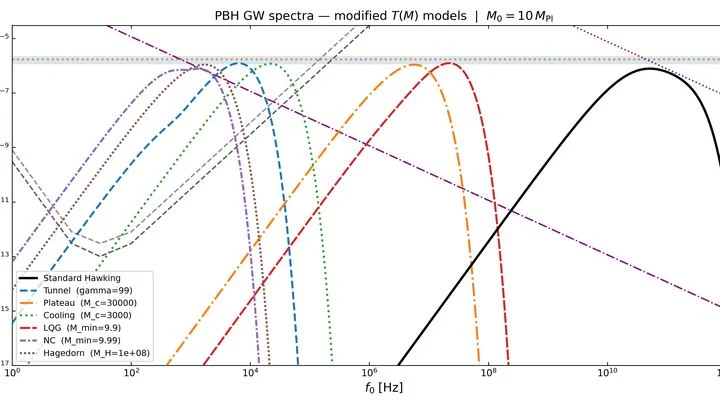
Primordial black holes behave like boiling kettles: as they evaporate, they whistle gravitational waves. The character of the whistle, its spectrum, depends on how the hole's temperature relates to its mass.
When two black holes merge, the newborn hole rings like a bell, emitting gravitational waves. In the past, only the fundamental tone of this ringing was captured. But analysis of the GW250114 merger showed that the signal hides extra faint vibrations — nonlinear overtones.
Two giant black holes spiral together and collide — a ripple of spacetime spreads across the Universe. Detectors of gravitational waves catch this ripple. But the signal may hide more than just mass and distance: if the laws of physics differ ever so slightly in different directions, the wave will be distorted.
Each merger of black holes produces gravitational waves — ripples in the fabric of the universe — predicted by Einstein and first detected with key contributions from Kip Thorne.
A guitar string after being plucked produces not only the fundamental note, but also quiet overtones. A similar phenomenon appeared in the gravitational waves from the merger of two black holes (event GW250114).
A gravitational-wave detector catches not only the roar of mergers but also the quiet splash when a star or gas cloud dives into a supermassive black hole. Such a dive, like a stone falling into a well, generates waves at all frequencies at once—and in that spectrum lies encoded the nature of the well itself.