A Magnetic Pattern from Three Rivals express
The magnetic field increases, but the magnetization stays put. It's like a scale where you add weight, yet the needle doesn't move until enough has accumulated to jump to the next mark. That's exactly how rare-earth tetraboride crystals behave, and physicists have been puzzled for decades.
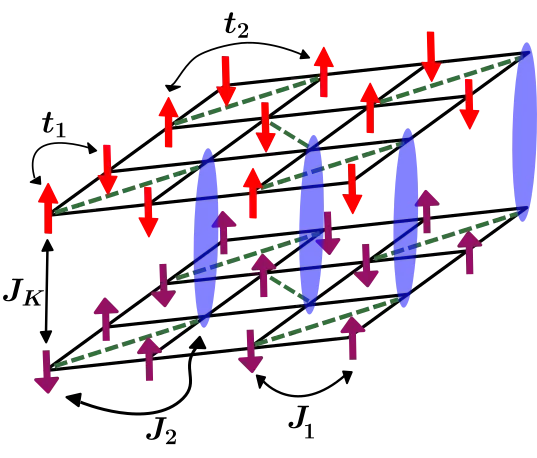
Inside these crystals, rare-earth ions sit on a peculiar geometric grid — the Shastry–Sutherland lattice, resembling a parquet of squares and triangles. This arrangement creates magnetic frustration: electron spins (their tiny magnetic arrows) cannot simultaneously satisfy all neighbors and must find a complex compromise. The authors of the new study added two more players to this picture: the kinetic energy of electrons and the Kondo effect — where conduction electrons screen the magnetic moments of ions, quenching them.
Using hybrid and semiclassical Monte Carlo simulations, they reproduced all experimentally observed magnetization plateaus — at 1/6, 2/9, 1/4, 1/3, 1/2, 2/3, and 3/4 of the maximum. Most of these states turned out to be partially Kondo-screened: some spins are 'frozen' by the field, while others continue interacting with electrons. Most striking, the strange magnetoresistance measured in ErB4 and TmB4 found a surprisingly simple explanation within this mechanism.
Thus, a model built from three competing principles not only unraveled the old puzzle of metamagnetism but also opened a way to predict new correlated phases in other frustrated Kondo lattices. Physicists can now deliberately search for materials where this triple play gives rise to even more exotic magnetic textures.
Original abstract
as written by the authors arXiv:2605.17469
We invoke a new mechanism to account for multiple magnetization plateaus observed in rare-earth tetraborides. Using a combination of hybrid and semiclassical Monte Carlo simulations of the Kondo lattice model (KLM) on the Shastry-Sutherland lattice (SSL), we find robust magnetization plateaus at fractions 1/6, 2/9, 1/4, 1/3, 1/2, 2/3 and 3/4 of the saturation magnetization. We find that most of the plateau states are partially Kondo screened and emerge from the field-tuning of a complex three-way competition between the kinetic energy, the Kondo coupling, and the magnetic frustration. Most remarkably, the unusual magneto-transport reported in ErB$$_4$$ and TmB$$_4$$ admits an unexpectedly simple explanation within our mechanism. This work not only provides an elegant and simple solution to the long-standing puzzle of metamagnetism and anomalous magnetotransport in RB$$_4$$, but also introduces a novel mechanism to predict and discover new correlated phases in frustrated Kondo lattices.
The word 'metamagnetism' comes from the Greek 'meta'—meaning 'after, beyond'—and refers to a sharp jump in magnetization upon a small change in field, as if the magnet suddenly 'wakes up'.
In Greg Egan's novel 'Schild's Ladder', physicists explore exotic states of matter under strong quantum frustration, where spacetime itself becomes akin to a frustrated lattice.