A magnetic monopole is a hypothetical particle that carries a single magnetic pole — either a north or a south pole alone — unlike ordinary magnets which always have both. In classical electromagnetism, magnetic monopoles do not exist; magnetic field lines always form closed loops. However, in 1931 Paul Dirac showed that if even one monopole existed in the universe, it would explain why electric charge is quantized. Monopoles appear naturally in many grand unified theories, which attempt to unify the electromagnetic, weak, and strong forces. Their discovery would be a revolutionary breakthrough, confirming physics beyond the Standard Model and providing a window into the earliest moments of the universe.
History
The concept was first proposed by Pierre Curie in 1894, but the modern theoretical framework was developed by Paul Dirac in 1931. The 't Hooft–Polyakov monopole, a concrete solution in non-Abelian gauge theories, was discovered independently by Gerard 't Hooft and Alexander Polyakov in 1974.
How it works
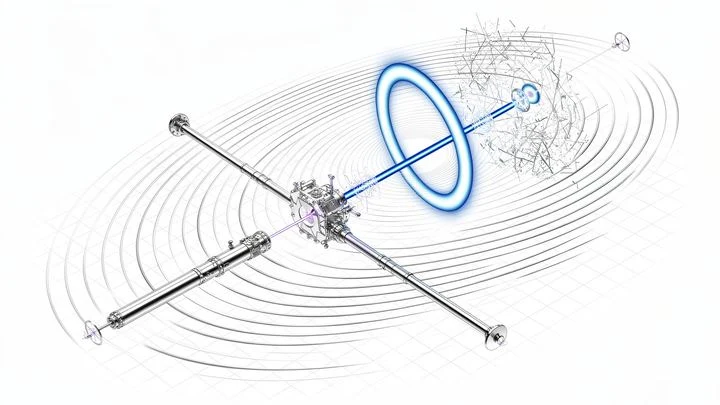
In quantum field theory, a monopole is a topological defect — a stable configuration of fields that cannot be smoothly transformed into the vacuum state. In grand unified theories, the symmetry breaking that separates the strong and electroweak forces can create point-like monopoles with a mass of about 10^16 GeV, far beyond any accelerator's reach. These monopoles would interact with magnetic fields, accelerating in a way that could produce detectable signals, such as specific ionization patterns in detectors or gravitational waves when cosmic strings break.
In practice
Monopoles are primarily a theoretical tool for testing grand unified theories, but they are also actively searched for in cosmic ray detectors and in experiments looking for magnetic charge in matter.
Fun fact
If magnetic monopoles exist, they would make the universe's magnetic field decay over time, as monopoles would accelerate along field lines and drain their energy.
In the first moments after the Big Bang, the universe was a searing 'soup' of particles. As it cooled, phase transitions occurred — much like water turning to ice. At one such moment, magnetic monopoles of dark matter could have been born: tiny clumps of field with a single magnetic pole.
At the center of attention is a monopole, a special clump of a non-Abelian field (a field where the order of operations changes the result), resembling a magnetic charge without a pair. In this work, it is placed in curved spacetime described by Einstein's equations with a Gauss-Bonnet addition (a correction important at small distances).
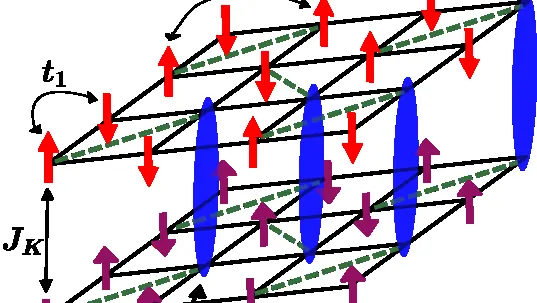
In a world locked in a crystal lattice and cooled nearly to absolute zero, matter knows how to hide its deepest secrets. A quantum spin liquid is a state where electron spins never freeze, even at zero temperature, remaining in an eternally flickering superposition.
When the cooling cosmos, in the aftermath of the Big Bang, lost its primordial symmetry, tensions arose in the fields, like microcracks forming in solidifying glass. Global monopoles, predicted by Gerard 't Hooft and Polyakov, became such “scars” on the fabric of the universe. Each monopole is a tiny but incredibly massive knot of field.
Light from a distant blazar, an active galactic nucleus whose jet points our way, travels for billions of years. Along the way, it triggers cascades of charged particles that the intergalactic magnetic field deflects sideways. This creates a blurred gamma-ray glow around the blazar: a secondary halo.
In the hot early universe, like in an overcrowded dance hall, magnetic monopoles swirled — loner particles carrying only a north or only a south pole. In an ordinary magnet, poles always come in pairs, but here each one is on its own. Theories that unify all forces of nature predict that such particles should have been produced in vast numbers, yet today we don't see them.
Immediately after the Big Bang, in the seething cauldron of the cooling Universe, much like in unevenly hardening glass, stresses appeared — hairline cracks in reality, cosmic strings. Picture a tightrope walker balancing on an invisible cable stretched across the abyss of warped spacetime.
An ordinary magnet always carries two poles — north and south. Split it in half, and each piece immediately grows its own pair. But deep in particle theory lives a strange notion: the monopole — a particle carrying just one magnetic charge, a lone pole without a partner.
A magnet with only one pole — north, but no south. Split it in half, and instead of two ordinary magnets, you get two more one-pole magnets. In our world, no such particle has been found, although many theories predict their existence. These hypothetical objects are called magnetic monopoles.
The authors of the study noticed a curious connection.
The magnetic field increases, but the magnetization stays put. It's like a scale where you add weight, yet the needle doesn't move until enough has accumulated to jump to the next mark. That's exactly how rare-earth tetraboride crystals behave, and physicists have been puzzled for decades.
A magnet with only one pole (north, without a south) is not a fragment but a particle in its own right. Physicists call it a magnetic monopole (a carrier of a single magnetic charge). Such visitors could have been born in the early universe, when the forces were just separating.
The Mpemba effect is surprising: hot water sometimes freezes faster than cold. Scientists built a simple model: a bead in a thick, honey-like medium, on a landscape with two dips and a wall at the edge. The bead moves viscously, unable to hop over the central bump.
According to theories beyond the Standard Model, our best description of elementary particles and their interactions, pairs of magnetic monopoles were born in the first instants after the Big Bang. These hypothetical particles carry only one magnetic pole—'north' or 'south'—unlike familiar magnets where poles are inseparable.
The nucleus of deuterium, or the deuteron, can be pictured as a microscopic spinning top. If its charge distribution is not perfectly symmetric, then in an external electric field this top experiences a minuscule tilt of its spin axis.
A rotating black hole is a cosmic whirlpool that sucks in everything around it. Some of these holes have invisible threads that stretch from the event horizon like spokes from a wheel. Scientists have long debated what these threads are and whether they can be observed.
In a new study, physicists have shown that these threads are not just a mathematical artifact.
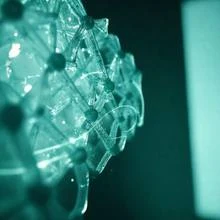
Plasma in a fusion reactor is like a swarm of fireflies that you need to keep inside an invisible jar. It used to be thought that the jar's walls had to be perfectly smooth, or the fireflies would find a crack and escape. New work shows that the jar can be glued together from pieces with noticeable seams, and the swarm will still stay inside.
The classic BCS theory of superconductivity, developed by John Bardeen, Leon Cooper, and Robert Schrieffer, describes the mechanism by which electrons pair up into Cooper pairs and move without resistance.
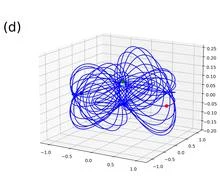
Three bodies attracting each other by universal gravitation: a problem that has stumped mathematics for three centuries. After Poincaré, it became clear that no general solution exists and trajectories are chaotic. But within this chaos there are islands of order: periodic orbits where motion repeats.
Two translators listen to the same symphony. One hears only the fundamental tone: a clean, predictable melody. The other catches the overtones that color every note.