Two Atoms Send Photons Marching in Triplets express
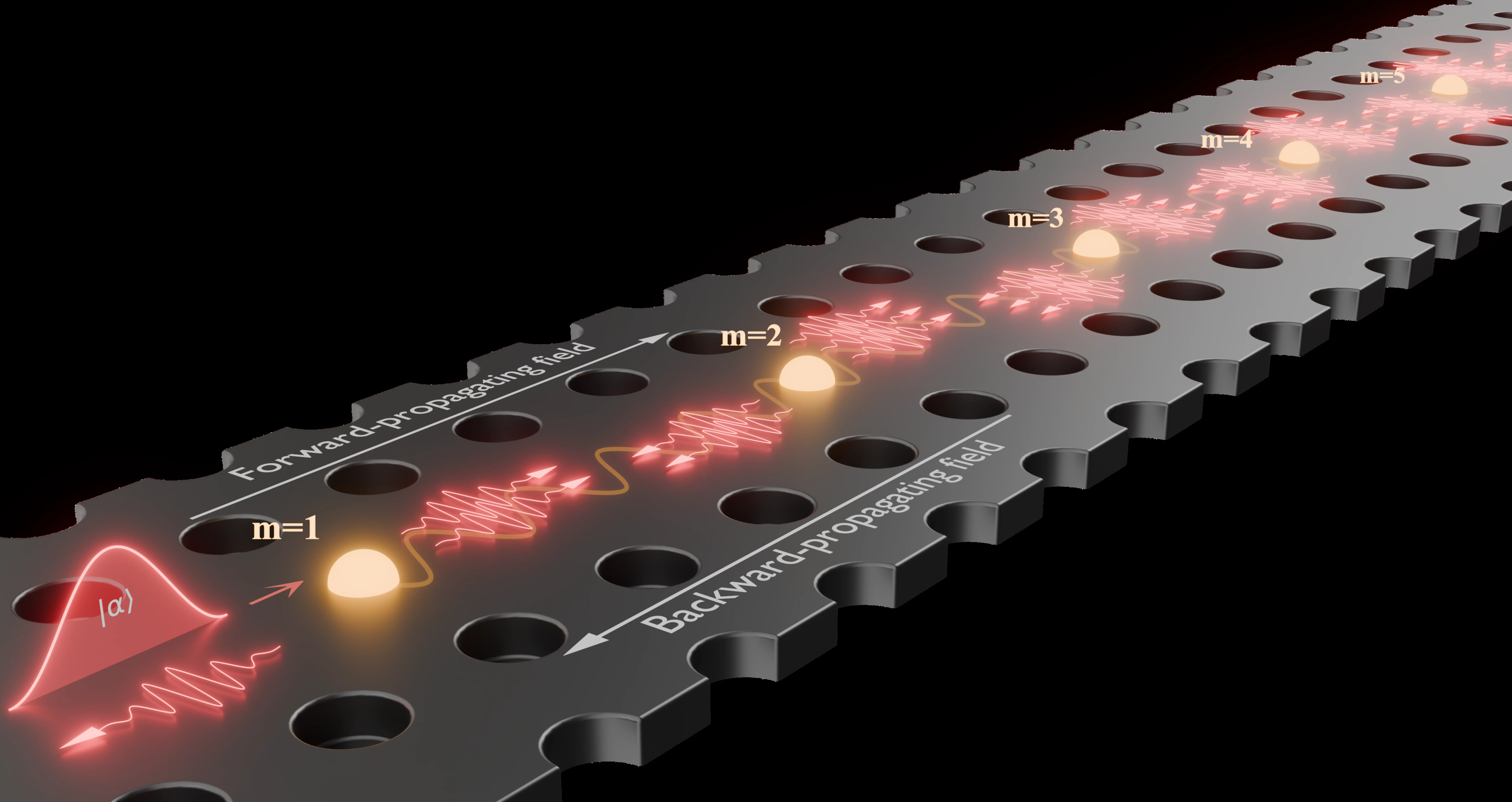
Light is a stream of photons. In a special waveguide, resembling a narrow corridor, a 'gatekeeper' atom usually lets them through one at a time. This phenomenon is the domain of single-particle spectroscopy.
When two 'gatekeepers' are placed side by side, they force photons to gather in trios. In the experiment, two artificial atoms — essentially tiny superconducting circuits — connected by a common waveguide, produced exactly this effect. Photons, which normally ignore each other, suddenly start traveling in groups of three. They still race along at the speed of light, but their behavior becomes radically different. This result aligns with the Standard Model of particle physics and paves the way for multitasking quantum optics.
Pioneers of quantum optics dreamed of this for decades — Leonard Mandel and Roy Glauber.
Original abstract
as written by the authors arXiv:2605.18525
Controlling light photon-by-photon is central to quantum optics. At a fundamental level, photon interactions are mediated by their coupling to atoms, and ultimate control requires deterministic light-matter interfacing of single photons to single atoms. Extending this paradigm to radiatively couple multiple individual atoms in a deterministic and scalable manner opens the arena of many-body quantum optics. Here, we realize such a setting by coherently coupling solid-state artificial atoms to a nanophotonic waveguide and demonstrate higher-order photon correlations that are controlled by the number of quantum emitters. We study the scaling of nonlinear photonic transport induced by emitter-photon scattering and demonstrate that adding a quantum emitter generates higher-order photon correlations. Specifically, we experimentally observe genuine three-photon correlations from a pair of collectively coupled emitters, while contributions from lower photon numbers are suppressed. In addition, we scale to three resonant quantum emitters coupled to the waveguide. These advancements demonstrate the onset of many-body quantum optics in waveguide quantum electrodynamics, enabling new photonic quantum simulators, the creation of many-body entangled states, and the exploration of novel quantum phase transitions.
To see individual photons, you need total darkness and ultrasensitive detectors. In an ordinary lightbulb, there are so many that counting them is pointless.
In science fiction, quantum communication promises instant data transfer. Photon triples aren't capable of that yet, but they help us better understand the quantum world.