Quantum light control refers to the set of techniques for manipulating light at the level of individual photons, where the quantum nature of the electromagnetic field becomes directly observable. This includes generating single photons on demand, squeezing light to reduce noise in one observable at the cost of increasing it in another, and even extracting photons from the vacuum — the quantum ground state of the field. It also covers controlling how molecules emit light, such as shaping the emission spectrum or direction through cavity quantum electrodynamics.
History
The theoretical foundations were laid in the 1960s and 1970s, with Roy Glauber formalizing quantum coherence and the first squeezed light produced in 1985 by Richard Slusher and colleagues at Bell Labs. The dynamical Casimir effect was first observed experimentally in 2011 by Chris Wilson and collaborators.
How it works
At the heart of quantum light control is the ability to prepare and measure specific quantum states of the electromagnetic field. Single-photon sources use quantum emitters like atoms, quantum dots, or defect centers in crystals that emit one photon at a time. Squeezed light is produced by nonlinear optical crystals that correlate photon pairs, reducing quantum fluctuations in one quadrature. Vacuum emission can be stimulated by rapidly changing boundary conditions — the dynamical Casimir effect — where moving mirrors or superconducting circuits convert virtual photons into real ones. Cavity QED uses high-finesse optical cavities to enhance or suppress spontaneous emission, giving experimenters control over how and when a molecule releases its energy as light.
The vacuum is not truly empty — it teems with virtual photons that can be coaxed into real ones by rapidly changing the speed of a mirror, an effect first predicted by Gerald Moore in 1970.
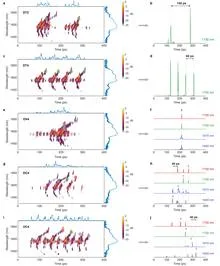
A conductor raises the baton, and the orchestra produces not just sound but a complex score: each note sounds at its own moment, at its own pitch, with the right volume. Light can also be a score, if you control its spectrum and timing. Previously, this required bulky setups that could not be reconfigured after assembly.
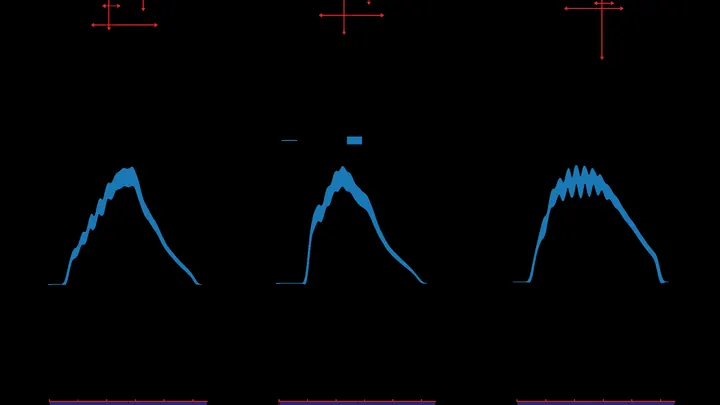
Quantum bits (qubits) are like delicate music in a noisy factory. Ambient magnetic fields constantly 'drown out' their quantum state, turning a coherent signal into cacophony. Usually, this destructive process is slowed by retuning the qubits themselves to different frequencies, but that doesn't always work.
Light is a stream of photons. In a special waveguide, resembling a narrow corridor, a 'gatekeeper' atom usually lets them through one at a time. This phenomenon is the domain of single-particle spectroscopy.
Inside every cell, there's a network of thin tubes — microtubules. They act as both scaffolding and rails: they hold the cell's shape and transport cargo. These tubes are built from the protein tubulin and naturally glow faintly under ultraviolet light. Scientists wondered: can we make this glow stronger or weaker on demand?
The key to control is the amino acid tryptophan.
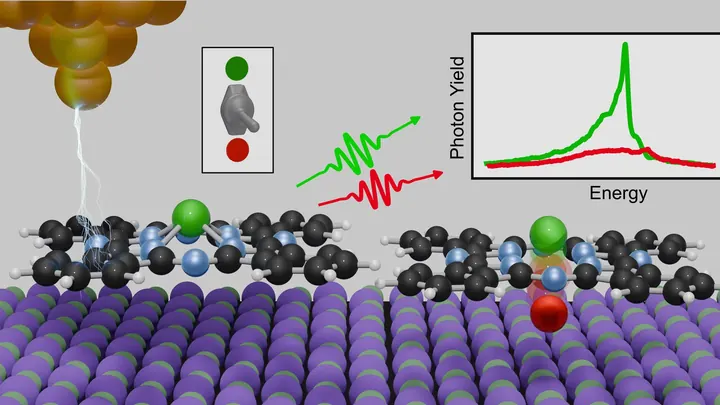
In a molecule resembling chlorophyll and built from carbon, a metal atom at the center acts as a toggle. Shifting it by fractions of a nanometer can make the molecule glow, quench, or boost its brightness a hundredfold.
A typical accelerator is like an assembly line where electrons are the workpieces. To get the desired X-ray pulse, the workpiece is fine-tuned after it's already on the line: squeezed, filtered, corrected. In the new work, engineers decided to take a different approach — shaping the workpiece before it even hits the conveyor.
At LCLS-II, electrons are knocked out of a metal by a short laser pulse.
A glowing dot the size of a molecule. Run a current through it, and it flashes like a tiny lightbulb. That's what the experiment with dye molecules on a thin salt film looks like.
When current enters a molecule, one electron hands it energy. The molecule immediately gives that energy back, as light. It's like a swing: give it one push, and it rocks and then stills.
A photon is like a car in a multi-story parking lot, where each floor is its frequency (color). Usually it gets stuck on one level, but scientists added an elevator — a programmable modulator that moves the photon between floors on command.
Four cesium atoms hang in vacuum, held by laser tweezers like beads on an invisible thread. Around them is a ring resonator, a closed loop of mirrors where light circulates without obstacles. When a probe beam strikes this tiny chain, something strange happens: the atoms scatter light not uniformly in all directions, but predominantly in one direction.