Quantum Escape from Orbit express
A swing can rock strongly or barely move. Usually, if left alone, it stays in its chosen mode. But in the microworld, things are different: a tiny membrane, oscillating under the action of a laser beam, can spontaneously jump from one amplitude to another. This is like escaping from one orbit to a neighboring one, only the escape is driven not by a rocket but by ubiquitous quantum noise.
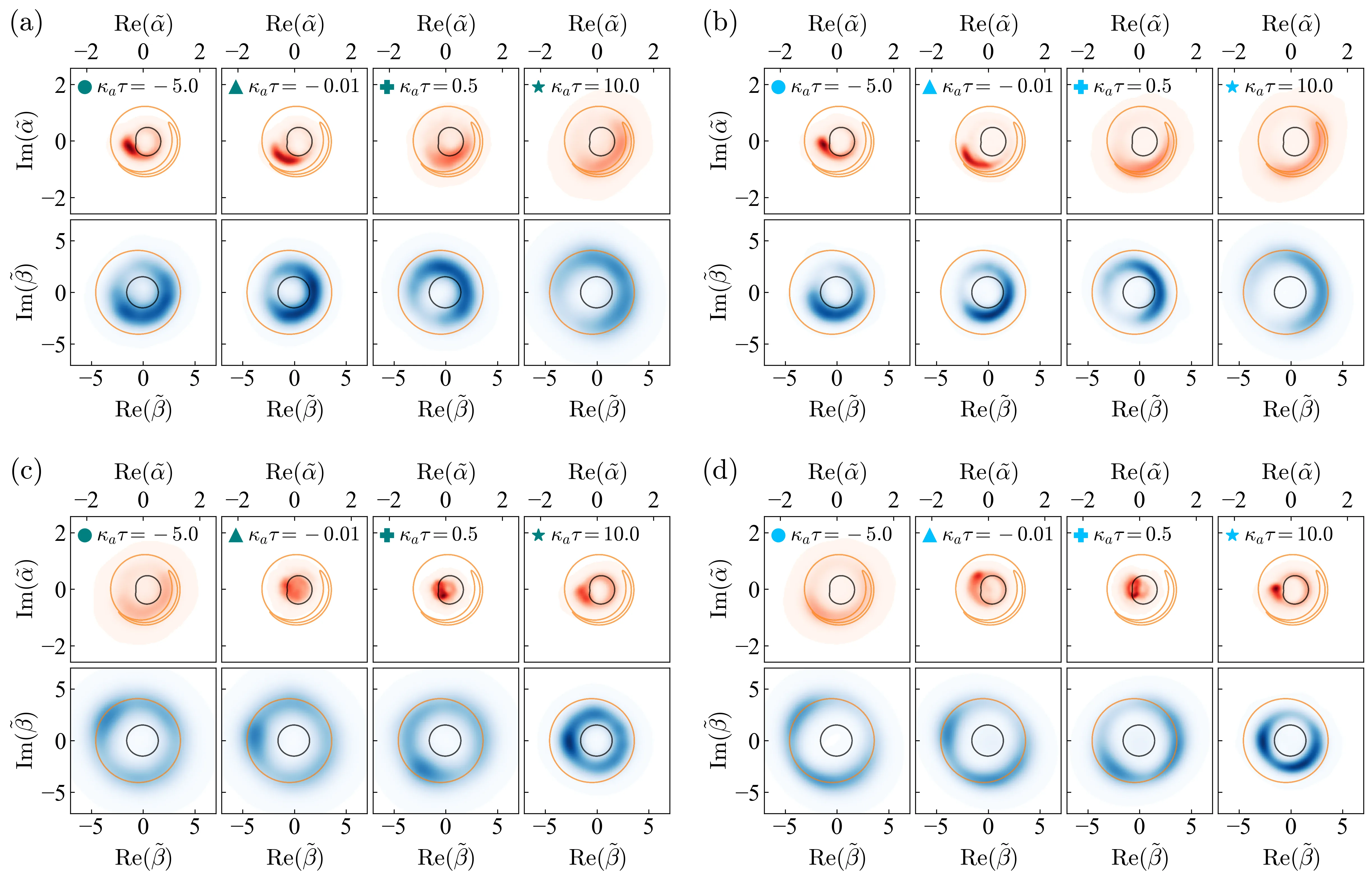
Physicists studied such an optomechanical resonator (a device where light and mechanical motion are coupled) and found an unexpected detail. The switching route depends on the phase of the oscillation (on the rise or on the fall) at which the system "decides" to escape. For small oscillations, the path is always the same, like a narrow corridor in the mountains. But from large amplitudes, you can escape via several trails, each with its own "steepness"—its own activation energy.
To see these hidden trails, the scientists used the method of quantum jumps — tracking individual switching events while varying the strength of quantum noise. This allowed them to reconstruct the geometry of the escape: for the small cycle, a single radial corridor with an almost classical temperature dependence (the rate grows according to the Arrhenius law), and for the large one, several competing corridors with different activation scales. This led to a bend in the plot of switching rate versus noise level — a clear sign of a multi-channel quantum escape.
Such sensitivity to phase opens the way to ultra-precise control of quantum systems. It will be possible not just to detect transitions but also to influence them by choosing the right moment. For future quantum machines and sensors, this is like gaining the ability to shift gears in a car not at random but at the ideal point of the engine's revolution — smoothly and without jerks.
Quantum noise, which causes these jumps, is not just interference but a fundamental property of nature. It exists even at absolute zero temperature, when all classical motion freezes.
In Stanislaw Lem's novel "Fiasco," quantum fluctuations of macroscopic objects are used as the reason for the impossibility of precise contact with an alien civilization.