How a cell catches broken DNA ends express
A torn telephone wire is a nuisance, but a torn DNA is a catastrophe. A double-strand break, when both strands of the helix snap at the same spot, threatens the cell with death or transformation into cancer. Fortunately, the cell has its own 'glue': special proteins that gather into a droplet right at the accident site. This droplet holds the broken ends together, much like spray foam fixes a frayed cable. But how it always ends up exactly where needed and never misses either of the two ends had remained a mystery.
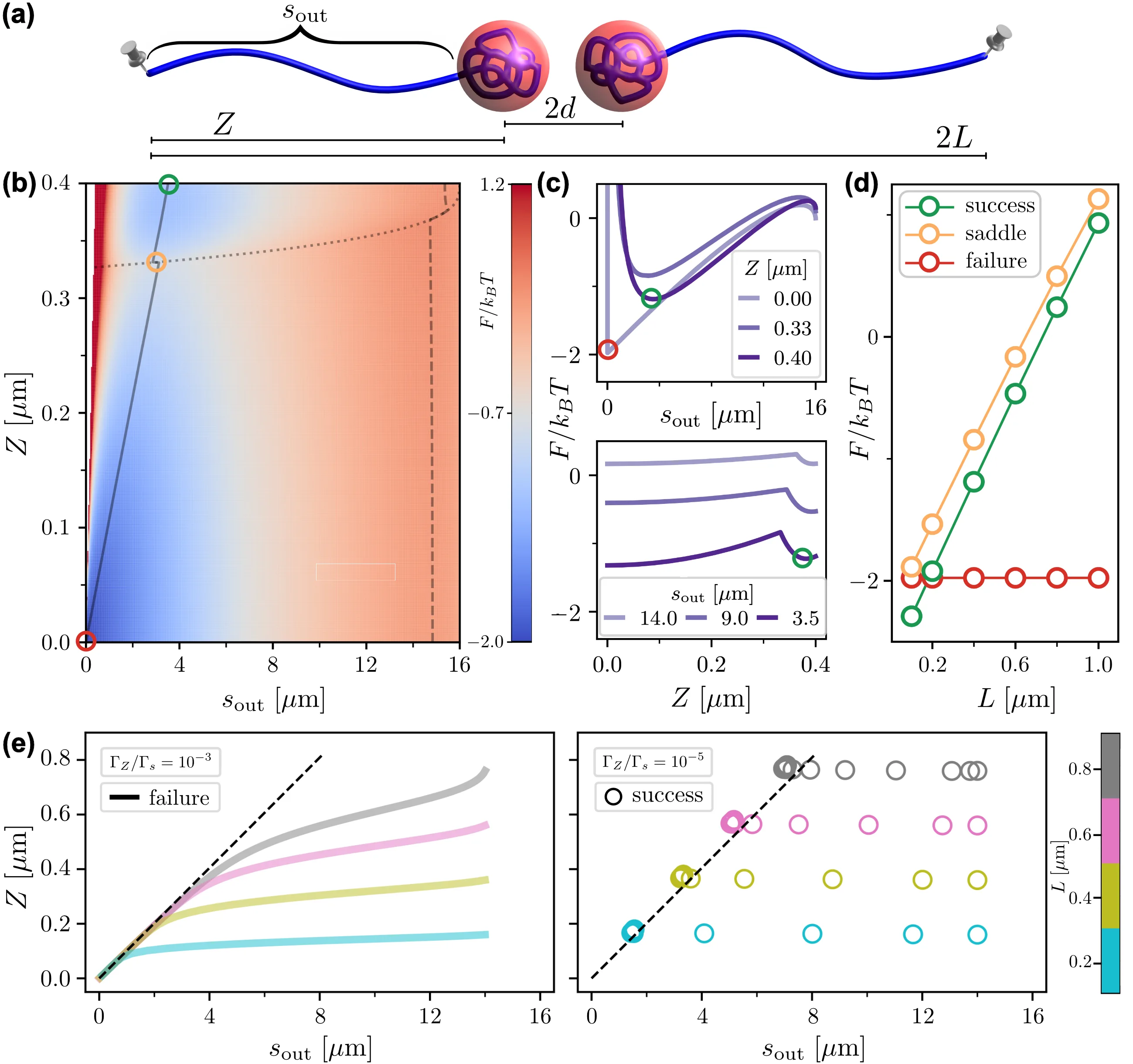
The authors of the new study proposed that the break itself serves as the signal. The repair proteins float in the nucleus in a soluble, 'calm' form, but the moment they touch a broken DNA end, they change their structure and become 'sticky,' ready to clump together. This process was simulated on a computer, incorporating Brownian motion (the random jostling of molecules) and polymer physics. It turned out that the fate of the repair is a race against time: the condensate must assemble faster than the elastic DNA strand can coil up and drag the ends far apart.
The researchers built an energy landscape of the process — something like a map of hills and valleys along which the system rolls. It has two finish lines: successful joining or failure, when the ends drift apart. The outcome is governed not only by speed but also by how far apart the ends are at the moment of the break. For the first time, this showed that reliable repair is not a miracle but the result of a simple physical competition.
Original abstract
as written by the authors arXiv:2605.24987
Cells deploy robust mechanisms to repair DNA damage, safeguarding genomic stability and cellular health, but the physical principles underlying these processes remain incompletely understood. Experiments show \emph{in vitro} that upon a DNA double-strand break, a DNA--protein condensate can tether the broken DNA ends before they disperse away, a critical step for subsequent repair biochemistry. However, it remains puzzling how such condensation reliably achieves spatiotemporal localization at the break site and captures both broken ends despite intrinsic stochasticity. Here, we propose that broken DNA ends can trigger a conversion of proteins from a soluble state to a condensate-competent state. Combining this idea with Brownian dynamics simulations and theory, we propose a physical mechanism for reliable DNA-end tethering. Simulations show that such break-induced conversion can drive local DNA--protein condensation with two possible outcomes: successful or failed tethering. To rationalize this, we construct an effective free energy landscape, identify the corresponding stationary states, and demonstrate that tethering is governed by a kinetic competition between polymer relaxation and condensation dynamics. Together, our study shows that DNA end-dependent conversion, coupled with DNA--protein condensation, can reliably tether broken DNA ends.
A single human cell experiences up to 50 double-strand DNA breaks per day, just from breathing and body heat. Without a rapid repair mechanism, we would not survive an hour.