A Fiery Trail in Thin Air express
A pebble the size of a grape enters the atmosphere almost tangentially and skims across the sky without falling. That's exactly what happened to a meteoroid weighing about 45 grams. It came in at such a shallow angle that it traveled 164 kilometers at an altitude of 92 kilometers — where the air is a million times thinner than at the surface. Dozens of cameras and three infrasound stations picked up its flight and the shock wave it generated.
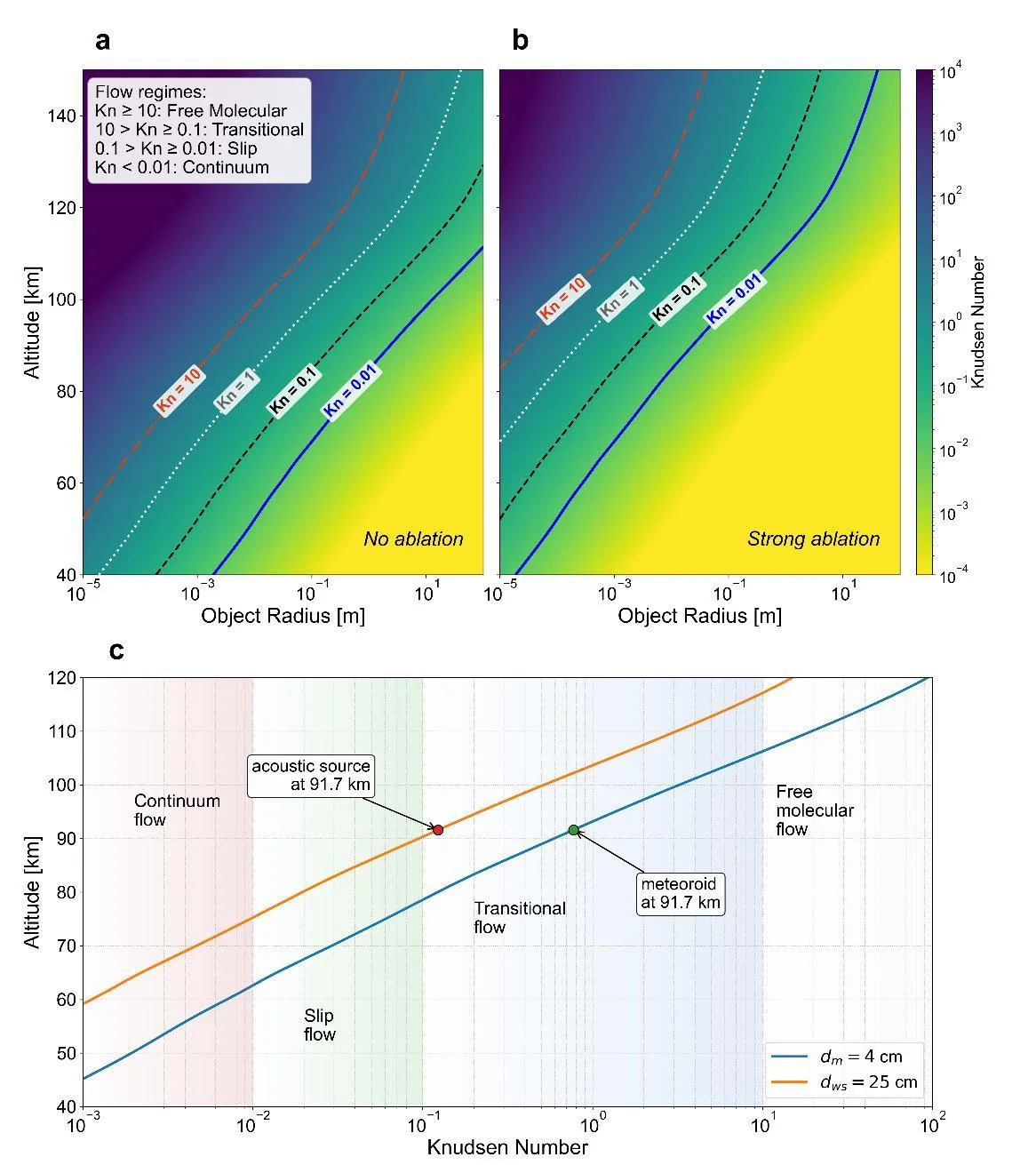
But this meteoroid behaved differently. It began to break apart and vaporize at pressures that would be too weak for a typical meteor. Analysis showed the object resembled a carbonaceous chondrite — a loose, porous material rich in frozen gases and water. When heated, these volatiles burst out, enveloping the core in a dense cloud of vapor. The cloud acted as a shield: it increased the effective cross-section for the incoming flow and allowed a stable shock wave to form.
This phenomenon is called hydrodynamic shielding. Under normal conditions, it requires a denser medium, but the outgassing created a temporary 'atmosphere' around the meteoroid in which the shock wave could be born and travel all the way to the ground as low-frequency sound — infrasound. Thus, a tiny wanderer from space momentarily altered the properties of the thin air around it and left an audible trace.
Original abstract
as written by the authors arXiv:2605.29150
Hydrodynamic shielding is a theoretically well-established but observationally elusive and experimentally difficult-to-replicate phenomenon with implications that extend far beyond meteor physics. Rare earthgrazing meteoroids with infrasound signatures that penetrate to the ground can be used to probe hydrodynamic shielding that leads to strong shock formation at high altitude. Here, we report the first coordinated optical and multi-station infrasound observations of a centimeter-scale earthgrazing fireball that generated sustained cylindrical line shock at thermospheric altitudes near 92 km. The event was recorded by numerous optical stations and three infrasound arrays, allowing trajectory reconstruction, ablation behavior, acoustic source localization, and shock characteristics. Optical observations indicate early mechanical erosion and ablation/evaporation at exceptionally low dynamic pressure, consistent with a cometary or a porous, volatile-bearing CM chondritic object. Independent infrasound detections localize shock generation to multiple points along a 164 km trajectory segment near perigee. Weak-shock modeling yields a consistent blast radius of ~30 m, implying an acoustic-equivalent source size far exceeding the physical dimensions of the ~45 g nucleus. We demonstrate that classical gas dynamics and ablation-driven hydrodynamic shielding alone cannot account for these observations under ambient thermospheric conditions. We show that volatile release provides the additional flow-field density enhancement required to amplify hydrodynamic shielding, reduce the effective local Knudsen number, and sustain a shock envelope capable of radiating detectable infrasound. These results demonstrate that small, volatile-rich meteoroids can transiently establish continuum-like flow in rarefied environments.
The infrasound from this meteor was so low that the human ear wouldn't have perceived it — the oscillation frequency was below 20 hertz, like the deepest bass notes of an organ.
In Arthur C. Clarke's novel 'Rendezvous with Rama,' an alien spacecraft uses a similar gas cloud for protection during atmospheric entry.