A Fiery Trail in Thin Air express
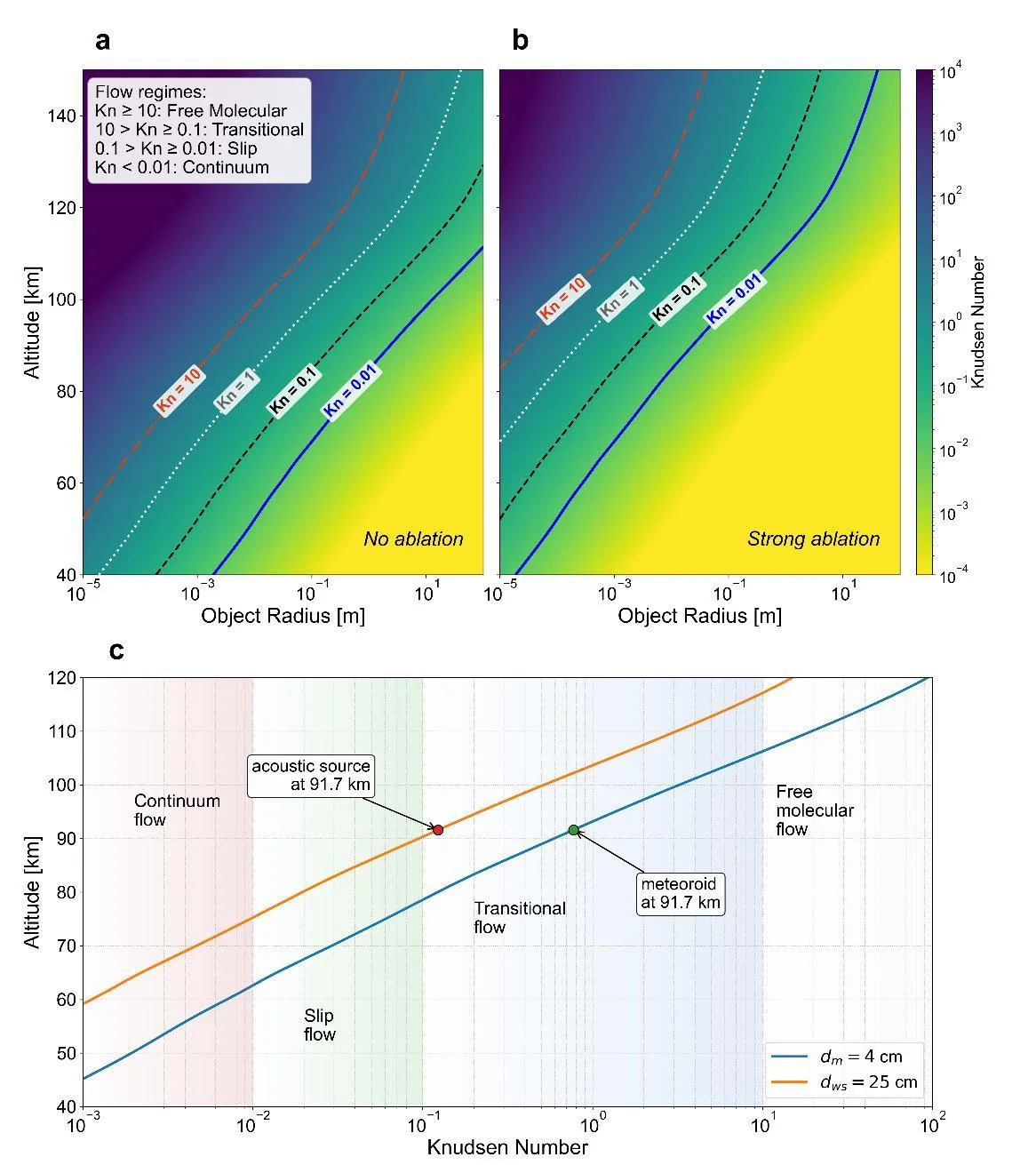
A pebble the size of a grape enters the atmosphere almost tangentially and skims across the sky without falling. That's exactly what happened to a meteoroid weighing about 45 grams. It came in at such a shallow angle that it traveled 164 kilometers at an altitude of 92 kilometers — where the air is a million times thinner than at the surface. Dozens of cameras and three infrasound stations picked up its flight and the shock wave it generated.
But this meteoroid behaved differently. It began to break apart and vaporize at pressures that would be too weak for a typical meteor. Analysis showed the object resembled a carbonaceous chondrite — a loose, porous material rich in frozen gases and water. When heated, these volatiles burst out, enveloping the core in a dense cloud of vapor. The cloud acted as a shield: it increased the effective cross-section for the incoming flow and allowed a stable shock wave to form.
This phenomenon is called hydrodynamic shielding. Under normal conditions, it requires a denser medium, but the outgassing created a temporary 'atmosphere' around the meteoroid in which the shock wave could be born and travel all the way to the ground as low-frequency sound — infrasound. Thus, a tiny wanderer from space momentarily altered the properties of the thin air around it and left an audible trace.
The infrasound from this meteor was so low that the human ear wouldn't have perceived it — the oscillation frequency was below 20 hertz, like the deepest bass notes of an organ.
In Arthur C. Clarke's novel 'Rendezvous with Rama,' an alien spacecraft uses a similar gas cloud for protection during atmospheric entry.