Volatile elements are chemical elements and compounds with low boiling points that easily evaporate or sublimate at relatively low temperatures. In planetary science, this includes substances like water, carbon dioxide, nitrogen, and noble gases, as well as elements like zinc, sodium, and potassium that have low condensation temperatures. These materials are crucial for understanding planetary formation, as they tend to remain gaseous or icy in the outer regions of protoplanetary disks but condense closer to the star.
History
The term 'volatile' in a geological context dates back to the 19th century, but its importance in planetary science was established in the mid-20th century with the study of meteorite compositions and the development of condensation sequence models.
How it works
The behavior of volatiles is governed by their vapor pressure, which increases sharply with temperature. When a planet forms, the heat from accretion and radioactive decay can drive volatiles out of rocks and into the atmosphere, where they may escape into space if the planet's gravity is too weak or if the solar wind is strong. This process, called volatile loss, explains why inner planets like Earth are depleted in volatiles compared to outer planets and comets.
In practice
Understanding volatiles is essential for assessing the resources available on the Moon or Mars for future space missions, as water ice and other volatiles can be used for life support and rocket fuel.
Fun fact
Zinc, a volatile element, is so depleted in the Moon's rocks compared to Earth's that scientists use its isotopic ratios as evidence that the Moon formed from a giant impact that vaporized much of the early material.
The star AB Aur is young, about 4 million years old. Around it swirls a dense disk of gas and dust. Recently, a long gas stream, a flow of material from the surrounding cloud, crashed into it.
Putting together the Solar System is like crafting a high-end tasting menu: the recipe isn't always set in stone — sometimes the final ingredient is added while the dish is already cooking.
A pot of water has just been stirred: the whirlpools and eddies gradually calm down, and the liquid becomes smooth. A similar process, but in the quantum world, occurs in superfluid helium or in a cloud of ultracold atoms.
Plutonium is a metal with attitude. One form shrinks when cooled, another swells. But at room temperature, the alloy behaves strangely: the ruler says one thing, X-rays say another. The ruler shows the sample barely grows, while X-rays see atoms in the crystal lattice moving further apart.
The solar wind and ultraviolet constantly peel a thin layer of gases off Earth, like wind carrying away steam over a hot pot. This process is slow, taking billions of years. But for planets near red dwarfs, it's harsher: they bask right next to the star, and X-ray fluxes sandblast their atmospheres like an abrasive blaster.
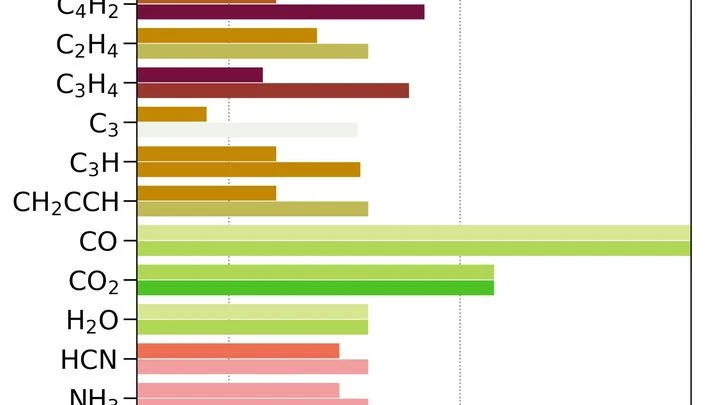
Young stars are surrounded by disks of gas and dust, like construction sites for future planets. From this material, rocky worlds and gas giants will eventually assemble. So the chemical composition of the disk directly determines what the planets will be like.
In a superconductor, electric current flows without loss, like water through a perfectly smooth pipe. But if you place such a material in a magnetic field, vortices appear inside — tiny whirlpools where superconductivity is destroyed. As long as these whirlpools stay put, current flows freely.
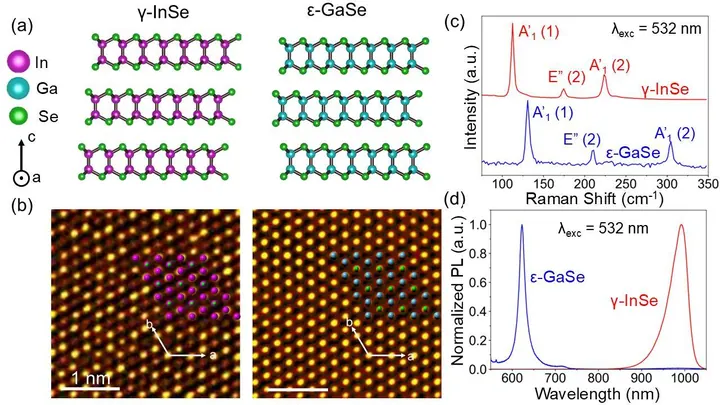
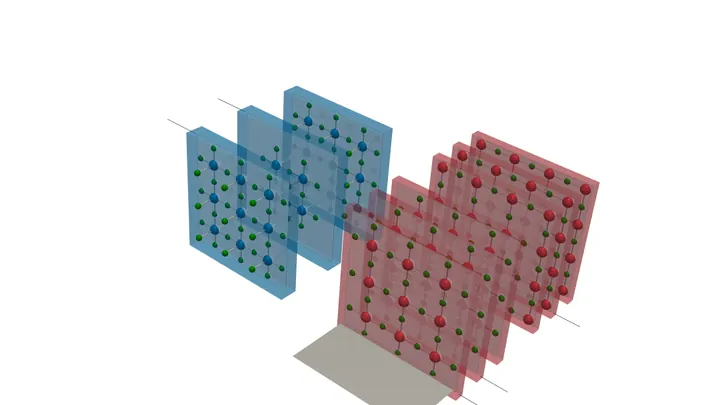
Light passing through a window pane refracts the same in all directions. But in thin layered crystals, it's a different story: light traveling along the layers sees the material differently than light traveling across them. It's as if a sheet of paper were transparent but transmitted light differently along and across its fibers.
Electrons in a metal are like a crowd in a subway: each on their own, but at the slightest push, everyone moves at once. Physicists call this collective oscillation of the electron gas a plasmon. In superconductors, these oscillations are especially important because they reveal how electrons interact with each other.
A young planet grows like a snowball rolling down a slope: countless small pebbles from the surrounding gas disk stick to it. The larger it gets, the stronger it pulls in gas — hydrogen and helium. A dense, hot envelope forms around it. Pebbles falling through it heat up from friction and their own weight, like grains of sand falling into thick honey.
Heat an ordinary quartz watch by ten degrees, and it will start losing seconds each day. Atomic clocks are more precise, but they take up an entire cabinet. Diamond with a tiny defect, a nitrogen vacancy, promises atomic-clock accuracy in the volume of a grain of sand.
Water is the gold standard for life. We search for its traces on Mars, in icy moons, and in the atmospheres of distant planets. But what if life doesn't need water? On a warm rocky exoplanet with a thin atmosphere, water would evaporate within hours.