The Five-hundred-meter Aperture Spherical Telescope (FAST) in Guizhou, China, is the world's largest filled-aperture radio telescope, with a dish diameter of 500 meters. Its primary scientific goal is to detect the 21-centimeter hydrogen line — the characteristic radio emission from neutral hydrogen atoms — which allows astronomers to map the distribution of gas in galaxies and probe the epoch of reionization when the first stars formed. FAST is also a key instrument for detecting fast radio bursts (FRBs), pulsars, and potential extraterrestrial signals.
History
FAST began construction in 2011 and achieved first light in September 2016, with full operations starting in January 2020. It was designed as a successor to the Arecibo Observatory, which was destroyed in 2020. The 21-cm line itself was predicted by Hendrik van de Hulst in 1944 and first detected by Harold Ewen and Edward Purcell in 1951.
How it works
The 21-cm line arises from the hyperfine transition in neutral hydrogen: the electron's spin flips relative to the proton's spin, emitting a photon with a wavelength of 21.1 cm. FAST's enormous collecting area makes it extremely sensitive to this faint emission. The telescope uses an active surface — 4,450 triangular panels controlled by actuators — to deform the dish into a paraboloid, focusing radio waves onto receivers suspended above. Its sensitivity allows it to detect hydrogen in distant galaxies and to catch the brief, intense pulses of FRBs.
In practice
FAST is used for hydrogen surveys of nearby galaxies, pulsar timing arrays for gravitational wave detection, and the search for fast radio bursts. Its data also contribute to studies of dark matter distribution via hydrogen mapping.
Fun fact
FAST's dish is so large that it could hold 30 football fields, and its sensitivity is so high that it can detect a cell phone signal on the Moon.
The Sun's edge looks like a fuzzy fringe: thin jets of hot gas, spicules, shoot upward from it. They live only a few minutes and are constantly changing. In 2024, a balloon-borne telescope managed to spot not only the jets themselves but also their faint glow in hydrogen lines that had never been captured there before.
Betelgeuse, the red supergiant familiar from Orion's shoulder, keeps surprising us. After the mysterious Great Dimming of 2019–2020, when the star suddenly dimmed, it didn't just recover; it changed its ways.
Radio astronomy began with the mysterious noise caught by the antenna of Karl Jansky and the rhythmic pulses that Jocelyn Bell Burnell playfully called 'little green men'.
Every fast radio burst is like a resounding strike of a bell in the void. And in its fading ring, the entire structure of space is encoded: over billions of light-years, the radio pulse is slightly delayed by every free electron it meets.
The Universe at 700 million years old was a noisy construction site, just beginning to light up. Telescopes caught a signal from that distant epoch: the galaxy REBELS-25, massive and full of stellar fuel.
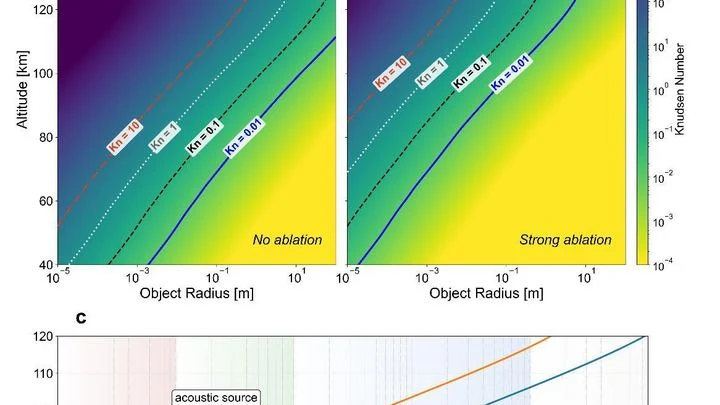
A pebble the size of a grape enters the atmosphere almost tangentially and skims across the sky without falling. That's exactly what happened to a meteoroid weighing about 45 grams. It came in at such a shallow angle that it traveled 164 kilometers at an altitude of 92 kilometers — where the air is a million times thinner than at the surface.
Radio waves from a gamma-ray burst — the cataclysmic death of a massive star whose flash briefly outshines an entire galaxy — reach Earth polarized. This means their electric field oscillates predominantly in a single plane, like a compass needle frozen in a magnetic field.
A supernova explosion is the death of a massive star, leaving behind a gas cloud. If there's plenty of hydrogen around, the shock wave spreads like an echo from a distant gunshot.
In giant accelerators, particles zip through detectors in billionths of a second, and telling one from another requires a stopwatch of incredible precision. The new µRWELL-PICOSEC detector acts as such a stopwatch: it captures the moment a particle passes with a precision of 48 picoseconds: that's 48 trillionths of a second.
The Universe is expanding, but at what speed? Astronomers have been arguing for decades about the precise value of the Hubble constant. Two classic methods give slightly different results. Now there's a third — using mysterious radio bursts.
Cosmic rays are not light but charged particles bombarding Earth from all directions. Most of them are protons (hydrogen nuclei), but heavier nuclei also show up: helium, nitrogen, iron.
A gamma-ray burst is like a shot from a cosmic cannon: a brief but dazzling flash that outshines an entire galaxy for a few seconds. But when observed in the hardest gamma-ray band (photons with energies above a gigaelectronvolt), the signal often gets lost in the noise, like a whisper in a noisy hall.
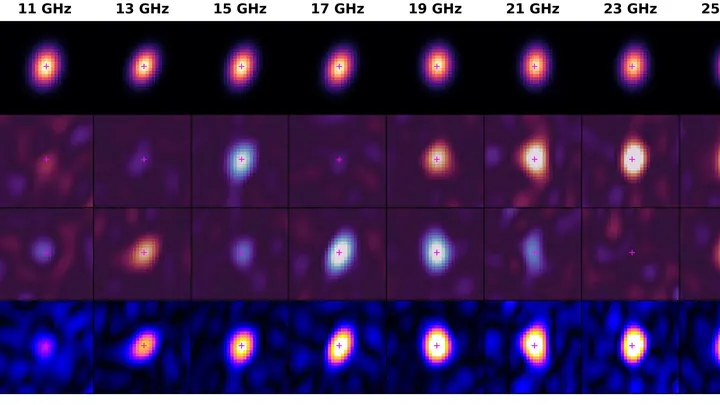
The night sky is no longer as quiet as it used to be. Thousands of satellites are whizzing overhead, and each one can accidentally emit radio waves, interfering with astronomers trying to listen to distant galaxies. To make sense of this noise, scientists pointed the 21CMA radio telescope in China at Starlink satellite passes.
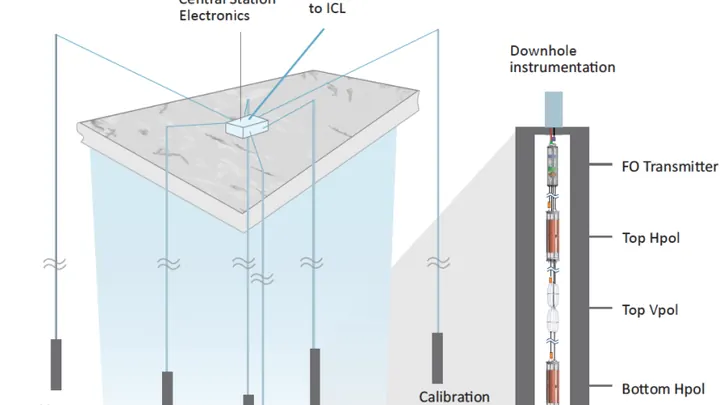
Deep within the Antarctic ice, at depths where sunlight never reaches, antennas hang suspended. They listen not for sounds but for radio waves, waiting for a signal from a particle that is nearly impossible to catch. A neutrino passes through the Earth like a bullet through fog, but occasionally, very rarely, it grazes an ice atom.
When a planet passes in front of its star, some starlight filters through its atmosphere. Gases in the atmosphere block certain colors and let others through, like the colored glass of a stained-glass window. By seeing which colors are dimmed, you can figure out what the air of a distant world is made of.
For the first few hundred million years after the Big Bang, the universe was dark: there were no stars yet, and space was filled with cold hydrogen. This gas emits radio waves at a wavelength of 21 centimeters — like a quiet whisper that reaches us across 13 billion years.
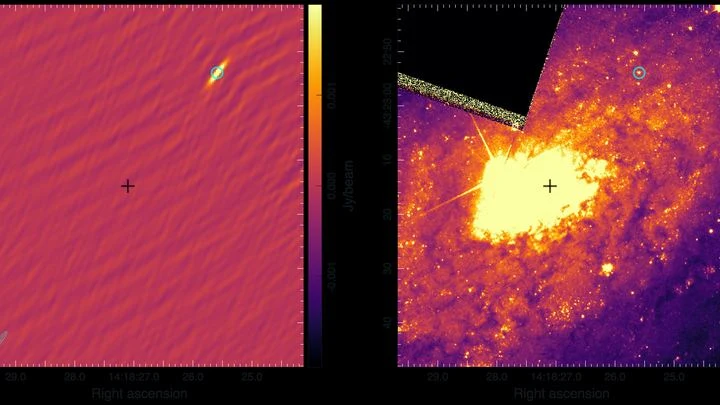
In the Andromeda galaxy, our Milky Way's nearest large neighbor, astronomers have spotted giant cold clouds where stars are born. These clouds are made of gas and dust, but seeing them directly is tricky: they barely shine.
Radio telescopes scattered across the globe pick up waves from distant black holes. But two telescopes placed almost side by side see only a blurry blob — fine details are beyond them. Usually, such pairs are considered useless and discarded. But that's a mistake: even a blurry blob holds clues.
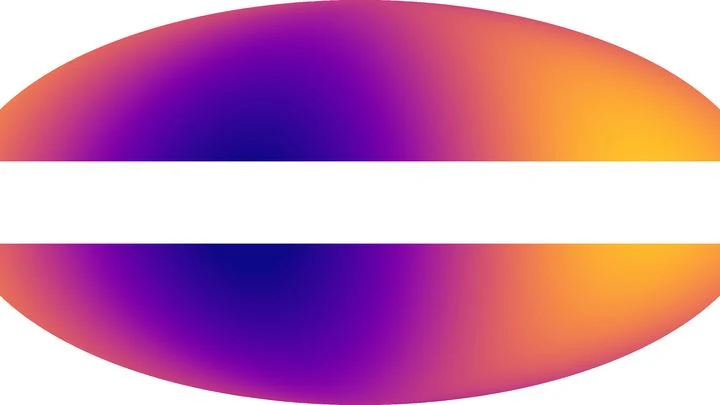
A distant radio signal travels toward us through gas, and the more gas it encounters, the more the signal is 'slowed down.' Astronomers use this to weigh the invisible envelope of our Galaxy: its halo. But if the halo is uneven, like a thick scarf draped over the shoulders, measurements in different directions will differ.
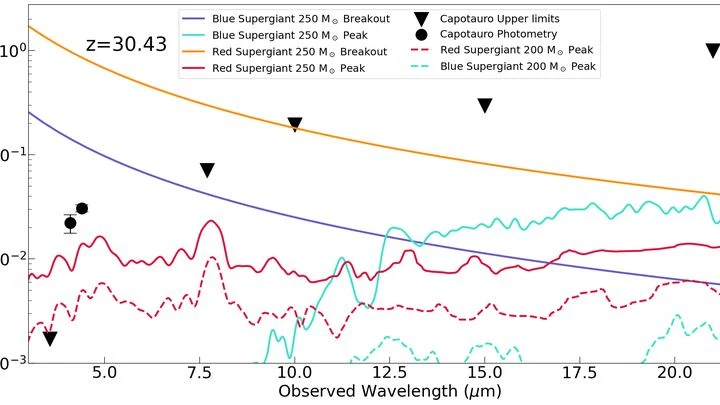
The James Webb Space Telescope spotted bright points of light from an era just 100–300 million years after the Big Bang. At first they were taken for distant galaxies, but now a hypothesis suggests they might be lone fireworks — explosions of the very first stars.
Fast radio bursts are millisecond-long cosmic signals. Previously, searching for them was like blindly tuning a radio dial. The EDEN neural network sees the entire frequency spread and recognizes the burst pattern like a musician reads notes. On source FRB 20121102A, it found 5,927 bursts — three times more than before.