Quarks in a Crowd: The Recipe for a Solid Core express
Inside a neutron star, matter is squeezed so hard that atomic nuclei stop being separate clumps. Neutrons and protons get closer together, and their innards, quarks, begin to feel their neighbors through the walls of their 'bags'.
When density reaches several times nuclear density, quarks no longer fit inside individual baryons. This gives rise to quark matter: quarks move freely throughout the volume, but at the slightest disturbance they instantly lock back into neutrons or protons. It's like a packed rush-hour bus: passengers stand shoulder to shoulder, but when the bus brakes suddenly, they grab each other, forming temporary clusters.
The authors built an idealized model called IdylliQ that shows how the filling of quark states—'quark saturation'—makes matter suddenly stiffen. Pressure grows faster than energy density, and the speed of sound jumps to unexpectedly high values. This matches observational data: neutron stars turn out to be more massive and stiffer than old theories predicted.
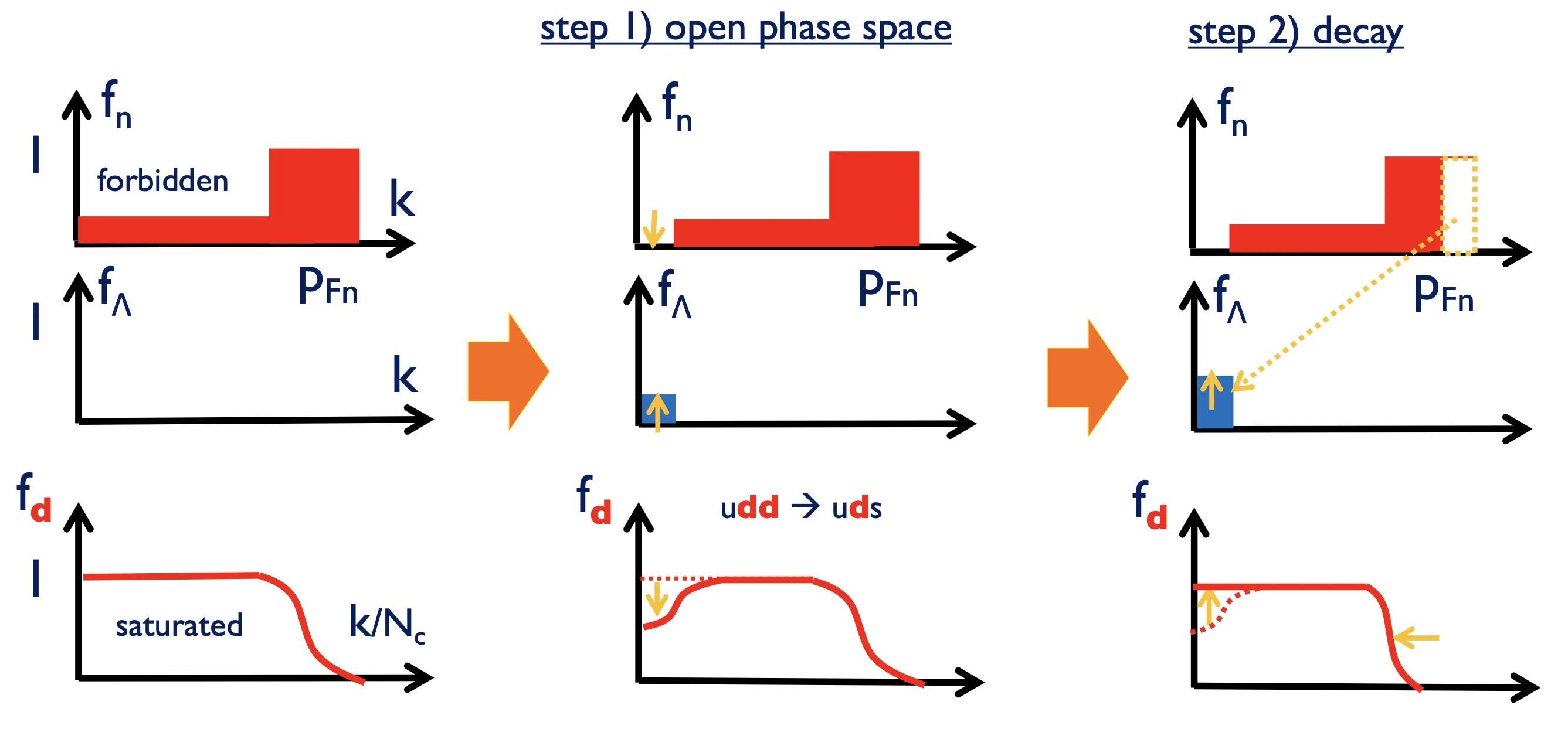
When hyperons, heavy relatives of neutrons, are added to the mix, they usually soften the star, making it unable to support a large mass. But quark saturation introduces an effective repulsion between different baryon species. Hyperons can no longer multiply freely, and the softening problem resolves itself.
If you could take a piece of quark matter and let it go, it would instantly explode into a cloud of ordinary particles — quarks just can't stand being alone.
In Robert Forward's novel Dragon's Egg, life on the surface of a neutron star is depicted, where matter made of quarks and nuclei behaves bizarrely under monstrous gravity.