Color superconductivity is a theorized state of matter that occurs in quark matter at extremely high densities, such as inside neutron stars. Under these conditions, quarks—the fundamental constituents of protons and neutrons—pair up to form Cooper pairs, analogous to electrons in a conventional superconductor. This pairing allows the quark matter to flow without resistance, exhibiting superfluidity and superconductivity. The term 'color' refers to the strong force charge (red, green, blue) that quarks carry, and the pairing pattern is dictated by the color structure of the strong interaction.
History
The concept was introduced in 1977 by Bertrand Barrois and independently by Steven Frautschi, but it gained prominence in the late 1990s with detailed studies by Mark Alford, Krishna Rajagopal, and Frank Wilczek, who identified the CFL phase.
How it works
At densities several times nuclear saturation, the strong force becomes weak enough (due to asymptotic freedom) that quarks near the Fermi surface can form Cooper pairs via gluon exchange. The pairing is in the color-antisymmetric channel, leading to a condensate that breaks the color symmetry. The most studied phase is the Color-Flavor-Locked (CFL) phase, where quarks of all three flavors (up, down, strange) pair in a symmetric pattern. This condensate gives mass to gluons via the Higgs mechanism, making the color force short-range, and allows the quark matter to behave as a superfluid.
In practice
While not directly applicable on Earth, color superconductivity is crucial for understanding the interior of neutron stars, their cooling, and the possible emission of gravitational waves from their oscillations.
Fun fact
In the CFL phase, the quark matter is so dense that a teaspoon of it would weigh about a billion tons, and it would be a perfect superfluid, flowing without any viscosity.
Deep inside a neutron star, where matter is compressed to the density of an atomic nucleus, neutrons form a superfluid and protons form a superconductor. A neutron vortex is a quantized vortex in the superfluid, akin to a miniature whirlpool that cannot stop spinning.
At low temperatures, many materials become superconductors — current flows without resistance. But how exactly does this happen if electrons were initially trapped in an insulator? Half a century ago, Philip Anderson suggested that the answer lies in a special quantum dance of particles.
The proton is not a solid ball but a tiny prison. Inside it, three quarks are locked up, and the gluon field keeps them from escaping — something like invisible threads that only grow stronger if the quarks try to move apart.
A handful of sand in your fist: the grains press against each other, and your hand can't squeeze any further. Ordinary matter behaves similarly. But in a neutron star, compression is billions of times stronger — atoms are crushed, electrons are squeezed into protons, and nearly all space is filled with neutrons.
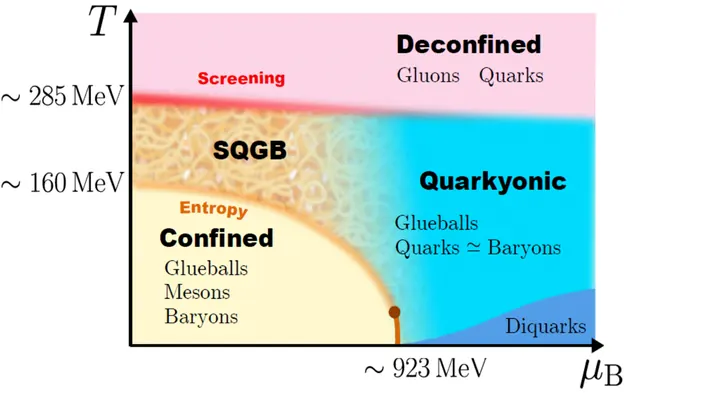
Neutron stars are cosmic alchemical retorts: at supranuclear densities, hadrons melt into quark-gluon plasma (QGP), and at the very core where pressure peaks, a color superconductor (CS) is born.
Inside a neutron star, matter is squeezed so hard that atomic nuclei stop being separate clumps. Neutrons and protons get closer together, and their innards, quarks, begin to feel their neighbors through the walls of their 'bags'.
A neutron star is a sphere about the size of a small city but with a mass of one and a half Suns.
If you squeeze a handful of sand down to the size of a pinhead, it turns into a rock. But squeeze it even harder, to the density of an atomic nucleus, and the grains lose their identity. Protons and neutrons dissolve, and the stuff becomes a soup of free quarks.
If you try to break a proton apart and pull out a quark, you're in for a surprise. Ordinary forces, like the electric force, weaken as particles fly apart. Here, it's the opposite. The farther a quark gets from its neighbors, the harder it's pulled back.
Picture a packed bus where every passenger is an electron. In a superconductor, passengers pair up and move in sync, losing no energy. But in high-temperature superconductors like cuprates, this idyll only works when extra passengers are added. If you drop some off, the pairs start acting strangely.
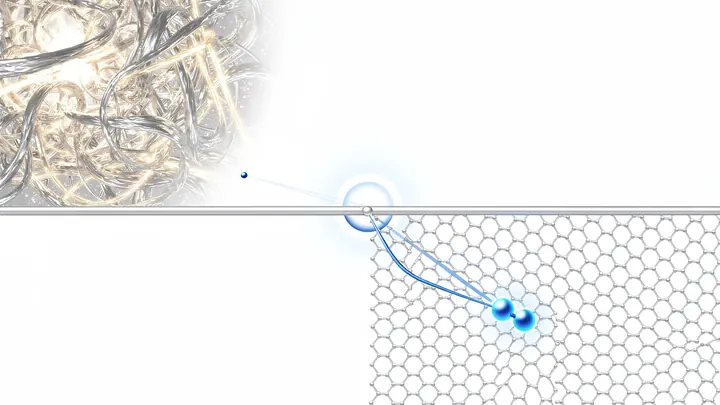
In a superconducting resonator, light doesn't just bounce around: it embraces the qubit so tightly that their joint dance can no longer be described by old textbooks. The researchers took an indium arsenide nanowire, turned it into a superconducting qubit, and placed it inside a microwave resonator.
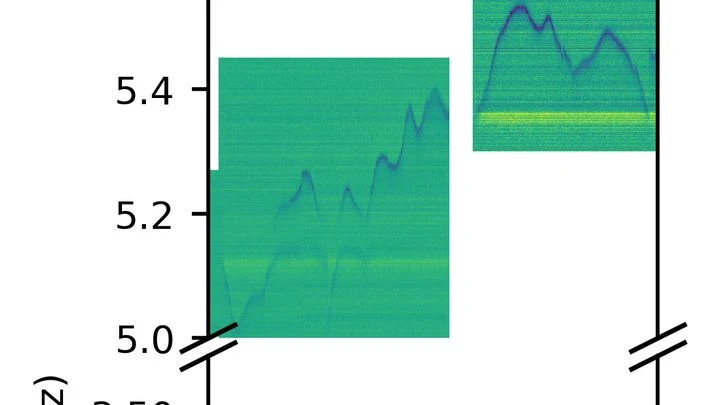
The surface of the uranium compound UTe2 crystal looks like a frozen sea: in some places, electrons move freely; in others, they get stuck near atoms. A scanning tunneling microscope, a device that probes the surface with an atomically sharp tip and senses individual electrons, revealed that this landscape is not random.
Inside some materials, electric current flows with zero resistance. These are superconductors, and they only work when it's very cold. Copper oxides are special: they stay superconducting at somewhat higher temperatures, but why has been a puzzle for forty years.
Ordinary light is a stream of independent particles: photons fly through each other without noticing their neighbors. But in superconducting circuits cooled to near absolute zero, the situation changes. There, photons travel along narrow metal tracks, and if tiny elements called Josephson junctions are embedded in these tracks, light begins to 'feel' itself.
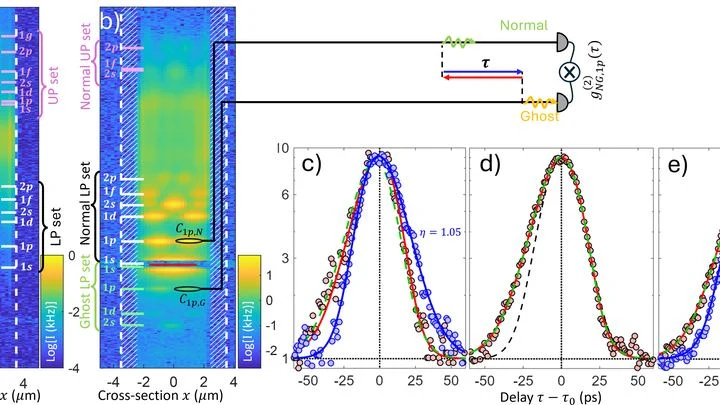
Inside a tiny mirrored cavity, smaller than the thickness of a hair, light is trapped and bounces off the walls many times. If you place a material that can absorb and emit light inside, the light particles (photons) start to 'dress' in excitations of the material — this is how polariton modes are born.
Water in a kettle heats to 100 degrees, and stops being water, turning into steam. Something similar happens to atomic nuclei when they are smashed together at enormous speeds in the Large Hadron Collider.
Two beams of light, red and blue, enter a tiny ring made of silicon nitride. The ring is smaller than the thickness of a human hair. At the input, both beams are equally bright. But inside the ring, one of them suddenly starts to outshine the other, like two equally matched people in a debate where one unexpectedly gains the upper hand.
Quantum particles in a strongly disordered environment behave like dancers executing steps in sync: each knows its own move and never collides with others. This kind of coordinated, frictionless flow, superfluidity, unexpectedly emerged in an experiment on a superconducting quantum chip.
A supersolid is ice that flows. Think of a pond with a frozen crust, but beneath it, a liquid depth without friction. Usually, creating that crust means changing the liquid's properties throughout its entire volume.
The Penrose tiling, assembled from two types of tiles, covers a plane without a repeating pattern — a mathematical marvel discovered by Roger Penrose that has found physical embodiment in the quantum world. Researchers modeled a chain of particles interacting according to a rule reminiscent of Fibonacci numbers and the golden ratio.
Ordinary wires: electrons jostle, lose energy, and heat up: that's resistance. In superconductors, some electrons pair up in sync, like dancers swirling without collisions. But these pairs hide: you can't see them directly, only infer their presence from flawless coordination.
A superconducting qubit, a tiny loop with zero resistance, crunches problems faster than you can blink. But cut the power, and everything it has calculated vanishes. Like a chef who cooks without writing down the recipe: as long as he's at the stove, he remembers every step, but an hour later — nothing.
The authors of the study propose writing the result into diamond.