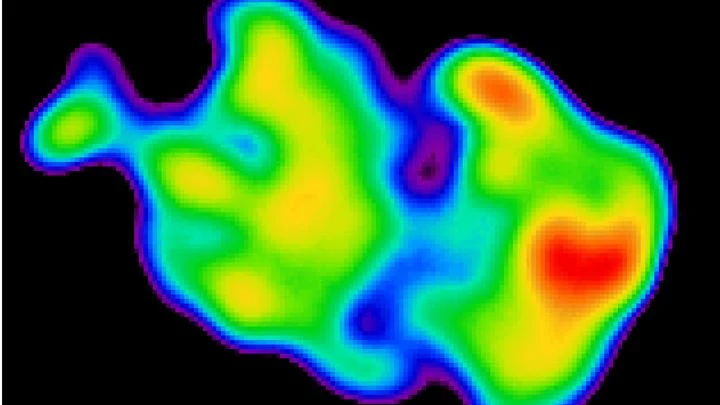
A quarkstar is a hypothetical type of compact star composed primarily of quark matter — a state of matter where quarks are no longer confined inside protons and neutrons but exist freely. This could occur in the cores of neutron stars if the pressure becomes so extreme that nucleons dissolve into their constituent quarks. Quark stars would be denser and smaller than neutron stars of the same mass, potentially explaining some observed stellar remnants that seem too compact to be ordinary neutron stars.
History
The concept was proposed in the 1970s by physicists like Edward Witten and others, who speculated about strange quark matter being the true ground state of matter. The term 'quark star' became more prominent in the 1980s and 1990s as astrophysicists sought explanations for certain pulsar observations.
How it works
In a neutron star, gravity compresses matter to densities several times that of an atomic nucleus. If the density exceeds a critical threshold, the neutrons themselves may 'melt' into a soup of up, down, and strange quarks. This quark matter would be stabilized by the strange quark's presence, forming a self-bound state that could exist even without external pressure. The resulting star would have a sharp surface and a different mass-radius relationship than a neutron star.
In practice
Quarkstars are studied in astrophysics to interpret observations of compact objects, such as the mass and radius measurements of neutron stars from X-ray and gravitational wave data, helping constrain the equation of state of dense matter.
Fun fact
If quarkstars exist, they might be covered by a thin crust of ordinary nuclear matter, and their surface could be so hard that it would be like a mirror for X-rays, making them appear as 'strange' X-ray sources.
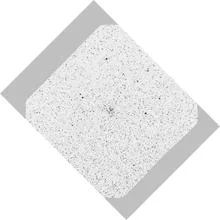
In the stellar family of the Phoenix galaxy, there are five old globular clusters, and the sixth child was long considered a foundling. The object Fornax 6, located just 270 parsecs from the galaxy's center, looked like a random clump of field stars or a compact group of distant galaxies. Astronomers argued over whether it deserved to be called a cluster.
At the center of a neutron star, matter is compressed so tightly that a teaspoon weighs a billion tons. You'd think there's no better place to look for signs of quantum gravity. But between the laboratory and the fundamental scale lies a chasm of 10⁸⁰ in density.
Three doors lead into this room.
A handful of sand in your fist: the grains press against each other, and your hand can't squeeze any further. Ordinary matter behaves similarly. But in a neutron star, compression is billions of times stronger — atoms are crushed, electrons are squeezed into protons, and nearly all space is filled with neutrons.
In June 2024, the CHIME radio telescope recorded over 700 radio bursts per hour from source FRB 20240114A. Such a hyperactive repeater releases in one hour nearly all the magnetic energy of a typical magnetar (a neutron star with an ultra-strong field).
Spacetime is not empty: it shivers. After the Big Bang, the universe was filled with a hum of gravitational waves, like the low rumble of a giant bell. In this ripple, as it turns out, particles of dark matter, the invisible substance that holds galaxies together, can be born.
But the previous idea had a snag.
In the microscopic world of the strong interaction, nature's most powerful glue, quarks never wander alone. Over large distances, they stick together into the protons and neutrons we know. But under extreme compression, like in the depths of a neutron star, this glue creates far more exotic forms of matter.
Neutron stars are cosmic 'ice cubes' of unimaginable density: a tablespoon of their material would outweigh Mount Everest. It was a mystery what lay in their cores: ordinary neutron matter (a giant atomic nucleus) or exotic quark matter, where particles are not bound into neutrons.
Inside a neutron star, matter is squeezed so hard that atomic nuclei stop being separate clumps. Neutrons and protons get closer together, and their innards, quarks, begin to feel their neighbors through the walls of their 'bags'.
A neutron star is a sphere about the size of a small city but with a mass of one and a half Suns.
For a long time, a void yawned in the family of ultra-dense remnants of dead stars. Neutron stars, swift city-sized tops, rarely weigh more than two Suns. Black holes start at about five solar masses. Between them lies a 'gap' where for decades no object could be found.
If you squeeze a handful of sand down to the size of a pinhead, it turns into a rock. But squeeze it even harder, to the density of an atomic nucleus, and the grains lose their identity. Protons and neutrons dissolve, and the stuff becomes a soup of free quarks.
At the center of almost every large galaxy lurks something supermassive and dark. Most often, that something is thought to be a black hole — a region where gravity is so strong that even light cannot escape. But what if it's not a black hole, but a dense ball of ultralight particles — a boson star?
The core of a neutron star can be likened to a taut string of super-nuclear density. Sound traveling along it is the oscillation of pressure, whose speed $$c_s$$ betrays the stiffness of matter. New research shows that this cosmic string does not hum monotonically.
Ordinary matter consists of atoms, and atoms are made of nuclei and electrons. But in a neutron star, gravity compresses matter so strongly that electrons are squeezed into protons, and almost everything turns into a dense packing of neutrons. It's like one giant atomic nucleus the size of a city.
Every isolated quantum system inevitably moves toward thermal equilibrium — a state where all details of the past are erased. It’s like an orchestra: instead of a symphony, it starts playing white noise — random but statistically predictable notes.
An atomic nucleus is like a droplet with a thin coating — a neutron 'skin.' Inside the droplet, protons and neutrons are mixed evenly, but on the outside, like the froth on milk, a layer forms where neutrons are noticeably more abundant.
A neutron star is the collapsed core of a massive star, squeezed to the size of a city. In its heart, matter is packed so densely that atoms cease to exist, and protons and neutrons dissolve into a sea of quarks.
In a gas cloud left after a star exploded (called a supernova remnant), astronomers noticed a giant glowing letter S. It was drawn by two jets of superheated material ejected during the cataclysm. These jets didn't just shoot straight out — they slowly spun like a top, which bent their path into curves.