Quantum Cat Made of 120 Photons express
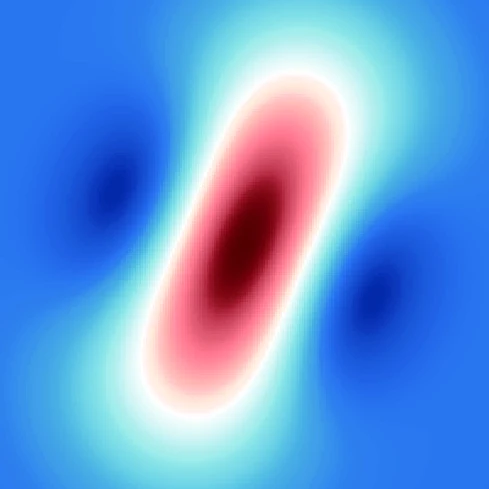
The quantum cat is a state of light proposed by Schrödinger: photons behave like a spinning coin, seen as both heads and tails at once. Physicists have created such a 'coin' from 120 photons, racing at the speed of light in a light trap. Usually, a large system quickly collapses into one option due to increasing disorder (entropy).
The solution proved elegant: a quantum switch (qubit) was coupled with the light and a mathematical trick was applied that naturally maintains balance. Even with noise, accuracy exceeded 96%, and without noise the method is flawless. Astonishingly, the previous record of 40 photons has been tripled. Such large cats will help probe the boundary between quantum wonders and the familiar world, and also serve as ultra-sensitive sensors and the basis for fault-tolerant quantum computers, building on the work of von Neumann. The assessment of duality comes from a special technique invented by Wigner.
Original abstract
as written by the authors arXiv:2606.03293
Large-size cat states are especially meaningful and fundamental for exploring the quantum-to-classical transition, as well as promising resources for quantum metrology and fault-tolerant quantum computation. However, amplifying the magnitude of cat states remains challenging because of the growing fragility under decoherence. We propose to generate large cat states by using the dynamical invariant of hybrid qubit-bosonic systems under Hermitian or non-Hermitian time-dependent Hamiltonian. It is a study with the universal quantum control (UQC) theory, in which the system dynamics is analyzed in the ancillary picture via a unitary transformation conditional on the qubit state. The controllable dynamics that can be encoded in the evolution of the dynamical invariant is presented by the Heisenberg equation, which imposes constrains on the Hamiltonian. When the qubit is prepared in a balanced superposed state, the bosonic mode can evolve deterministically from the vacuum state to the cat state of a mean photon number over $$120$$. In the Hermitian case, the generation is perfect; and in the non-Hermitian case, the fidelity is over $$0.962$$. Our protocol can also be applied to the generation of the intrinsic cat states and the four-component cat states of large size. Through the preparation of macroscopic quantum states, our work essentially advances UQC to hybrid discrete-continuous variable systems.
The previous record for cat light was about 40 photons. The new result triples that number.
In 'The Quantum Thief' by Hannu Rajaniemi, quantum states store identities — large cat states could be a step toward such exotica.