Quantum Cat from 120 Photons: Macroscopic Superposition of Light express
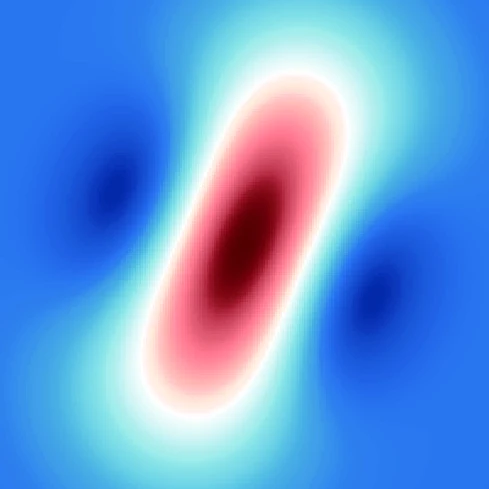
A quantum cat is a special state of light, the idea of which was proposed by Erwin Schrödinger in his famous thought experiment. Here, photons behave like a spinning coin that an observer sees as both heads and tails at once — a vivid analogy for quantum superposition, where a system exists in two mutually exclusive states simultaneously. Physicists have managed to create such a 'coin' from 120 photons racing at the fundamental speed of light inside an optical trap. Usually, a large system quickly collapses into one definite state due to growing disorder — entropy, which in the quantum world manifests as decoherence, destroying fragile superposition upon interaction with the environment.
The solution turned out to be elegant: a quantum switch (a qubit, the elementary unit of quantum information) was coupled to the light, and a mathematical trick was applied that automatically maintains the balance of the superposition. This method actively counteracts the growth of entropy, stabilizing the state. Even with noise, accuracy exceeded 96%, and under ideal conditions the method is flawless. Remarkably, the previous record of 40 photons has been tripled. Such large 'cats' will help probe the boundary between quantum wonders and the familiar classical world, and also serve as ultra-sensitive sensors and the basis for reliable quantum computers, building on the work of John von Neumann, who laid the mathematical foundations of quantum mechanics. The duality of the state is assessed using a special technique invented by Eugene Wigner, which allows quantitative measurement of the degree of superposition.
The previous record for cat light was about 40 photons. The new result triples that number.
In Hannu Rajaniemi's novel 'The Quantum Thief', quantum states are used to store personalities — large cat states could be a step toward such exotic technology.