Stellar composition evolution refers to the changes in the chemical makeup of a star over time, driven not only by internal nuclear fusion but also by external interactions such as collisions, stellar winds, and binary companion dynamics. While a star's core slowly fuses lighter elements into heavier ones, its surface composition can be dramatically altered by accreting material from a companion, losing mass via strong winds, or even merging with another star. These processes can create stars with unusual surface abundances, like carbon-rich or metal-poor signatures, that differ from what simple stellar evolution models predict.
History
The concept gained prominence in the mid-20th century as astronomers began observing binary stars with anomalous abundances, leading to the realization that mass transfer and wind processes could alter stellar surfaces. Key theoretical work by A. G. Massevitch and others in the 1950s–1960s laid the foundation for understanding these effects.
How it works
In binary systems, a more massive star can transfer mass onto a smaller companion, polluting its outer layers with hydrogen, helium, or heavier elements. Conversely, strong stellar winds from a massive star can strip away its outer envelope, exposing deeper layers that have been processed by nuclear fusion. In more extreme cases, collisions or mergers between stars can thoroughly mix their interiors, producing a single star with a blended chemical composition. These mechanisms act on timescales from millions to billions of years, depending on the system's mass and separation.
In practice
Understanding composition evolution is crucial for interpreting stellar populations in galaxies, dating star clusters, and predicting the final fates of binary systems, including those that produce supernovae or gravitational wave sources.
Fun fact
Some stars, called 'carbon stars,' owe their carbon-rich atmospheres to material dredged up from their interiors or transferred from a companion, making them look strikingly red compared to typical stars.
The star AB Aur is young, about 4 million years old. Around it swirls a dense disk of gas and dust. Recently, a long gas stream, a flow of material from the surrounding cloud, crashed into it.
When the JWST telescope breaks the light of a distant exoplanet into a spectrum, it reads a chemical chronicle. But this chronicle is not a monolithic truth; it's an atmosphere constantly rewritten by the star's radiation.
Forget the familiar images of planetary cores — a sharp boundary between rock and gas is a thing of the past. The Juno probe, diving into Jupiter’s gravitational field, and Cassini, into the embrace of Saturn, discovered that heavy elements are not gathered at the center but smeared over a vast region, as if someone carelessly shook a cocktail.
At the center of attention are tiny stellar cities: ultra-faint dwarf galaxies. They resemble sparse swarms of fireflies circling within a vast invisible cloud. This cloud is a halo of ultralight dark matter. Its particles are so light that they behave not like billiard balls but like waves.
Putting together the Solar System is like crafting a high-end tasting menu: the recipe isn't always set in stone — sometimes the final ingredient is added while the dish is already cooking.
The outer crust of a neutron star is like a layered cake, where each layer is a strictly defined filling. It's a crystalline lattice of atomic nuclei immersed in a sea of electrons. The deeper you go, the stronger the pressure, and the heavier the nuclei that can exist there without falling apart.
Chondrules look like frozen raindrops made of stone. They're about the size of a grain of sand, but they record the history of the first few million years of the Solar System. Once, these droplets floated in the scorching gas around the young Sun, then clumped into asteroids and fell to Earth as meteorites.
No one has ever seen dark matter, but every galaxy feels its pull. Usually, it's pictured as a sea of identical, silent particles. The new work paints a livelier picture: two kinds of particles, heavy and light, constantly exchanging between them.
In a large gas cloud where stars are born, the magnetic field lines are roughly aligned in one direction, like the fibers in a piece of felt. But look inside, into the dense clumps that will eventually become stars, and the picture changes: there the lines are twisted every which way, like a ball of yarn after a kitten has played with it.
In the cold outer reaches of the Solar System, water is considered the main building material for ices. But some comets and distant icy bodies have an unusually high ratio of carbon monoxide (CO) to water, as if a scoop of ice cream suddenly had too much syrup. The authors of a new study set out to find where this imbalance comes from.
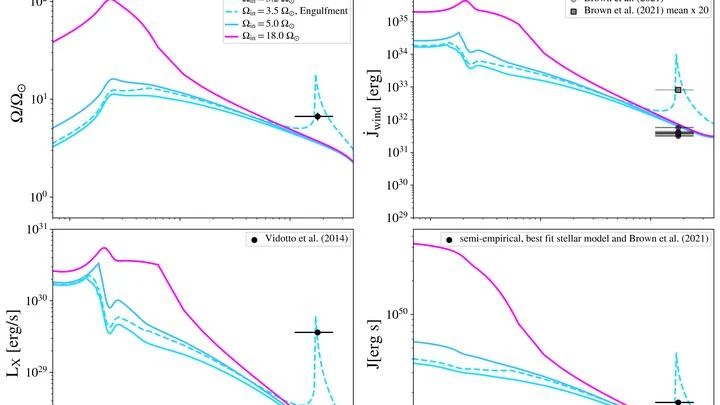
GJ 504, a star almost the same age as our Sun, is spinning with remarkable vigor: it completes a full rotation in just 3.4 Earth days, while actively emitting X-rays. For comparison, typical stars of the Sun's age rotate much more slowly, as if they've lost their youthful energy. GJ 504, however, behaves like a figure skater who has received a powerful push and launched into a rapid spin.
A young star is surrounded by a flat, rotating disk of gas and dust — the construction site for future planets. The disk lives its own life: gas flows toward the star, dust clumps together, and from outside, harsh ultraviolet light from neighboring hot stars presses down on it all, like wind blowing leaves off a path.
In a star cluster, like on a crowded dance floor, massive stars rarely stay single. More often they whirl in pairs or triples, and the distance between them can be less than from Earth to the Sun. But how do they manage to get so close to each other?
Simulations showed: it's all about the disk of gas and dust that envelops the pair. This disk, like a drain funnel, swirls the stars and slowly pulls them inward.