How Spin and Hidden Companions Confuse Stellar Ages express
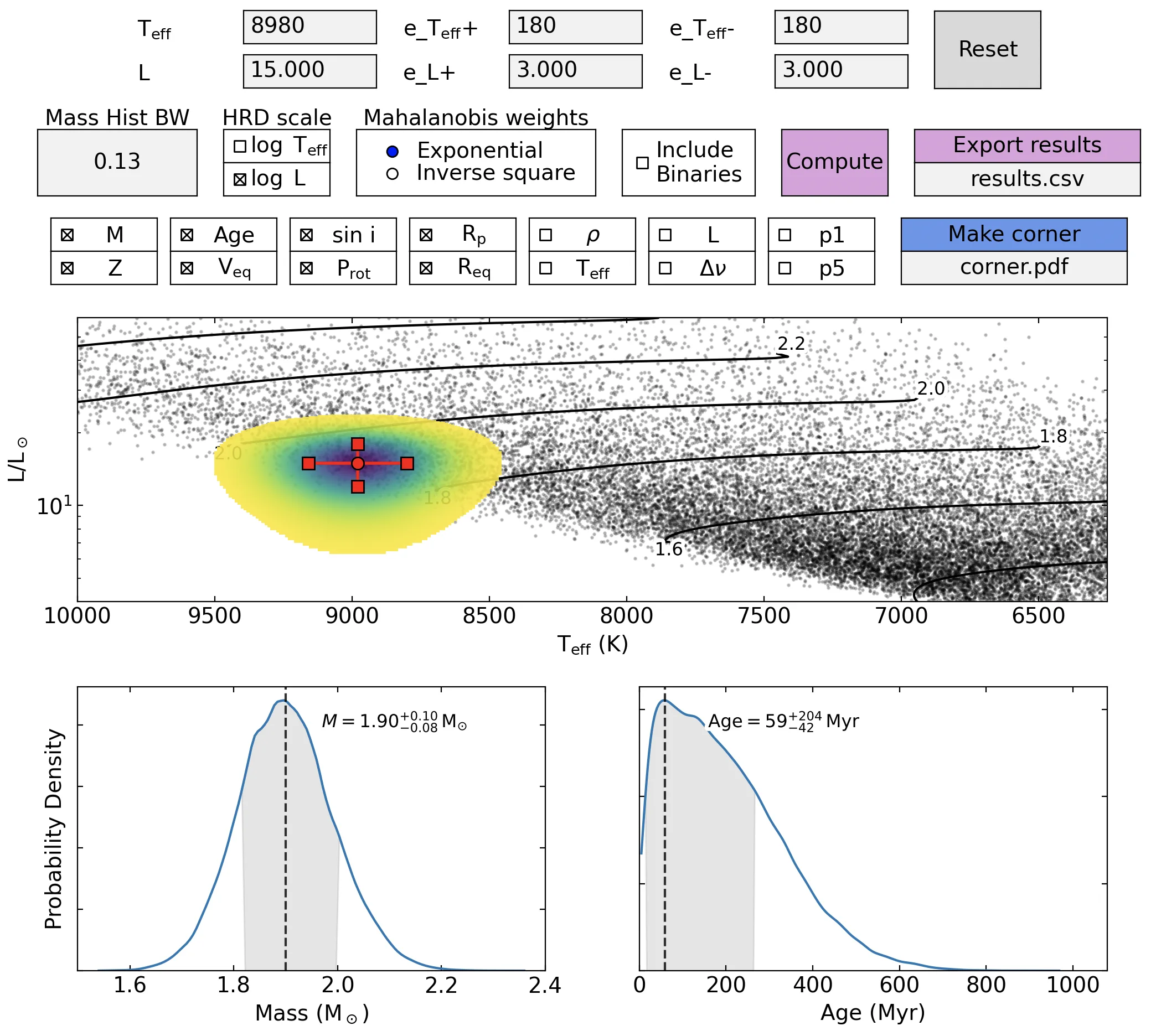
Imagine a person in an old photograph standing in a crowd while spinning — guessing their age would be nearly impossible. That's roughly how astronomers determine the ages and masses of distant stars, and they often get it wrong. For stars slightly heavier than the Sun (from 1.4 to 2.5 solar masses), standard methods like chemical-composition 'clocks' work poorly. Instead, scientists use stellar life charts — isochrones (lines where stars have the same age and composition but different masses)—and fit them to observational data. But these charts ignore two important distortions: rapid rotation and the possibility that a star is not alone but paired with an invisible neighbor.
The authors of the new study built a virtual star factory. They created thousands of model stars with varying rotation speeds, masses, axis tilts, and probabilities of having companions. Then they 'observed' these stars the way telescopes do and checked how much the standard isochrone grids err. It turned out that for young stars just arriving on the main sequence (like our Sun but at the start of its life), ages are underestimated by a factor of two or more. For stars that have lived more than 10% of their lifespan, ages are overestimated by about 31%, with a spread of 27%. Mass is confused on average by a tenth of a solar mass — seemingly small, but critical for planets.
Exoplanets, planets around other stars, directly depend on their star's properties. If we get age and mass wrong, we misjudge whether a planet could be habitable, how it evolves, and even whether we can detect it at all. The RAPID tool, created by the authors, lets you quickly estimate from observational data how likely various masses and ages are, already accounting for rotation and possible binarity. It's like getting not just one photo but a whole album with corrections for motion and company.
A star that rotates very fast can complete a full turn around its axis in a few hours — our Sun takes nearly a month to do the same.