Asteroseismology is the study of the natural oscillations of stars. Just as seismologists use earthquakes to probe Earth's interior, astronomers use stellar vibrations to infer the internal structure, composition, and evolution of stars. These oscillations, often caused by turbulent convection or magnetic activity, create subtle periodic changes in a star's brightness or surface motion. By analyzing these pulsations, scientists can determine a star's mass, radius, age, and even its internal rotation profile, turning distant points of light into objects with a known 'heartbeat'.
History
The field began in the 1960s with observations of the Sun's five-minute oscillations, but it expanded to other stars in the 1980s and 1990s with the advent of space missions like CoRoT and Kepler, which provided continuous, high-precision photometry.
How it works
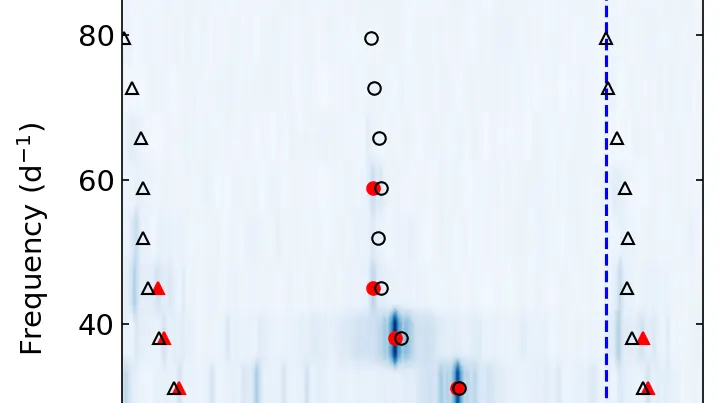
Stars vibrate in specific resonant modes, similar to how a bell rings at particular frequencies. The frequencies of these modes depend on the star's internal properties—denser or hotter regions transmit sound waves faster, altering the pattern of oscillations. Telescopes measure tiny brightness variations (photometry) or Doppler shifts in spectral lines over time. The resulting frequency spectrum is matched against theoretical models to deduce the star's internal structure. For red giants, the oscillation patterns are especially rich, allowing precise age estimates that are otherwise difficult to obtain.
In practice
Asteroseismology is used to characterize exoplanet host stars, providing accurate stellar radii and ages that are critical for interpreting planetary properties and understanding planetary system evolution.
Fun fact
The Sun oscillates with a dominant period of about five minutes, and these oscillations were first detected in the 1960s but were initially dismissed as noise in the solar atmosphere.
A star blinks every 38 seconds. This is no random twinkle: inside the white dwarf WD 0158−160, steady oscillations run like the beats of an invisible metronome. From the rhythm of those beats and the star's precise distance, astronomers have computed its mass and temperature — without ever looking at its spectrum.
A sculptor shapes mountains from magnetic fields and heat, but the stone resists. A neutron star, the ultra-dense remnant of a supernova explosion, in a binary system pulls matter from its companion star. This infalling matter heats the star's crust unevenly, while the magnetic field tugs from within.
After a supernova explosion, a dense ball the size of a city remains at the center — a newborn neutron star. It is hot, compressed, and rings like a bell after being struck. These tremors, the star's oscillations, emit gravitational ripples that sensitive detectors on Earth can catch.
A sunspot, a dark island on the fiery surface, lives its own turbulent life. Beneath it, in invisible depths, giant magnetic loops drift like twisted cables. When such a loop emerges, it can discharge as a flare, and hurl clouds of charged particles into space.
Scientists have long tried to understand what determines the strength and suddenness of these events.
A young star cluster resembles an orchestra before a concert: each instrument tunes up in its own way, and the overall hum seems like chaos. But if you listen closely, you can pick out individual notes.
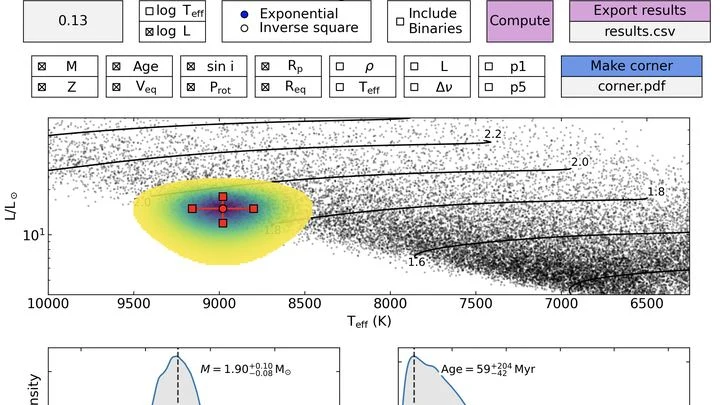
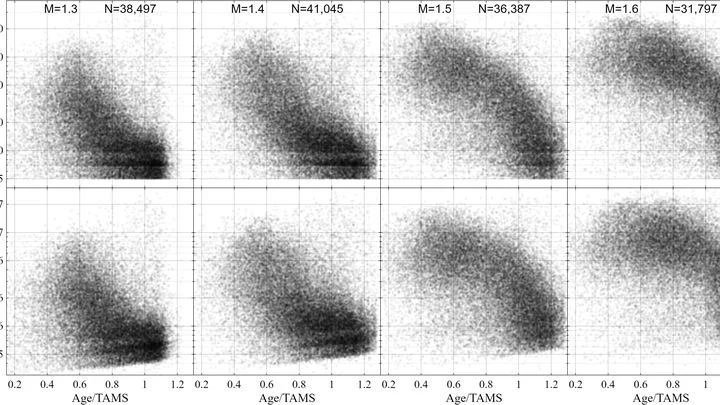
Imagine a person in an old photograph standing in a crowd while spinning — guessing their age would be nearly impossible. That's roughly how astronomers determine the ages and masses of distant stars, and they often get it wrong. For stars slightly heavier than the Sun (from 1.4 to 2.5 solar masses), standard methods like chemical-composition 'clocks' work poorly.
When two neutron stars, compressed to the size of a city, approach in their final dance, the spacetime around them comes alive, emitting gravitational waves.
The night sky looks still, but many stars tremble like a drum after a strike. For seven straight years, the TESS satellite stared at the same patches of sky and caught this trembling in 19,151 red giants — old, bloated stars. Previously, far fewer of these 'singing' giants were known, and now the list has grown by 80%.
Every molecule is like a set of building blocks: the same pieces can be assembled in different ways. Two assemblies with the same atoms but different geometry are called isomers. If one can be turned into the other by a simple rotation around a bond, they are conformers, like a bent arm versus a straight one.
A star like the Sun doesn't just shine: it hums quietly. Inside, plasma churns, and these motions make the surface rise and fall rhythmically. Catching such a tremor from Earth is nearly impossible: it gets lost in the noise of the atmosphere and the instrument itself. That's why astronomers listen to stars from space, where it's quieter.
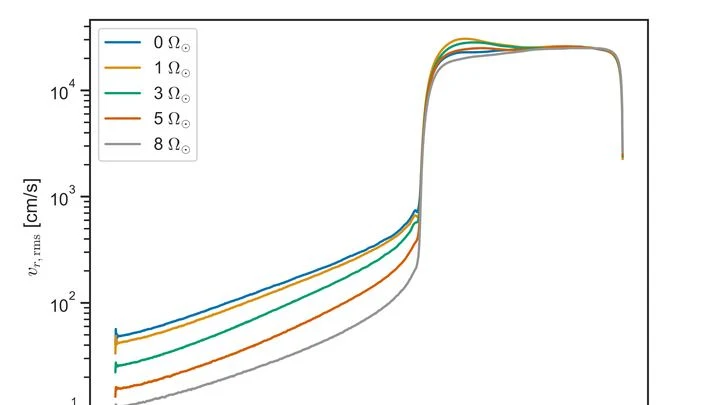
A star like the Sun hums like a bell: sound waves inside make its surface tremble ever so slightly. From this trembling, astronomers, like doctors reading a pulse, infer the star's temperature, density, and age. But the Kepler telescope spotted an oddity: many stars that spin fast and are covered in spots show no trembling at all. It's as if they've lost their voice.
The Gaia space telescope has measured how fast more than a hundred thousand stars spin. It turns out that a star's rotation speed depends on its temperature. For stars cooler than 6500 degrees, the surface moves at 10–20 kilometers per second.
A star trembles like a bell after being struck. These tremors, tiny fluctuations in brightness and surface, can be caught by a telescope. From the frequencies of these 'stellar notes,' astronomers infer what's happening inside: how old the star is, how it's structured.