Systematic uncertainty is a type of measurement error that arises from imperfect calibration, modeling assumptions, or experimental design, causing results to be consistently offset from the true value. Unlike random errors, which scatter measurements around a central value, systematic errors shift all measurements in the same direction, affecting accuracy rather than precision. In cosmology, systematic uncertainties are often the difference between a revolutionary discovery and a mundane artifact, as seen in debates over 'impossible' galaxies or anomalies in cosmic expansion.
History
The concept has been central to experimental science since the 19th century, with pioneers like Gauss and Kelvin emphasizing the need to distinguish systematic from random errors. In modern physics, systematic uncertainty became a formal discipline in the mid-20th century with the rise of high-precision particle physics and cosmology.
How it works
Systematic uncertainties enter through known or unknown biases in instruments, data processing, or theoretical models. For example, a telescope's mirror distortion or an incorrect assumption about galaxy brightness can skew distance measurements. Researchers estimate these uncertainties by cross-checking with independent methods, calibrating against standards, or simulating the measurement process. The goal is to quantify the bias and correct for it, or at least report it alongside results.
In practice
Systematic uncertainty analysis is critical in fields like particle physics (e.g., Higgs boson mass measurements), cosmology (e.g., dark energy surveys), and medical imaging (e.g., ultrasound diagnostics), where small biases can lead to incorrect conclusions.
Fun fact
In 2014, the BICEP2 team announced detection of primordial gravitational waves, but the signal turned out to be largely due to systematic uncertainty from galactic dust, a famous cautionary tale.
The early Universe was not just a hot soup of particles. In the first fractions of a second, mirror symmetry could have been broken: the world and its reflection would not be quite identical. If so, the large-scale cosmic web of galaxies would retain a barely noticeable 'curl'—as if all matter were slightly twisted in one direction.
Technological disasters like Chernobyl rarely strike without warning. They gestate for years: organizations ignore warnings, their complexity mirroring the rise of entropy — a measure of relentless chaos that builds up unnoticed until it avalanches.
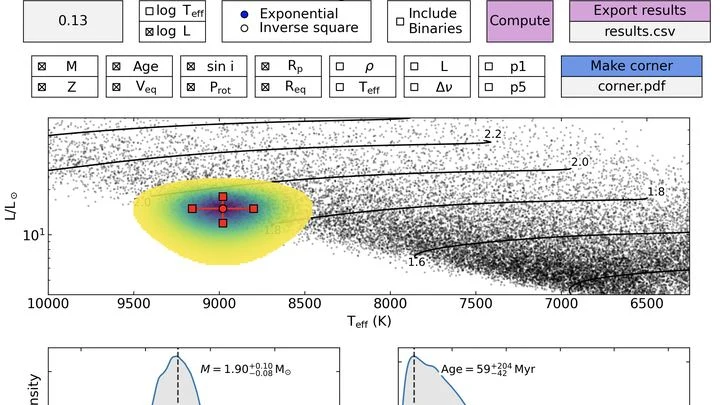
Imagine a person in an old photograph standing in a crowd while spinning — guessing their age would be nearly impossible. That's roughly how astronomers determine the ages and masses of distant stars, and they often get it wrong. For stars slightly heavier than the Sun (from 1.4 to 2.5 solar masses), standard methods like chemical-composition 'clocks' work poorly.
You can edit a cell perfectly, and it still turns out useless. The gene is fixed exactly as planned, yet the cell behaves unpredictably: it drifts, changes fate, loses safety. It's like fixing one gear in a watch, but the watch still runs wrong because the whole mechanism is out of sync.
Previously, a cell was viewed as a list of independent parts.
A neutron star is a sphere the size of a city, but it weighs as much as one and a half Suns. Inside such a sphere, matter is so compressed that a teaspoon of it would weigh billions of tons. But physicists don't fully know what this matter is made of.
The universe is a pie baked from a single recipe, but the teaspoon and the kitchen scale stubbornly show different amounts of sugar. That’s how it is with the expansion of the universe: measurements from nearby stars (the spoon) give one number, while those from the ancient light of the Big Bang (the scale) give a completely different one.