The Cosmos Twists Light express
The oldest light in the universe has been traveling toward us for nearly 14 billion years. It was born when the cosmos first became transparent, and since then its plane of oscillation has been rotating ever so slightly. The cause is an invisible ocean permeating all of space: the dark energy field that makes the universe expand faster and faster.
If this field interacts slightly with light, it acts like a giant crystal that splits a beam. The effect is called cosmic birefringence. Scientists took several mathematical descriptions of such a field, with different shapes of the "landscape" it rolls down, and compared them with two sets of observations. The first is data on how the expansion rate of the universe changed over different epochs. The second is direct measurements of the polarization rotation of that very ancient light, the cosmic microwave background.
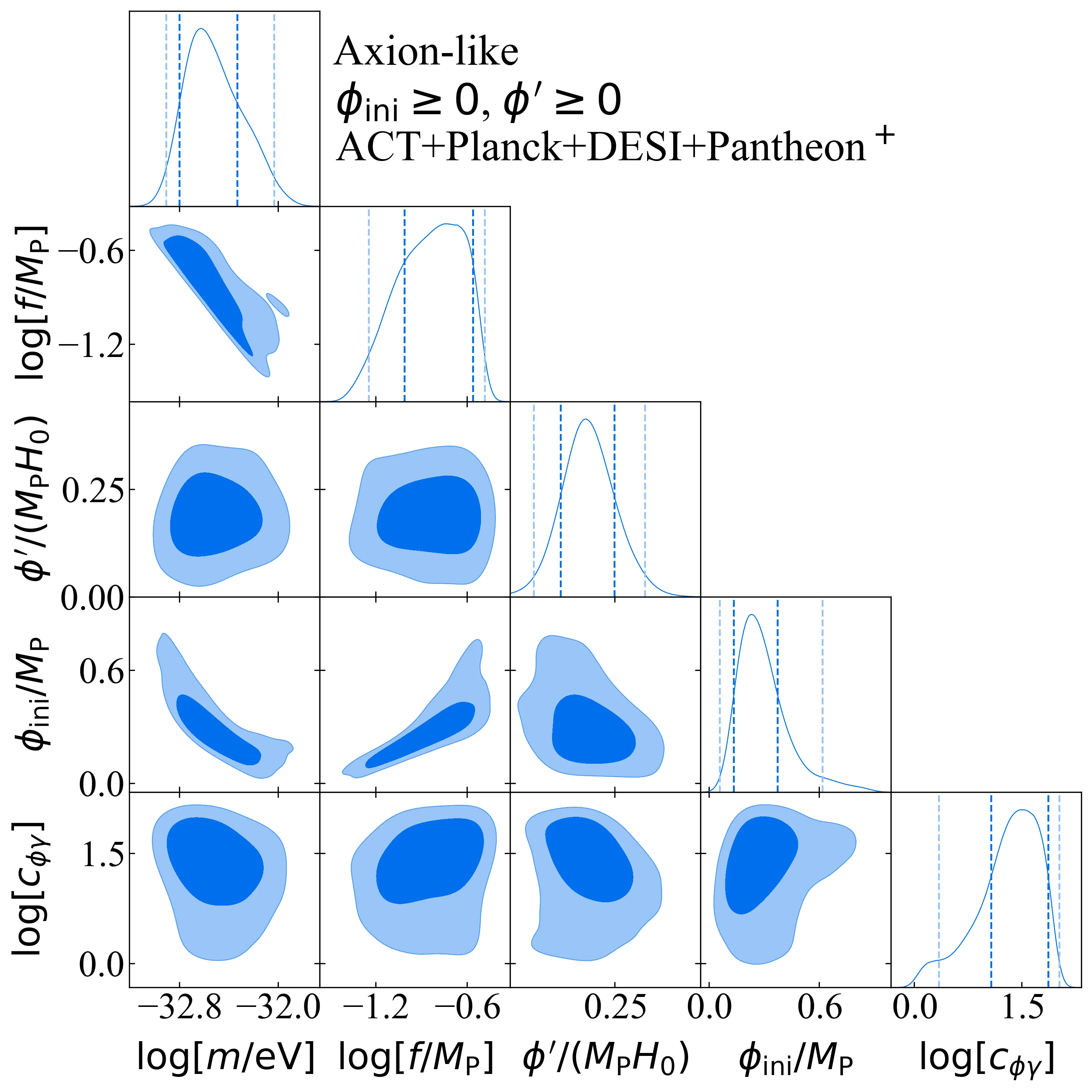
The combined analysis showed that not all models survive. The simplest one, similar to an axion (a very light particle), works only with an implausibly large coupling constant to light. However, variants with quadratic, linear, or power-law potentials are quite consistent with the data. But for this, the characteristic energy of the field must be close to the grand unification scale — about $10^{16}$ gigaelectronvolts. This is the energy at which, according to theories, all forces of nature merge into one.
In other words, if dark energy is indeed structured this way, its "spring" is wound at the level of the most fundamental forces of the universe. The tiny rotation of ancient light turns out to be a window into physics inaccessible to any accelerator. And light that began its journey in the infant universe brings us news of its deepest laws.
The cosmic microwave background is the oldest light in the universe. It began its journey just 380,000 years after the Big Bang, when the cosmos became transparent.
In Stanisław Lem's novel "Solaris," the ocean affects the planet's orbit — much like the hypothetical dark energy field alters the course of cosmic expansion.