A coupling constant is a parameter that quantifies the strength of an interaction between particles or fields. In physics, every fundamental force has its own coupling constant: the electromagnetic force has the fine-structure constant, the strong force has the strong coupling constant, and the weak force has the Fermi constant. These constants determine how likely particles are to interact, and they can vary with energy in quantum field theory, a phenomenon known as running coupling.
History
The concept of coupling constants emerged in the 1930s with the development of quantum electrodynamics. The running of coupling constants was discovered in the 1960s and 1970s, leading to the development of quantum chromodynamics and the Standard Model.
How it works
In quantum field theory, interactions are described by Feynman diagrams where particles exchange force carriers (photons, gluons, W/Z bosons). The coupling constant is the probability amplitude for a particle to emit or absorb a force carrier. At higher energies, quantum fluctuations can screen or anti-screen the charge, causing the effective coupling to change. For example, the strong coupling becomes weaker at high energies (asymptotic freedom), while the electromagnetic coupling becomes stronger.
In practice
Coupling constants are essential in particle physics experiments like those at the Large Hadron Collider, where precise measurements of coupling strengths test the Standard Model and search for new physics.
Fun fact
The fine-structure constant, which measures the strength of electromagnetic interactions, is approximately 1/137 and has been called 'the number that physicists would most like to know the origin of.'
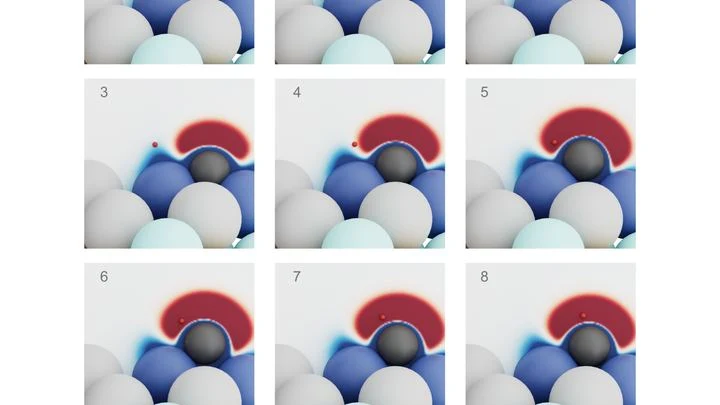
A mountain pass connects two valleys. In one, the protein is folded; in the other, it is unfolded. To get from one to the other, you must cross the saddle — the highest point on the path. In protein science, this point is called the transition state, and the coordinate that shows the distance to it is the committor.
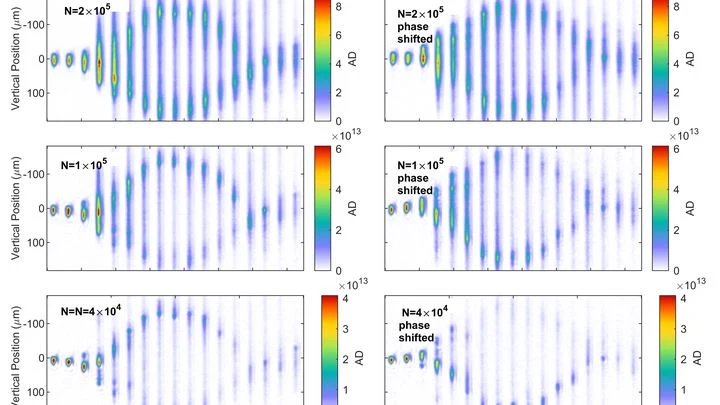
A cloud of cold atoms is trapped between two mirrors. Light is shone through it, and the atoms start to emit collectively: this effect is called superradiance. But the atoms don't just 'glow': their spins (internal magnetic arrows) interact with light in two distinct ways.
A quantum chain is like a string of lights, where the bulbs are the spins of particles. Ideally, all bulbs glow in sync, following a common rhythm: that's symmetry. But if you cut off a piece of the string, the rhythm can get out of step: within that segment, symmetry is broken.
Physicists study a chain of strongly interacting particles (the XYZ model).
The proton is not a solid ball but a tiny prison. Inside it, three quarks are locked up, and the gluon field keeps them from escaping — something like invisible threads that only grow stronger if the quarks try to move apart.
Quantum chromodynamics is the theory that describes how quarks and gluons assemble into protons and neutrons. In its equations, there is a strange angle, the parameter θ (theta).
A kitchen sponge soaked in syrup: in some spots there's more syrup, and your finger sticks right away; in others, it barely touches. That's roughly how a catalyst surface works. Molecules don't react everywhere but at especially sticky points — active sites.
A child on a swing: too strong a push and they fly off. Roughly this is how powerful light tears electrons out of an atom. It would seem that the stronger the push, the more certain the destruction. But in the quantum world it is different: when the field strength crosses a certain threshold, the atom suddenly freezes.
A swarm of fireflies rarely collides, yet they synchronously change color by exchanging signals. This is how neutrinos behave in dense streams from collapsing stars: they collectively transform from one type to another, even though individually they interact extremely weakly.
The weak equivalence principle, silently tested since the time of Galileo and laid at the foundation of general relativity, states: all bodies fall equally, regardless of their internal composition.
Two tiny spinning tops fly apart after a collision. Their rotation is not predetermined: it becomes definite only at the moment of measurement. This is quantum entanglement: the state of one top instantly responds to the state of the other, no matter how far apart they are.
If you try to break a proton apart and pull out a quark, you're in for a surprise. Ordinary forces, like the electric force, weaken as particles fly apart. Here, it's the opposite. The farther a quark gets from its neighbors, the harder it's pulled back.
Inside every cell, there is a scaffold of filaments, like construction scaffolding that gives the cell its shape and allows it to move. These filaments are connected by crosslinking proteins: some simply hold them together like ropes, while others act as tiny motors that crawl along the filaments and pull them toward each other.
Physicists built a chain of Rydberg atoms — atoms with electrons in enormous orbits, comparable to planetary paths. These giant atoms feel their neighbors intensely, turning the chain into a quantum analog of a string.
Two taut strings plucked at the same time sound different if they are connected by a rubber band. Energy starts to flow from one to the other, and the pitch of the combined sound shifts slightly. Two nanomechanical bridges, microscopic beams etched into a crystal, behave much the same way.
Neutrinos are the most elusive of all known particles. Every second, trillions of neutrinos from the Sun fly through your body, but you never notice: they barely interact with matter. To catch even one, physicists build giant detectors — pools of water or liquid argon deep underground.
The law discovered by Wolfgang Pauli forbids identical particles from occupying the same spot. Hence, in cold matter, a Fermi sea is born: particles, like water, fill energy levels from bottom to top. The shape of the sea's surface — including 'islands' of emptiness — dictates the properties of the whole system.
A snowflake falling from a cloud chooses between a left-handed and a right-handed form. The difference between them is almost imperceptible, like a breath of wind, yet it is that very breath that decides which pattern will grow.