Phantom dark energy is a hypothetical form of dark energy with an equation of state parameter w less than -1, where w is the ratio of pressure to energy density. Unlike standard dark energy (w = -1, as in a cosmological constant) or quintessence (w > -1), phantom energy has negative pressure so extreme that it causes the universe's expansion to accelerate at an ever-increasing rate. If real, it would lead to a 'Big Rip' scenario, where the expansion eventually tears apart all structures, from galaxy clusters to atoms, at a finite time in the future.
History
The term 'phantom dark energy' was introduced in 2002 by Robert Caldwell, who also proposed the Big Rip scenario in a subsequent paper, building on earlier discussions of dark energy with w < -1.
How it works
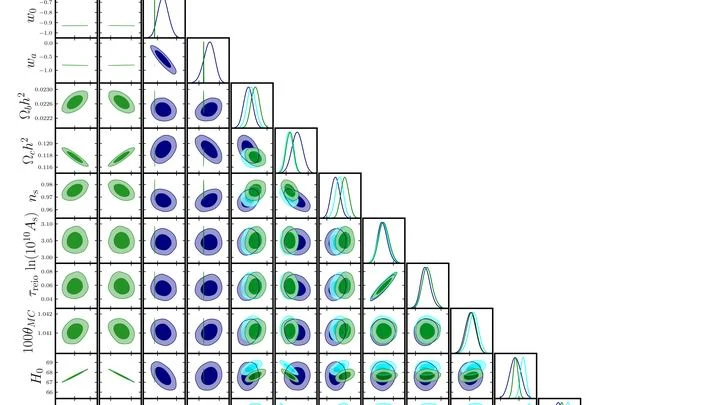
In general relativity, the acceleration of the universe's expansion depends on the combination of energy density and pressure. For w < -1, the negative pressure dominates, driving a repulsive gravitational effect that grows stronger as the universe expands. This behavior can be modeled with a scalar field whose kinetic term has the wrong sign (a 'phantom field'), which is unstable at the quantum level but mathematically consistent in classical cosmology. The parameter w is inferred from observations of supernovae, cosmic microwave background, and baryon acoustic oscillations, but current data are consistent with w = -1, with w < -1 not excluded.
In practice
Phantom dark energy is primarily a theoretical construct used to test the limits of cosmological models and to interpret observational data, helping constrain the nature of dark energy.
Fun fact
If phantom dark energy were real, the universe would end in a 'Big Rip' within a finite time, but current measurements suggest we are safe for at least tens of billions of years.
The cosmological standard model is like a recipe for a cake where everything is strictly measured: dark matter is like flour without a single lump (zero pressure), and dark energy is like the perfect leavening agent (equation of state exactly minus one). But what if the flour is a bit damp and the leavening agent has lost its oomph?
A climber on a ridge notices something strange: the horizon around them seems to freeze. No forward, no backward — only emptiness and silence. This is roughly the picture painted by new calculations for our Universe. At some point in its expansion, the invisible boundary, the future event horizon, stopped growing.
Since Saul Perlmutter and his colleagues discovered the accelerated expansion of the universe, physicists have been scratching their heads over the nature of dark energy.
A classical black hole has a temperature and other thermodynamic properties. When physicists began accounting for changes in the cosmological constant, the energy of empty space, a strange coupling emerged in the equations.
The cosmological kitchen is full of invisible ingredients. Dark matter, like an invisible scaffold, keeps galaxies from flying apart, while dark energy, like yeast in dough, makes space expand ever faster.
A translator hears not just words, but intonation, pauses, the tremor in a voice. Ordinary entropy analysis of cosmic perturbations is like meeting minutes: it records facts but loses the nuances. Pseudoentropy entropy is a new tool that captures the hidden "music" of the early universe.
The universe is expanding faster and faster thanks to dark energy. But measurements of the rate give contradictory results. A new explanation: in the past, dark energy acted as a brake, slowing the galaxies' recession, and then switched to acceleration. Like a car that first rolls backward and then lunges forward.
The oldest light in the universe has been traveling toward us for nearly 14 billion years. It was born when the cosmos first became transparent, and since then its plane of oscillation has been rotating ever so slightly. The cause is an invisible ocean permeating all of space: the dark energy field that makes the universe expand faster and faster.
In the late 1990s, astronomers including Saul Perlmutter discovered that the universe is expanding at an accelerating rate. The cause was dubbed dark energy — an invisible force stretching the cosmos.
Our universe isn't just expanding: it's doing so faster and faster. It's like raisin bread dough in the oven: the raisins move apart, and the farther they've already separated, the faster they continue to recede. The strange force pushing the cosmos apart is called dark energy. Most scientists think it's constant, like a permanent spring built into the very fabric of space.
An inflating balloon starts out slowly, then suddenly expands faster and faster, as if someone is pumping it up from inside. That's roughly how our universe behaves: galaxies are receding with acceleration. The culprit behind this acceleration is called dark energy.
Our Solar System isn't an island in the void: it's a sensitive web stretched in a dark cosmic corner. Planets circle their orbits like dewdrops on threads, and we are the spider sensing the faintest tremor. That tremor betrays the approach of the catastrophe astronomers call the Big Rip.
A stone falls into a pond, and ripples spread across the water. But if the stone is very small and the water is not quite ordinary, the ripples pass right through it, as if it weren't there.
A black hole is not just a void but a massive object that warps the space around it. If it finds itself in a cloud of invisible dark matter, matter that emits no light but makes itself known through gravity, its behavior changes.
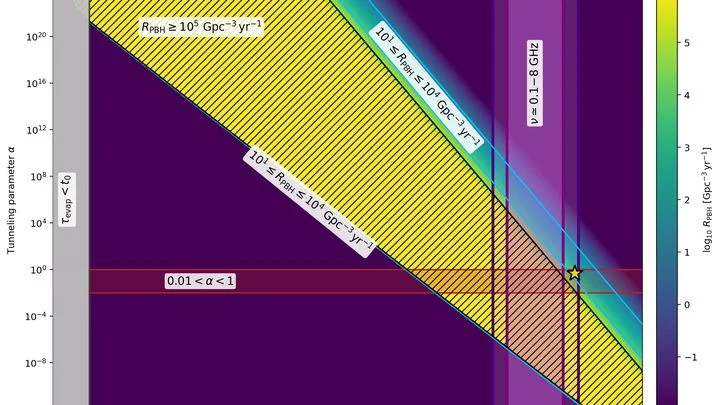
Some black holes are remnants from the Big Bang. Usually they fade via a slow radiation leak — predicted by Stephen Hawking. But a quantum switch could invert them into white holes, explosively releasing all energy like popcorn kernels that suddenly pop.
The universe is expanding faster and faster, like yeast dough in the kitchen. This expansion is helped by dark energy — the cosmic sugar. Ever since astronomers like Adam Riess noticed the acceleration in the late 1990s, they've been searching for the cause.
Data from the DESI galaxy survey hint: dark energy was more powerful in the past than today. This 'phantom' behavior threatens the Universe with a Big Rip — a finale where even atoms disintegrate. But the KMIX model explains this as an illusion. Two fundamental fields — like a distorting mirror — warp our picture: constant energy appears variable.
In 1976, Gerard 't Hooft noticed that the vacuum of a gauge theory is not as simple as it seems: it possesses a topological structure that manifests itself in a nonzero topological susceptibility.
The universe is expanding, and the pace of that expansion is set by dark energy, the mysterious force accelerating the recession of galaxies. In the standard cosmological model, its density is constant: a cosmological constant, an unwavering metronome since the birth of the cosmos.