How a Flat Floor Emerges from a Lattice express
Electrons in a crystal are like cars on city streets: some race down avenues, others get stuck in traffic jams. In certain lattices, motion freezes entirely — velocity stops depending on energy, and electrons become "flat." This isn't a traffic jam but a special rhythm of the network where waves cancel each other out. Previously, engineers knew only a few such intersections: the kagome pattern, the Lieb lattice, the pyrochlore lattice, just a handful of templates.
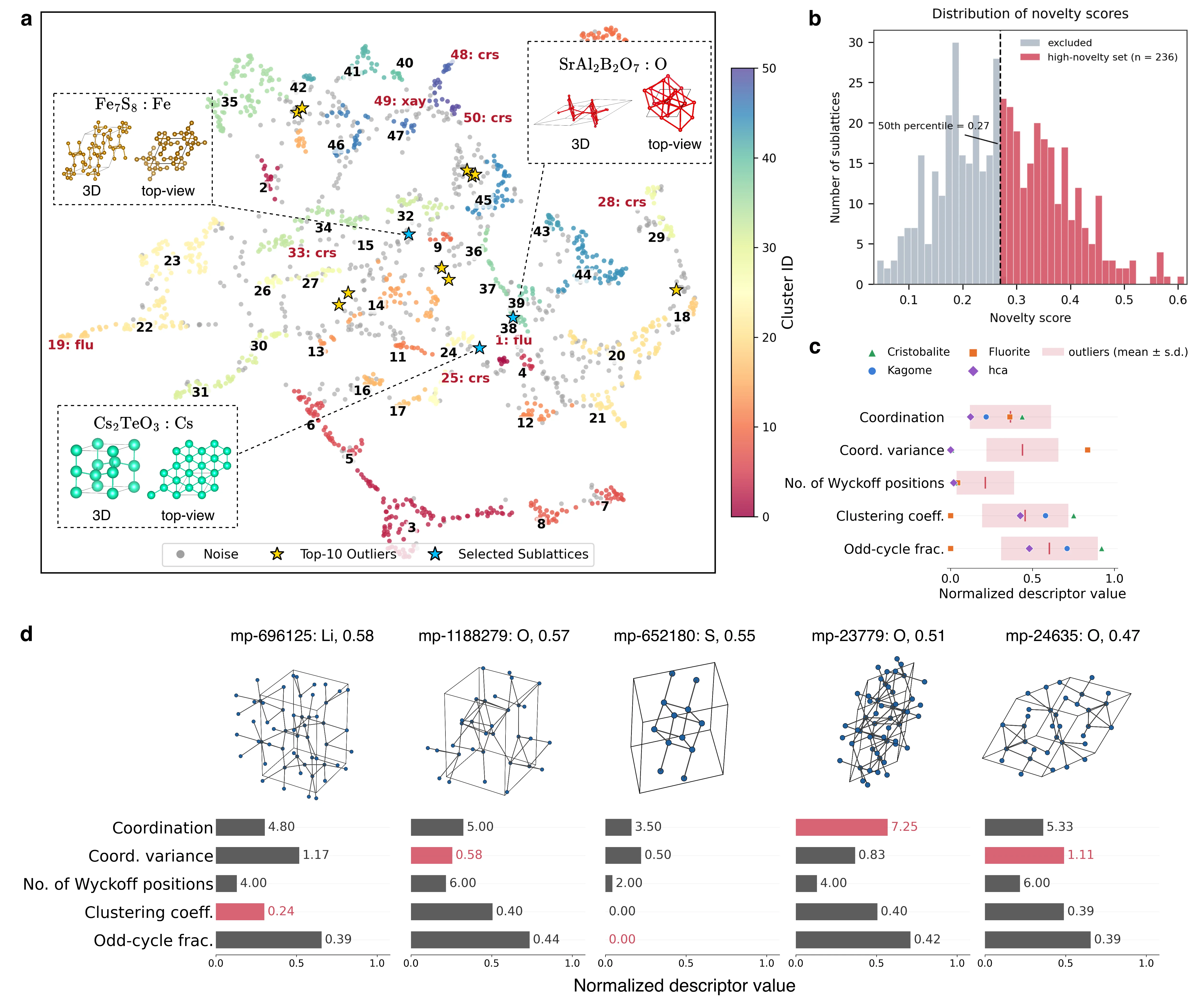
The authors of this work rejected the ready-made catalog. They represented the atomic skeleton as a continuous surface and launched a generator that sculpts new motifs unlike any before. The key trick is to choose skeletons outside known geometric clusters to guarantee novelty. Then the program SkeleGen attaches these skeletons to symmetry-allowed positions and completes the chemical environment, removing noise. This yielded 9352 candidates that passed a double filter: stability and band flatness.
The work changes the very approach to materials discovery. Instead of sifting through known shapes, scientists now grow geometry from scratch, like a gardener breeding a new variety of tree. Flat bands are just the first harvest; the method is suitable for any property tied to lattice connectivity. In the future, such design could lead to superconductors operating at room temperature or topological insulators with unprecedented signal protection.
Flat electronic bands make the mass of carriers infinite — an electron stops accelerating under voltage, as if hitting an invisible wall. This is the key to strong magnetic effects and exotic superconductivity.