After Mendel figured out the inheritance of a single trait, he wondered: what if you track two at once? He took peas with yellow smooth seeds and crossed them with green wrinkled ones. The first generation, as expected, was uniform—all yellow smooth. But in the second generation, besides the expected yellow smooth and green wrinkled, two new types appeared: yellow wrinkled and green smooth. And in strict proportions: 9 yellow smooth, 3 yellow wrinkled, 3 green smooth, and 1 green wrinkled. Mendel realized: genes for different traits are distributed into gametes independently of each other—as if nature were shuffling two separate decks of cards. Today we know this holds true for genes located on different chromosomes or far apart on the same chromosome.
History
Gregor Mendel described the law in the same 1866 paper where he also presented the law of segregation. He conducted dihybrid and trihybrid crosses of peas and showed that traits combine independently. After the rediscovery of Mendelian laws in 1900, the law of independent assortment was confirmed in experiments on various organisms. However, in 1906, William Bateson and Reginald Punnett discovered linked inheritance in sweet peas, which led to understanding the limitations of the law. Thomas Hunt Morgan and his students in the 1910s, using fruit flies, showed that genes are arranged linearly on chromosomes, and independent assortment is characteristic only of genes on different chromosomes or far apart on the same chromosome.
How it works
The law underlies combinative variation—the main source of genetic diversity in sexual reproduction. It allows breeders to combine useful traits from different parental lines in one organism and predict the proportion of offspring with the desired combination. In medical genetics, the law is used to calculate the probability of a child being born with two independent recessive diseases. Limits of applicability: the law holds only for genes located on different chromosomes or at a significant distance from each other on the same chromosome (crossover frequency > 50%). With tight linkage, genes are inherited together, and ratios deviate from Mendelian ones.
In practice
Breeders crossing a wheat variety with large ears but weak resistance to rust and a variety with small ears but high resistance can obtain a plant combining both useful traits. The law explains why a single litter of puppies can have individuals with different combinations of coat color and length.
Fun fact
Mendel tested the law on seven traits of peas, and all of them indeed were inherited independently. Later it turned out he was incredibly lucky: the genes for these traits in peas are located on seven different chromosomes—and peas have exactly seven. If even two genes had been close together on the same chromosome, he would have seen linkage and might not have deduced his law.
Two daughter cells receiving equal shares from the mother: that's the familiar picture of division. But what if one gets almost everything and the other just crumbs? Stochastic modeling shows that sometimes unequal division is more advantageous.
Each cell stores a protective reserve that helps it weather hardships. During division, this reserve is distributed between daughters.
Imagine a cookbook that gets rewritten from generation to generation. One day, the borscht recipe receives a secret ingredient from a pastry chef, and from that moment, the taste remembers not only ancestors but also a neighbor. In the Standard Model of evolution, genes behave the same way.
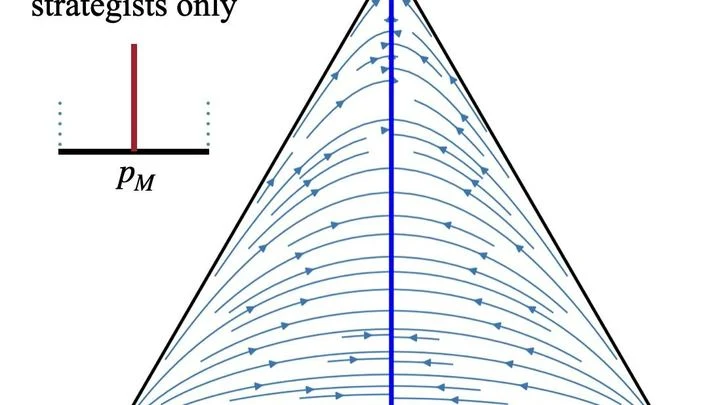
For a long time, biologists argued: if a herd of animals stably maintains a mix of aggressive and peaceful individuals, does each one alternately change behavior, or do some always fight while others always yield? In classical equations, these options are indistinguishable.
Ecosystems are not chaos but a complex dance where every species plays its part. Scientists modeled such a dance: two prey compete for carbon and water (the building blocks of cells), while a predator eats both. Sixteen scenarios emerged — from predator extinction to a steady rhythm for all three species.
Every tumor writes its own cosmology. Its cells are galaxies, and mutations are stellar flares marking the branches of a genealogical tree. The key to its history is the rhythm of accumulating genetic typos.
Inside every cell, a complex network of genes determines what it will become — a nerve cell, a muscle cell, or part of the skin. This choice often resembles flipping a toggle switch: two stable positions, and the cell decides which way to tip. But cells have a feature rarely considered in such models: they divide.
Electrons in a crystal are like cars on city streets: some race down avenues, others get stuck in traffic jams. In certain lattices, motion freezes entirely — velocity stops depending on energy, and electrons become "flat." This isn't a traffic jam but a special rhythm of the network where waves cancel each other out.
A patchy landscape isn't just a picture from a geography textbook. For microbes, cells, or animals, the world is a mosaic of patches: warmer here, more food there, and behind that rock — almost poison. When a mutant with a new trait appears in such a mosaic, its fate depends on which patch it lands on.
This new work ties two factors together.
Every shell is a stone diary of growth. The mollusk doesn't build it from a blueprint like an architect; it simply adds material along the edge, following the same rule over and over. It's as if a snail glued a new strip to its house each day, nudging it slightly sideways and making it a bit bigger. It's this repetition, not complex control, that creates the species' characteristic shape.
Engineers improving neural networks act like breeders: they try a variant, check the result, and keep the best. They collected 935 such trials from 161 papers and measured how often a code tweak turns out beneficial, harmful, or neutral. The picture is familiar to any biologist: 68% of changes degrade performance, 19% do nothing, and only 13% yield a gain.
In an anthill, some ants carry food and build, while others just eat and reproduce. This isn't just laziness: it's two distinct types of ants. Workers are smaller, while freeloaders are larger. If freeloaders become too numerous, the colony falls apart, like a communal kitchen where nobody washes the dishes.