Quantum Gas Breaks the Textbook Rules express
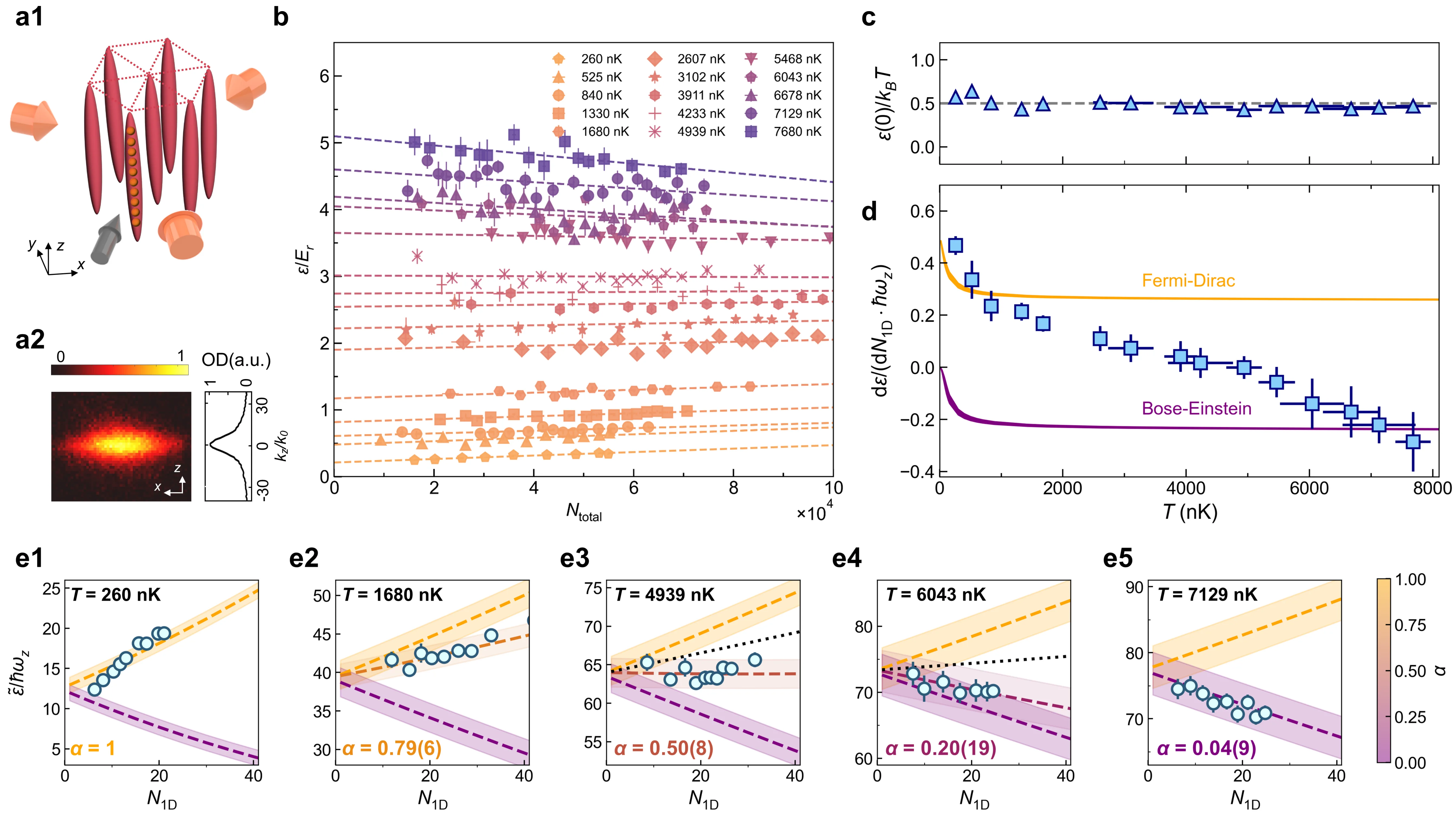
Textbooks divide particles into two camps: bosons love to crowd into the same state, fermions absolutely refuse. But nature allows a third option. Anyons are quasiparticles whose behavior lies somewhere in between. They can 'remember' how they were exchanged and obey a nonstandard exclusion principle.
A team of physicists took a one-dimensional quantum gas of strongly interacting atoms and turned it into an anyonic thermodynamic ensemble. In one dimension, the dynamical interaction between particles can be recast as a statistical one — a well-known mathematical trick. By varying the repulsion strength and temperature, the authors measured the gas's equation of state. The plots showed clear departures from the Bose–Einstein and Fermi–Dirac statistics.
These departures fell exactly on the curves of generalized exclusion statistics: that extended version of the Pauli principle. Additional measurements of pressure and Tan's contact confirmed the picture. The researchers now have a platform where particle statistics can be tuned with the turn of a knob.
Original abstract
as written by the authors arXiv:2606.19009
Anyons are quasiparticles with quantum statistics interpolating between those of bosons and fermions. Two distinct manifestations of anyonic behaviour have been theoretically established: fractional exchange statistics where particle exchange can produce any phase, and generalized exclusion statistics which extends the Pauli exclusion principle. While anyons exhibiting fractional exchange statistics have been observed in diverse platforms, experimental realizations of generalized exclusion statistics and direct measurements of its thermodynamic signatures have remained elusive. Here, we realize an anyonic thermodynamic ensemble obeying generalized exclusion statistics and detect its anyonic thermodynamics in a one-dimensional strongly interacting quantum gas. To achieve this, we exploit the bijective mapping between dynamical and statistical interactions in one dimension. By tuning interaction strength and temperature over a wide range, we measure the equation of state and identify clear departures from Bose-Einstein and Fermi-Dirac statistics. These deviations are quantitatively captured by generalized exclusion statistics, providing direct evidence for the generalized Pauli principle. Independent probes of other thermodynamic quantities including pressure and the Tan contact further validate this framework. Our results establish a versatile platform for engineering anyonic exclusion statistics and open the door to thermodynamic applications of anyons in quantum technologies.
The one-dimensional world is much friendlier to anyons: in two or three dimensions, creating such tunable statistics via interactions is far more difficult.