Quantum Gas Breaks the Textbook Rules express
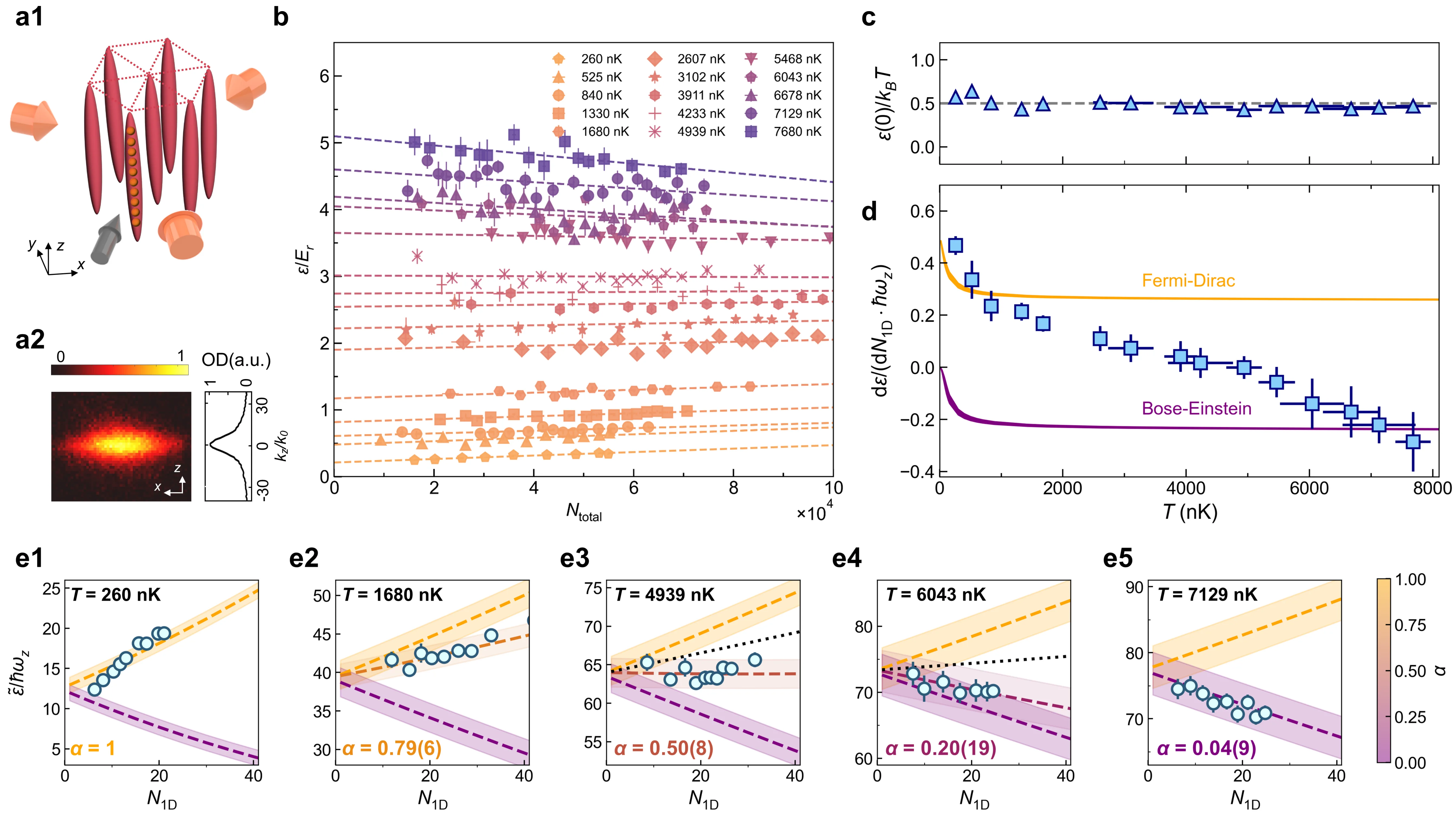
Textbooks divide particles into two camps: bosons love to crowd into the same state, fermions absolutely refuse. But nature allows a third option. Anyons are quasiparticles whose behavior lies somewhere in between. They can 'remember' how they were exchanged and obey a nonstandard exclusion principle.
A team of physicists took a one-dimensional quantum gas of strongly interacting atoms and turned it into an anyonic thermodynamic ensemble. In one dimension, the dynamical interaction between particles can be recast as a statistical one — a well-known mathematical trick. By varying the repulsion strength and temperature, the authors measured the gas's equation of state. The plots showed clear departures from the Bose–Einstein and Fermi–Dirac statistics.
These departures fell exactly on the curves of generalized exclusion statistics: that extended version of the Pauli principle. Additional measurements of pressure and Tan's contact confirmed the picture. The researchers now have a platform where particle statistics can be tuned with the turn of a knob.
The one-dimensional world is much friendlier to anyons: in two or three dimensions, creating such tunable statistics via interactions is far more difficult.