The Cosmic Magnetic Bow: How Primordial Black Holes Are Born ✛ ✦
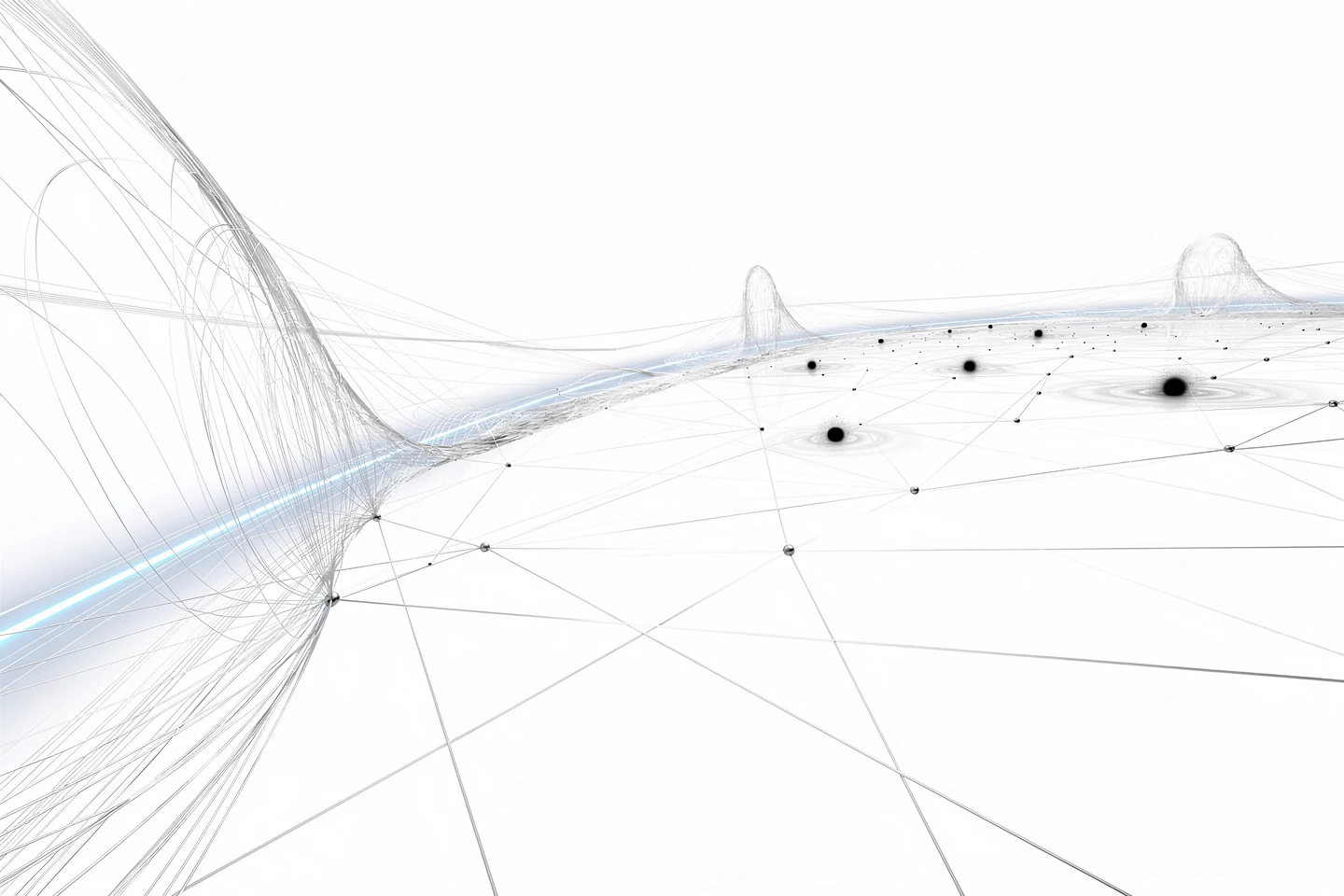
In the scorching plasma of the infant Universe, right after inflation, conceived by Alan Guth, the kinetic dominance epoch reigned. In this churning cauldron, even tiny magnetic fields — a billion times weaker than Earth's — played the role of a cosmic bow, causing a resonance that birthed primordial black holes. These holes, as first proposed by Stephen Hawking, could make up the elusive dark matter.
Envision: a bow endlessly drawn across a single string, producing a steady, almost inaudible hum. But the instrument's resonant soundboard is designed so that this monotonous sound nonlinearly generates piercing harmonics — the very ones capable of shattering glass. That's exactly how vector modes of magnetic fields — frozen ripples in spacetime — during the kinetic epoch, when the energy density of the expanding Universe obeys a stiff equation of state, induce scalar curvature perturbations. Their secret lies in constancy: vector modes neither decay nor grow, creating an ideal foundation for the secondary birth of inhomogeneities.
The power spectrum of the resulting perturbations is sharply amplified on large scales, following a universal law with a slope of minus five — a hallmark of the kinetic epoch, as unique as a fingerprint. In the Ratra magnetogenesis model, these perturbations reach a critical amplitude, and gravitational collapse gives birth to black holes with the mass of an asteroid yet the size of a proton. Such objects do not conflict with either big bang nucleosynthesis data, studied by George Gamow long ago, or observations of the cosmic microwave background.
The uncovered mechanism is a bridge to understanding the nature of dark matter and the origin of cosmic magnetism. The next step is to search for a gravitational-wave background with a unique spectral “signature” of –5. Experiments like pulsar timing arrays are already targeting this echo from the first moments. Thus, the quiet hum of magnetic fields transforms into a symphony that deciphers the mysteries of the cosmos.
Vanishingly weak — billions of times fainter than Earth's field — primordial magnetic fields of a few hundred nanogauss possess paradoxical power: their collective effect in the hot plasma of the early Universe triggers the birth of black holes that today could weigh as much as entire asteroids while remaining smaller than an atom.