A Machine That Comes Up with Theories About Thinking express
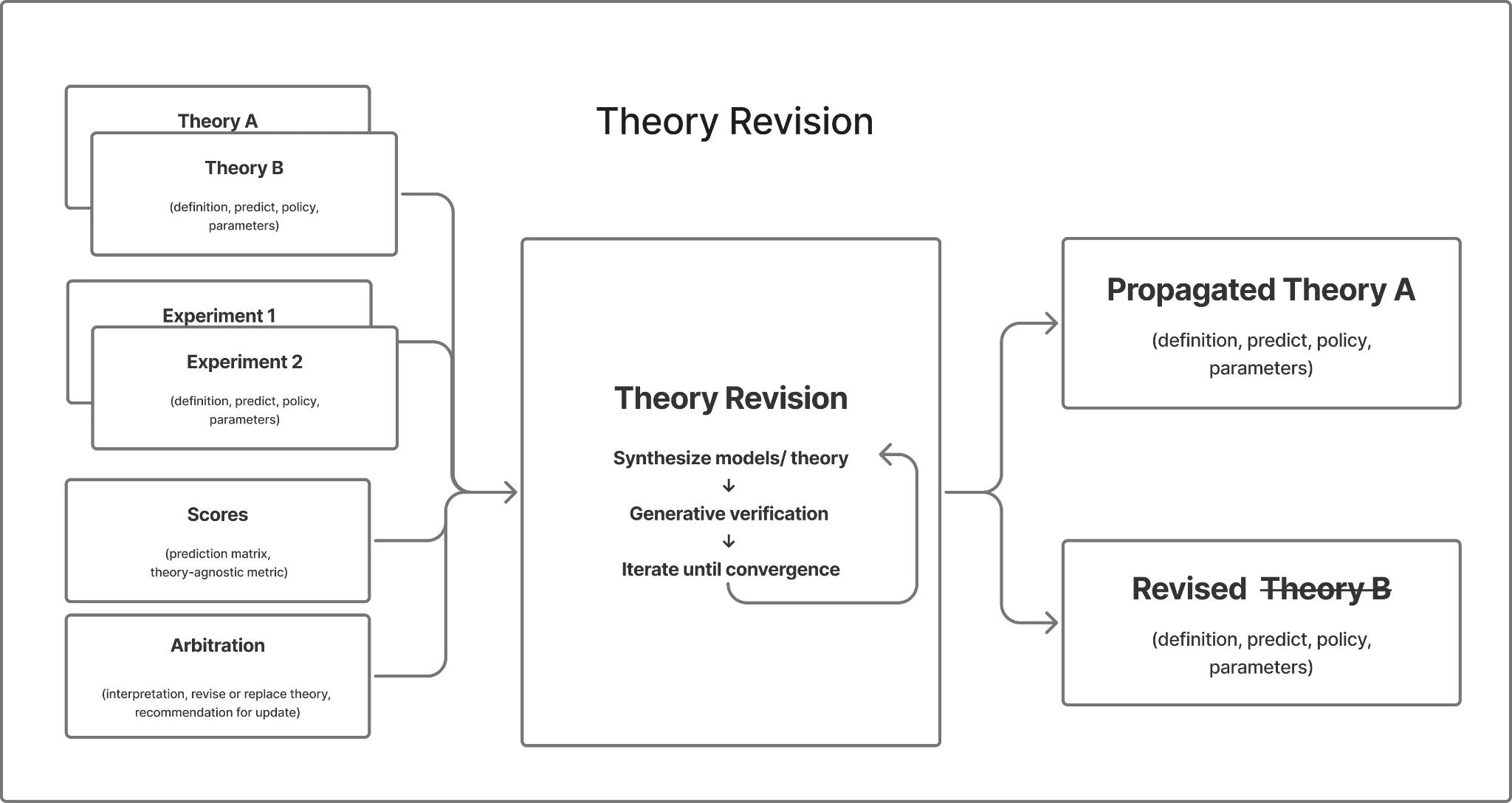
A closed loop: the machine proposes an idea, tests it on people, sees the failures, and spawns a new, more accurate guess. That's how AutoCog works — an automatic cognitive scientist. Previously, in the science of thinking (cognitive science), the hardest part, coming up with a theory, was done only by humans. Data collection was automated, models were computed by computers, but the creative step remained with humans. AutoCog closes this loop entirely for the first time.
The system is structured as a debate among several agents based on large language models. Each agent proposes its own decision-making model — not just text, but a working program. Then AutoCog designs the experiment that best adjudicates the debate, recruits volunteers online, and collects their responses. Theories are evaluated by how well they predict human behavior. Losing models analyze their errors and are reborn as improved versions. The cycle repeats.
This finding was not pre-programmed. When the system was run on simulated data, it recovered even unusual strategies that contradicted the language model's "common sense." This means AutoCog truly listens to data rather than repeating learned patterns. In experiments with real people, its theories proved more accurate than established ones and worked across two different tasks. The final test was passed by the new theory: its predictions were confirmed in a preregistered experiment with new participants.
The circle is closed. AutoCog turns theory-building about thinking from a vague art into a transparent, reproducible, and cumulative science.
The AutoCog system is structured as a debate: several language models compete to see whose theory best explains human behavior, and the losers then "mutate" into new versions.
A similar approach is described in Isaac Asimov's short story "The Last Question," where a machine iteratively improves its answers until it achieves a breakthrough.