When a cavity loses its notes but gains strength express
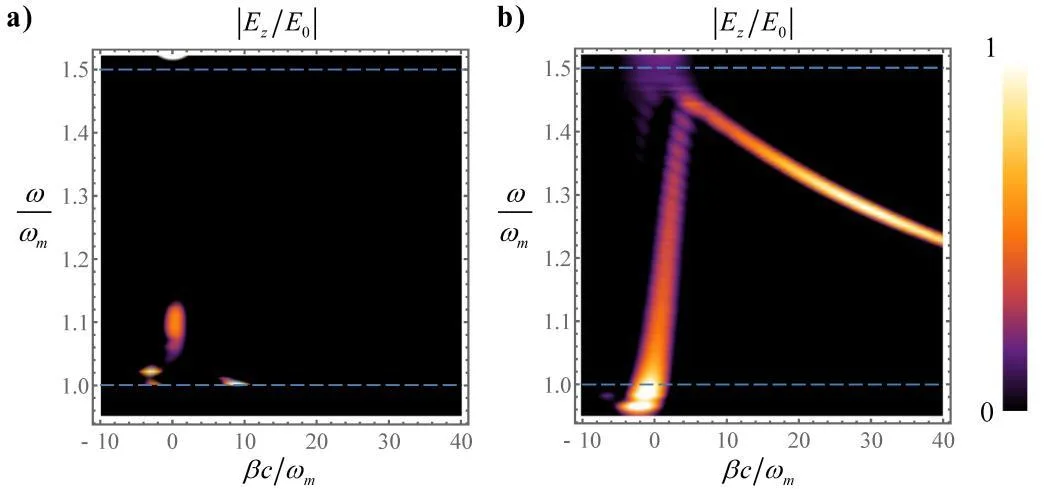
An ordinary microwave cavity resembles a music box: it responds only to strictly defined frequencies: its own notes. But what if you could make it sound different? Scientists changed the rules of the game by making the walls "one-way." Inside such a cavity, a wave can only run forward, never reflecting back.
In the experiment, they used a waveguide loaded with ferrite (a magnetic material). When the geometry was tuned so that wave motion became unidirectional, a sharp transition occurred: instead of a set of discrete resonances, a continuous frequency spectrum emerged. The field simultaneously compressed into a very small region — strong spatial localization appeared.
This discovery resembles an interpreter who gets distracted by every rustle in the hall, and a one-hour meeting stretches into two. In a nonreciprocal cavity, any perturbation is not scattered but trapped in a cage. Taming this effect will allow creating devices with unprecedented selectivity and sensitivity.
Original abstract
as written by the authors arXiv:2606.28979
Nonreciprocal systems enable asymmetric energy transport and suppress backscattering, giving rise to unconventional wave phenomena. Here, we show that nonreciprocal cavities based on unidirectional waveguides exhibit a continuous modal spectrum, in contrast to conventional cavities with discrete eigenmodes. Using a ferrite-loaded microwave cavity as an example, we demonstrate that enforcing unidirectionality, by tailoring the waveguide geometry, drives a transition from discrete to continuous spectra, accompanied by strong spatial localization of electromagnetic fields. Our results reveal that dissipation alone fails to regularize these singular responses, highlighting the need for additional mechanisms to control localization in nonreciprocal systems.
The ferrite used in the experiment is a material that transmits waves differently depending on the direction of the magnetic field. It is what makes the waveguide a "one-way street."