Cosmic Symphony: Algorithm Hears the Reverse Rhythm of the Early Universe ✛ ✎
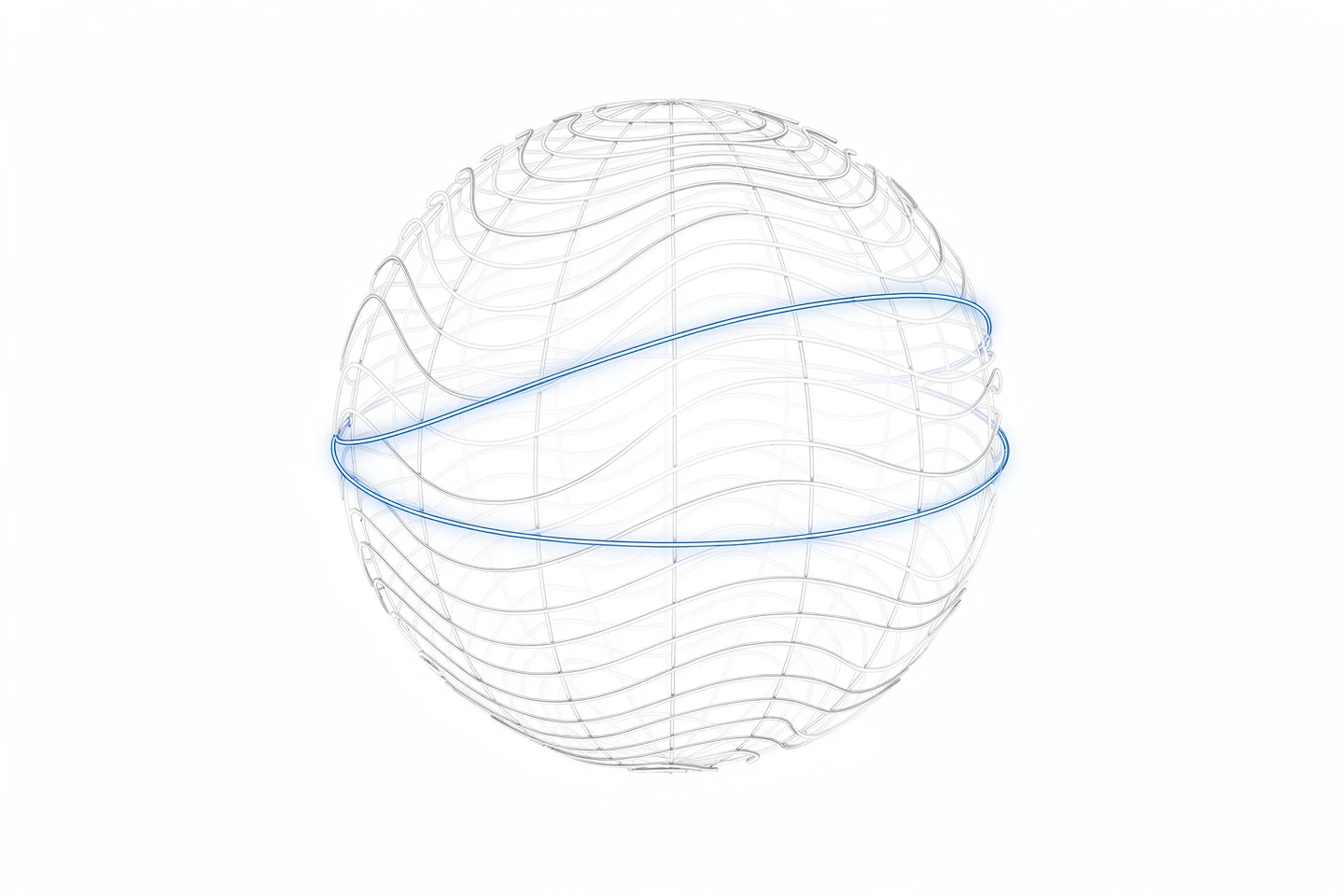
The cosmic microwave background is the first light that pierced the dense fog of the early universe. Its spectrum, like a frozen score of a cosmic symphony, preserves the tiniest density fluctuations from which galaxies grew. But instead of a predictable melody, an algorithm trained to listen to this ancient signal discerned a completely unexpected rhythm — oscillations not in wavenumber k, but in inverse k, as if the bass notes slowed down while the high ones sped up. This reverse tempo, written as cos(B/k) with B≈4 Mpc⁻¹, has forced cosmologists to rethink the scenario of the first moments.
Classical inflation models predict a smooth power-law spectrum, perhaps with slight modulation resembling logarithmic or linear waves. Yet data from three experiments, the Planck satellite and the ground-based ACT and SPT-3G telescopes, stubbornly pointed to a different pattern. Researchers applied a method free of human bias: the PySR algorithm sifted through analytical expressions, minimizing discrepancies with the data. Both Planck alone and the combined dataset confidently selected the inverse pattern, improving agreement with observations by nearly a factor of two compared to competitors. This signal is trustworthy: its reality is confirmed by independent polarization maps that rule out instrumental artifacts.
What kind of physics could produce such a strange rhythm? Inverse oscillations naturally arise if the early universe underwent a 'phantom' expansion phase — with an equation of state w < −1, violating the null energy condition. Such regimes, predicted in some extensions of string theory, cause space to expand more rapidly than in standard inflation, leaving a distinctive imprint on the distribution of galaxies. In essence, this is an echo of an era when the fabric of spacetime itself obeyed laws close to quantum gravity.
Future experiments — the Simons Observatory and CMB-S4—with their increased sensitivity to small angular scales will either confirm the existence of this reverse rhythm or erase it into noise. But already, spectroscopy of the cosmic microwave background is gaining a new dimension: symbolic regression is transforming from a passive tool into a full-fledged explorer, capable of uncovering unforeseen patterns. This is a step toward bringing the deepest secrets of the universe to the surface — from the nature of dark energy to scenarios that replace the Big Bang singularity with a quantum bridge. In this music of the spheres, heard by the algorithm, perhaps lies the key to unifying gravity with the microscopic world.
The symbolic regression algorithm independently 'invented' the function cos(B/k) without any theoretical hints — a similar approach previously rediscovered Kepler's laws from observational data.
The image of a universe pulsating in a cosmic rhythm echoes the cyclical worlds of Ursula K. Le Guin, where time flows backward and the structure of reality is defined by periodic patterns.