Wavenumber is a measure of how many wavelengths of a wave fit into a unit of distance. It is the spatial analogue of temporal frequency: while frequency tells you how many oscillations occur per second, wavenumber tells you how many oscillations occur per meter. In physics, wavenumber is usually defined as 2π divided by the wavelength (the angular wavenumber, often denoted k), but in spectroscopy and chemistry it is often defined simply as the reciprocal of the wavelength (the spectroscopic wavenumber, in units of reciprocal centimeters). Both definitions are common, so context matters.
History
The concept emerged in the 19th century with the development of wave theory, particularly in optics and acoustics. The term 'wavenumber' was popularized in spectroscopy in the early 20th century, where it became standard for describing spectral lines.
How it works
For a wave of wavelength λ, the wavenumber k = 2π/λ (angular) or ν̃ = 1/λ (spectroscopic). It appears naturally in the mathematical description of waves, where the phase of a wave traveling in space is written as kx − ωt, with ω being the angular frequency. The wavenumber thus encodes how rapidly the wave's phase changes with position. In quantum mechanics, the wavenumber is directly proportional to momentum via the de Broglie relation p = ħk, making it a bridge between wave and particle descriptions.
In practice
Wavenumbers are used extensively in infrared and Raman spectroscopy to identify molecular vibrations, and in crystallography to describe the periodicity of crystal lattices via reciprocal lattice vectors.
Fun fact
In spectroscopy, wavenumbers in reciprocal centimeters (cm⁻¹) are numerically equal to the energy of a photon in units of 1.986 × 10⁻²³ joules, so a wavenumber of 1000 cm⁻¹ corresponds to a photon energy of about 0.124 electronvolts.
Units by system: SI: reciprocal meter · CGS: reciprocal centimeter · Planck: reciprocal planck length · natural: reciprocal meter
Surf doesn't roll onto the shore as an even front. It comes in tongues of foam that merge and split apart. Magnetic fields inside materials behave much the same way: they breathe in waves, and until now nobody had seen them whole.
The orchestra plays, but the musicians can't hear each other. The conductor keeps stopping the music and walking over to each player to tune the instrument. That's roughly how space telescopes with segmented mirrors work.
A stone falls into water, and ripples spread in all directions. Throw a handful of stones at once, and the ripples overlap: you can no longer tell which ripple came from which stone. A neutron beam hitting a detector looks much the same: a bright spot blurred by many causes.
Trying to count people in a dark room by the sound of their breathing hits a wall of background noise — individual breaths are inaudible. Scientists working with quantum spins in solids face a similar challenge. Each spin (the electron's magnetic moment) has its own "voice," but it is drowned out by the technical noise of the instruments.
A fundamental string plucked at the moment of the Big Bang doesn't just hum a single note — waves run along it, and occasionally tiny loops peel off. These loops, like tuning forks, begin to ring at their own frequency, producing a very high-pitched sound.
A pebble tossed into a pond sends ripples spreading in all directions. Now imagine the pond itself suddenly turning into jelly — instantly, faster than the wave can complete a single crest. Some ripples would keep spreading but change their spacing, while others would unexpectedly turn around and run back toward the point of impact, as if time were flowing backward for them.
A conventional antenna array is like a choir: many voices singing in unison, with the sound amplified in only one direction. To catch a signal from another side, you have to rearrange the whole choir. Now imagine a single voice that can change its timbre so that the sound itself focuses in the desired direction.
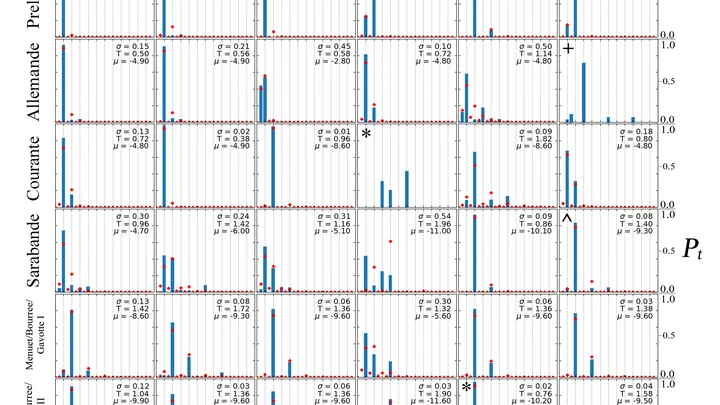
Music relies on repetition: we expect the beat to return, like a chorus coming back. But if you repeat the same thing for too long, it gets boring. The composer seems to walk a tightrope between the familiar and the unexpected.
Scientists translated this balance into the language of physics.
A star like the Sun doesn't just shine: it hums quietly. Inside, plasma churns, and these motions make the surface rise and fall rhythmically. Catching such a tremor from Earth is nearly impossible: it gets lost in the noise of the atmosphere and the instrument itself. That's why astronomers listen to stars from space, where it's quieter.
An ordinary comb parts hair into even strands. A laser 'comb' does the same to light: it emits not one color but thousands, spaced at exactly equal frequency steps. Such a tool has already helped measure time to billionths of a second and peer inside atoms.
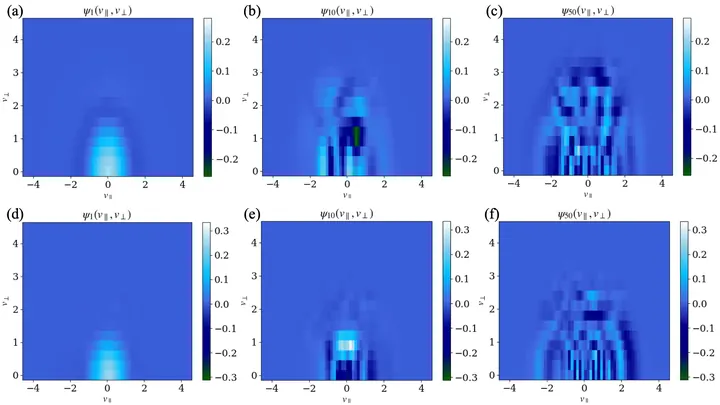
Hot plasma in a future fusion reactor is like a packed dance floor: billions of particles whirl in a complex rhythm, colliding and changing speed. Figuring out how tangled this dance is — no easy task. Scientists have found a way to measure its complexity without watching every move.
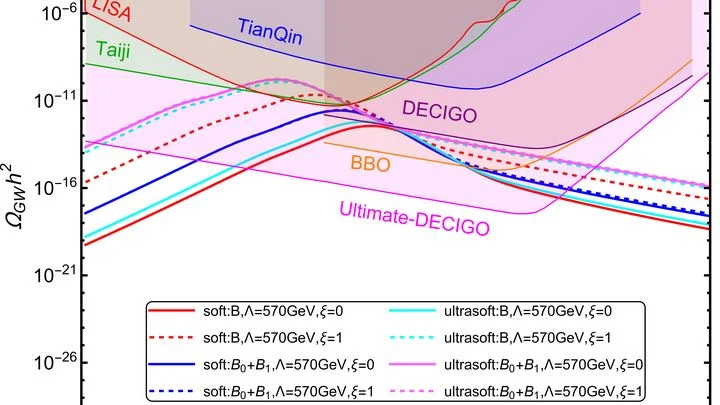
In the infant universe, right after the Big Bang, space was expanding rapidly, and the vacuum resembled a superheated liquid. When 'boiling' began, bubbles of true vacuum emerged. Expanding at the speed of light, they triggered gravitational waves — tremors of space itself that have reached us.
A century ago, quantum mechanics gave the world a neat picture: a particle rotating around a point can only have certain discrete amounts of angular momentum, integer multiples of Planck's constant. This rule seemed as solid as the law of gravity, and it followed from simple algebraic arguments.