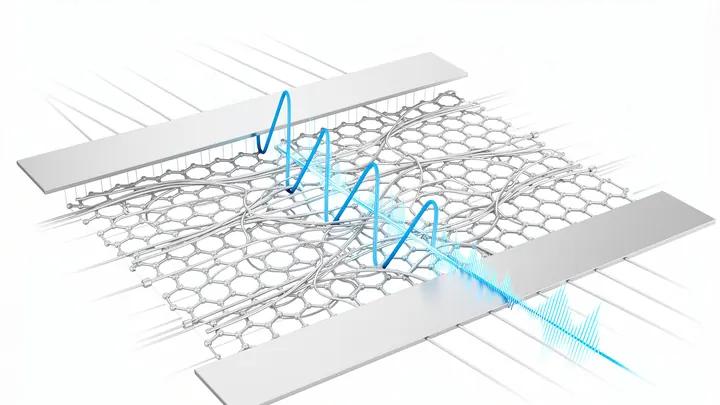
The scale of length, time, and energy at which quantum effects of gravity become significant.The Planck scale refers to the extreme regime of length (~10^-35 meters), time (~10^-43 seconds), and energy (~10^19 GeV) where quantum effects of gravity become as strong as the other fundamental forces. At this scale, the smooth spacetime of general relativity is expected to break down into a quantum foam or a discrete structure, and our current theories of physics are inadequate. Understanding the Planck scale is a central goal of quantum gravity research.
Max Planck introduced the units in 1899, but their physical significance for quantum gravity was recognized only in the 1960s with the development of quantum gravity theories.
The Planck length is derived from combining the fundamental constants: the speed of light, the gravitational constant, and Planck's constant. It is the scale at which the Compton wavelength of a particle equals its Schwarzschild radius, meaning quantum uncertainty and gravitational collapse compete equally. Probing this scale directly is impossible with current technology, but its effects might be observable in cosmic microwave background polarization or gravitational wave signals from the early universe.
The Planck scale guides theoretical models of the early universe, such as loop quantum cosmology, which predicts a quantum bounce instead of a singularity at the Big Bang.
If you tried to probe the Planck length with a microscope, the energy needed would be so enormous that it would create a black hole the size of the object you are trying to see.