The Quantum Wave That Gives Birth to the Universe ✎ express
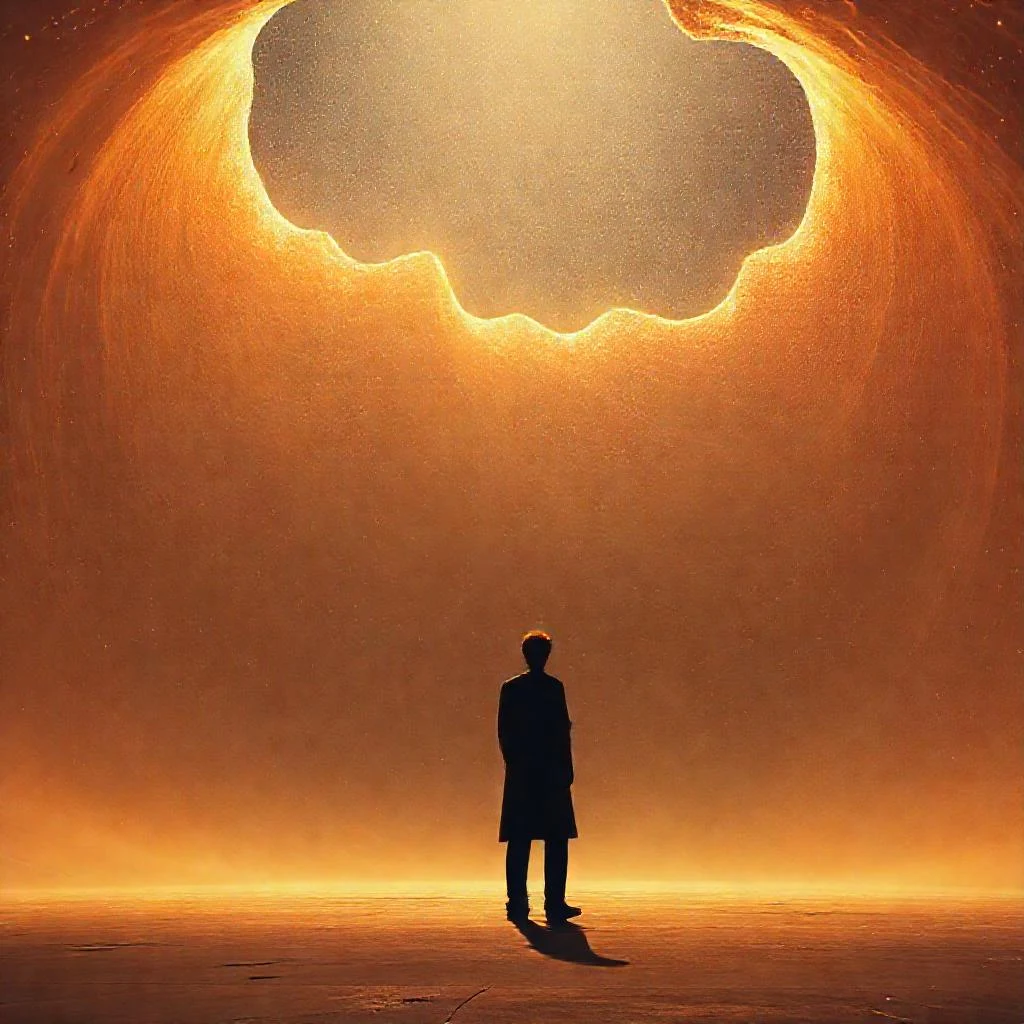
A quantum wave is like a long-exposure photograph: everything’s blurred, but the blur itself reveals motion. Usually these frozen waves are treated as convenient abstractions. Yet if at each point in the image you estimate, by brightness, the moment on the particle’s internal clock it landed there, flat space suddenly acquires curves. The resulting curvature exactly matches the geometry of an expanding universe — from the Big Bang to today. Typically, such a model is derived from Einstein’s equations, with gravity baked in from the start. But here, spacetime curvature emerges on its own, purely from the probabilistic nature of the wave. In other words, gravity is not a fundamental force, but a shadow of quantum uncertainty. This insight was first voiced by Georges Lemaître in 1927, while the wave-based toolkit was crafted by Erwin Schrödinger.
When Georges Lemaître first proposed the expansion hypothesis, Albert Einstein replied, "Your calculations are correct, but your physical picture is abominable." Today, this hypothesis is the cornerstone of cosmology.
In the movie Interstellar, the heroes travel through a wormhole — a tunnel in curved spacetime, similar to the one that spontaneously emerges from a quantum wave in the new theory.