Quantum Engine: A Photon Bucket Brigade Bypasses the Heat Barrier ✛ ✦
Any heat engine generates entropy — inevitable disorder. The efficiency limit is set by the Carnot formula, developed by Ludwig Boltzmann and Max Planck: the colder the exhaust compared to the furnace, the higher the efficiency. But in the classical world, to do that you have to slow the cycle to a snail's pace, and power drops to zero.
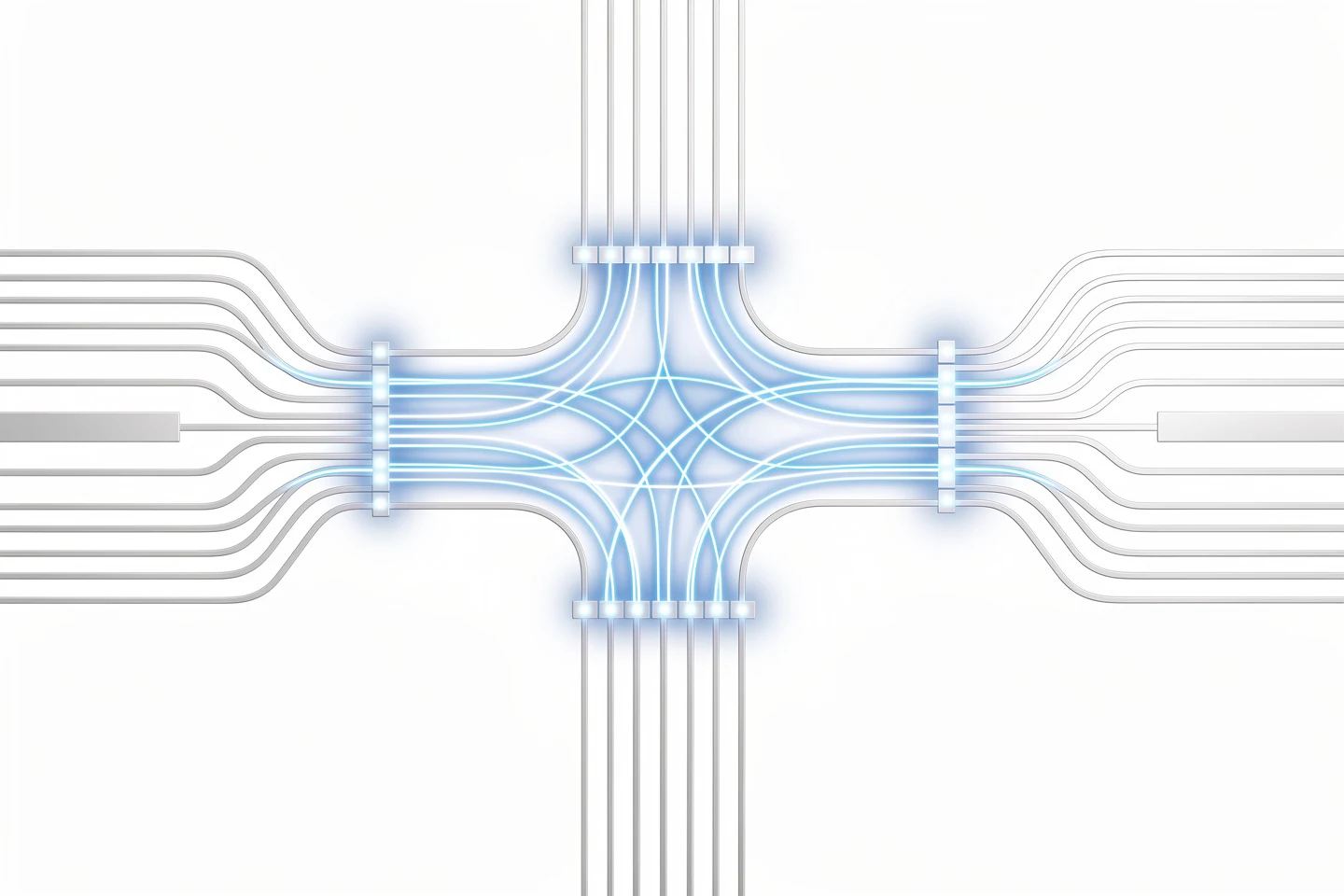
The working fluid is microwave photons inside superconducting resonators (microscopic chambers where light circulates without loss). The secret is collective handoff: the photons, like a chain of people passing a water bucket, transfer energy through a qubit (quantum switch). This conveyor belt generates almost no extra entropy — the increase is microscopic, and it's calculated using John von Neumann's formula. Modeling shows that with 15 photons, efficiency reaches 99.9% of the limit, and adding more particles only boosts power — for a conventional engine, that's nonsense. The success relies on quantum information theory and quantum optics; to preserve coherence, one must suppress quantum decoherence — the destruction of order by the environment. This approach flips engineering on its head: instead of fighting losses, you amplify them, making them work for you. These micro-engines could be used to cool quantum computers or become cells in ultracold batteries.
The coordinated behavior of photons resembles the laser effect: atoms emit light in sync, creating a powerful directed beam.